

151
5 Molecular Structures, Relative Stability, and Proton Affinities of Nucleotides
orientation of base and a pronounced deformation of ribose in dianionic nucleotides
[19, 20].
Comparison of values of torsion angles describing conformation of isolated nucleotides with average values of these angles for different forms of DNA indicates
that incorporation of DNTs into DNA macromolecule results in some deformation
of geometry of nucleotides. This also should be accompanied by changes in intramolecular hydrogen bonds. However, the energy values related to variety of such
deformations are still unknown.
Our study [53] reveals that the change of nucleotides geometry also leads to
change of intramolecular hydrogen bonds pattern which become unique for every
form of DNA. Thus, some corrections should be made for modeled structures of
nucleotides, as far as previous investigations of DNTs concluded that compensation of negative charge of phosphate group by hydrogen atom lead to appearance
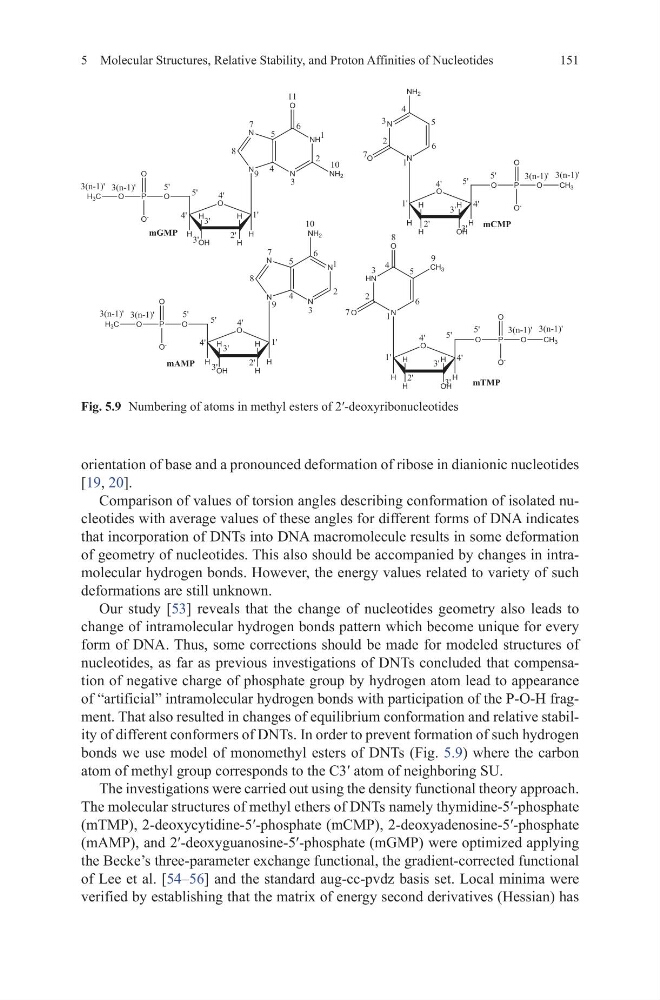
of “artificial” intramolecular hydrogen bonds with participation of the P-O-H fragment. That also resulted in changes of equilibrium conformation and relative stability of different conformers of DNTs. In order to prevent formation of such hydrogen
bonds we use model of monomethyl esters of DNTs (Fig. 5.9) where the carbon
atom of methyl group corresponds to the C3′ atom of neighboring SU.
The investigations were carried out using the density functional theory approach.
The molecular structures of methyl ethers of DNTs namely thymidine-5′-phosphate
(mTMP), 2-deoxycytidine-5′-phosphate (mCMP), 2-deoxyadenosine-5′-phosphate
(mAMP), and 2′-deoxyguanosine-5′-phosphate (mGMP) were optimized applying
the Becke’s three-parameter exchange functional, the gradient-corrected functional
of Lee et al. [54–56] and the standard aug-cc-pvdz basis set. Local minima were
verified by establishing that the matrix of energy second derivatives (Hessian) has
Fig. 5.9 Numbering of atoms in methyl esters of 2′-deoxyribonucleotides
5 Molecular Structures, Relative Stability, and Proton Affinities of Nucleotides
orientation of base and a pronounced deformation of ribose in dianionic nucleotides
[19, 20].
Comparison of values of torsion angles describing conformation of isolated nucleotides with average values of these angles for different forms of DNA indicates
that incorporation of DNTs into DNA macromolecule results in some deformation
of geometry of nucleotides. This also should be accompanied by changes in intramolecular hydrogen bonds. However, the energy values related to variety of such
deformations are still unknown.
Our study [53] reveals that the change of nucleotides geometry also leads to
change of intramolecular hydrogen bonds pattern which become unique for every
form of DNA. Thus, some corrections should be made for modeled structures of
nucleotides, as far as previous investigations of DNTs concluded that compensation of negative charge of phosphate group by hydrogen atom lead to appearance
of “artificial” intramolecular hydrogen bonds with participation of the P-O-H fragment. That also resulted in changes of equilibrium conformation and relative stability of different conformers of DNTs. In order to prevent formation of such hydrogen
bonds we use model of monomethyl esters of DNTs (Fig. 5.9) where the carbon
atom of methyl group corresponds to the C3′ atom of neighboring SU.
The investigations were carried out using the density functional theory approach.
The molecular structures of methyl ethers of DNTs namely thymidine-5′-phosphate
(mTMP), 2-deoxycytidine-5′-phosphate (mCMP), 2-deoxyadenosine-5′-phosphate
(mAMP), and 2′-deoxyguanosine-5′-phosphate (mGMP) were optimized applying
the Becke’s three-parameter exchange functional, the gradient-corrected functional
of Lee et al. [54–56] and the standard aug-cc-pvdz basis set. Local minima were
verified by establishing that the matrix of energy second derivatives (Hessian) has
Fig. 5.9 Numbering of atoms in methyl esters of 2′-deoxyribonucleotides