

3
1 Hybrid QM/MM Methods: Treating Electronic Phenomena …
1.2 QM/MM Methods
1.2.1 QM/MM, QM:MM, QM–MM?
Before going through all the interactions between the QM and the MM parts, we
will first settle a nomenclature that will be used throughout the chapter, to specify
which criteria are used to specify which atoms are treated by QM methods and
which are described by MM force fields. Two cases need to be considered:
• The two subsystems are not chemically bonded. For example, a solute molecule
in a solution. The interactions between the fragments are then weak interaction
(Keesom, Debye, London, H-bond, …), and we will call them physical interactions. In such situations we will use the acronym QM:MM, where the colon “:”
symbolizes these non-bonded interactions (in the chemical sense).
• The two subsystems are connected through covalent bonds. For example, the
amino-acid residues constituting a protein. To define the QM region one has
then to formally cut these strong chemical bonds. For such cases, we will use the
QM–MM acronym, where the dash “–” represents the cut bond(s).
• The QM/MM acronym will be used to describe any situation, following the traditional use of the slash “/” character in Quantum Chemistry.
1.2.2 Partition of the Hamiltonian
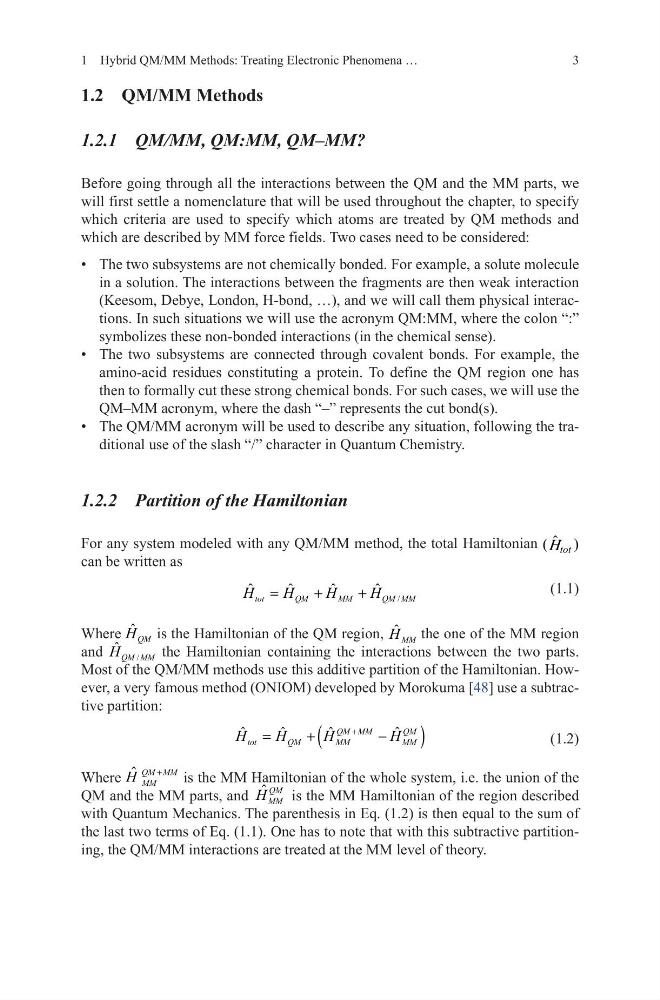
For any system modeled with any QM/MM method, the total Hamiltonian (
)
tot
Η
can be written as
(1.1)
Where ˆ QM
H is the Hamiltonian of the QM region, ˆ MM
H the one of the MM region
and
/
ˆ QM MM
H
the Hamiltonian containing the interactions between the two parts.
Most of the QM/MM methods use this additive partition of the Hamiltonian. However, a very famous method (ONIOM) developed by Morokuma [48] use a subtractive partition:
(1.2)
Where
QM MM
MM
H
+
is the MM Hamiltonian of the whole system, i.e. the union of the
QM and the MM parts, and
QM
MM
H
is the MM Hamiltonian of the region described
with Quantum Mechanics. The parenthesis in Eq. (1.2) is then equal to the sum of
the last two terms of Eq. (1.1). One has to note that with this subtractive partitioning, the QM/MM interactions are treated at the MM level of theory.
/
ˆ
ˆ
ˆ
ˆ
tot
QM
MM
QM MM
H
H
H
H
=
+
+
(
)
ˆ
ˆ
ˆ
ˆ
QM MM
QM
tot
QM
MM
MM
H
H
H
H
+
=
+
-
1 Hybrid QM/MM Methods: Treating Electronic Phenomena …
1.2 QM/MM Methods
1.2.1 QM/MM, QM:MM, QM–MM?
Before going through all the interactions between the QM and the MM parts, we
will first settle a nomenclature that will be used throughout the chapter, to specify
which criteria are used to specify which atoms are treated by QM methods and
which are described by MM force fields. Two cases need to be considered:
• The two subsystems are not chemically bonded. For example, a solute molecule
in a solution. The interactions between the fragments are then weak interaction
(Keesom, Debye, London, H-bond, …), and we will call them physical interactions. In such situations we will use the acronym QM:MM, where the colon “:”
symbolizes these non-bonded interactions (in the chemical sense).
• The two subsystems are connected through covalent bonds. For example, the
amino-acid residues constituting a protein. To define the QM region one has
then to formally cut these strong chemical bonds. For such cases, we will use the
QM–MM acronym, where the dash “–” represents the cut bond(s).
• The QM/MM acronym will be used to describe any situation, following the traditional use of the slash “/” character in Quantum Chemistry.
1.2.2 Partition of the Hamiltonian
For any system modeled with any QM/MM method, the total Hamiltonian (
)
tot
Η
can be written as
(1.1)
Where ˆ QM
H is the Hamiltonian of the QM region, ˆ MM
H the one of the MM region
and
/
ˆ QM MM
H
the Hamiltonian containing the interactions between the two parts.
Most of the QM/MM methods use this additive partition of the Hamiltonian. However, a very famous method (ONIOM) developed by Morokuma [48] use a subtractive partition:
(1.2)
Where
QM MM
MM
H
+
is the MM Hamiltonian of the whole system, i.e. the union of the
QM and the MM parts, and
QM
MM
H
is the MM Hamiltonian of the region described
with Quantum Mechanics. The parenthesis in Eq. (1.2) is then equal to the sum of
the last two terms of Eq. (1.1). One has to note that with this subtractive partitioning, the QM/MM interactions are treated at the MM level of theory.
/
ˆ
ˆ
ˆ
ˆ
tot
QM
MM
QM MM
H
H
H
H
=
+
+
(
)
ˆ
ˆ
ˆ
ˆ
QM MM
QM
tot
QM
MM
MM
H
H
H
H
+
=
+
-