

147
5 Molecular Structures, Relative Stability, and Proton Affinities of Nucleotides
electron density, a so-called bifurcation point [44], which is not observed for normal
hydrogen bonds. Taking into account that all criteria mentioned above deal with the
properties of the BCP, they can be referred to as BCP criteria.
The most immediate evidence of bonding within the AIM theory is the existence
of a bond path containing BCP between two atoms. The collection of bond paths
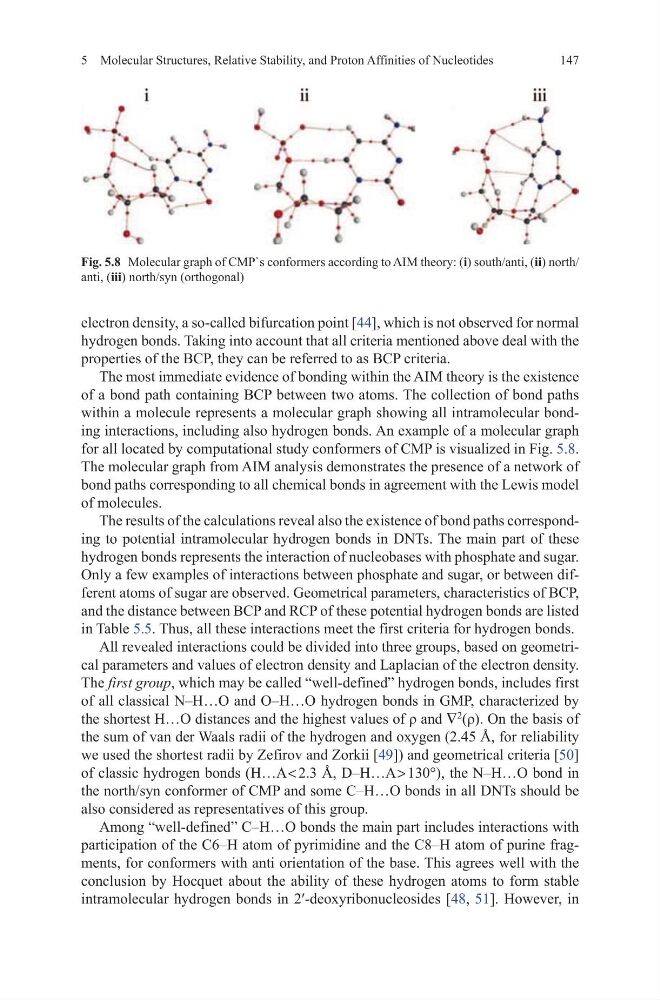
within a molecule represents a molecular graph showing all intramolecular bonding interactions, including also hydrogen bonds. An example of a molecular graph
for all located by computational study conformers of CMP is visualized in Fig. 5.8.
The molecular graph from AIM analysis demonstrates the presence of a network of
bond paths corresponding to all chemical bonds in agreement with the Lewis model
of molecules.
The results of the calculations reveal also the existence of bond paths corresponding to potential intramolecular hydrogen bonds in DNTs. The main part of these
hydrogen bonds represents the interaction of nucleobases with phosphate and sugar.
Only a few examples of interactions between phosphate and sugar, or between different atoms of sugar are observed. Geometrical parameters, characteristics of BCP,
and the distance between BCP and RCP of these potential hydrogen bonds are listed
in Table 5.5. Thus, all these interactions meet the first criteria for hydrogen bonds.
All revealed interactions could be divided into three groups, based on geometrical parameters and values of electron density and Laplacian of the electron density.
The first group, which may be called “well-defined” hydrogen bonds, includes first
of all classical N–H…O and O–H…O hydrogen bonds in GMP, characterized by
the shortest H…O distances and the highest values of ρ and ∇
2
(ρ). On the basis of
the sum of van der Waals radii of the hydrogen and oxygen (2.45 Å, for reliability
we used the shortest radii by Zefirov and Zorkii [49]) and geometrical criteria [50]
of classic hydrogen bonds (H…A < 2.3 Å, D–H…A > 130°), the N–H…O bond in
the north/syn conformer of CMP and some C–H…O bonds in all DNTs should be
also considered as representatives of this group.
Among “well-defined” C–H…O bonds the main part includes interactions with
participation of the C6–H atom of pyrimidine and the C8–H atom of purine fragments, for conformers with anti orientation of the base. This agrees well with the
conclusion by Hocquet about the ability of these hydrogen atoms to form stable
intramolecular hydrogen bonds in 2′-deoxyribonucleosides [48, 51]. However, in
Fig. 5.8 Molecular graph of CMP`s conformers according to AIM theory: (i) south/anti, (ii) north/
anti, (iii) north/syn (orthogonal)
5 Molecular Structures, Relative Stability, and Proton Affinities of Nucleotides
electron density, a so-called bifurcation point [44], which is not observed for normal
hydrogen bonds. Taking into account that all criteria mentioned above deal with the
properties of the BCP, they can be referred to as BCP criteria.
The most immediate evidence of bonding within the AIM theory is the existence
of a bond path containing BCP between two atoms. The collection of bond paths
within a molecule represents a molecular graph showing all intramolecular bonding interactions, including also hydrogen bonds. An example of a molecular graph
for all located by computational study conformers of CMP is visualized in Fig. 5.8.
The molecular graph from AIM analysis demonstrates the presence of a network of
bond paths corresponding to all chemical bonds in agreement with the Lewis model
of molecules.
The results of the calculations reveal also the existence of bond paths corresponding to potential intramolecular hydrogen bonds in DNTs. The main part of these
hydrogen bonds represents the interaction of nucleobases with phosphate and sugar.
Only a few examples of interactions between phosphate and sugar, or between different atoms of sugar are observed. Geometrical parameters, characteristics of BCP,
and the distance between BCP and RCP of these potential hydrogen bonds are listed
in Table 5.5. Thus, all these interactions meet the first criteria for hydrogen bonds.
All revealed interactions could be divided into three groups, based on geometrical parameters and values of electron density and Laplacian of the electron density.
The first group, which may be called “well-defined” hydrogen bonds, includes first
of all classical N–H…O and O–H…O hydrogen bonds in GMP, characterized by
the shortest H…O distances and the highest values of ρ and ∇
2
(ρ). On the basis of
the sum of van der Waals radii of the hydrogen and oxygen (2.45 Å, for reliability
we used the shortest radii by Zefirov and Zorkii [49]) and geometrical criteria [50]
of classic hydrogen bonds (H…A < 2.3 Å, D–H…A > 130°), the N–H…O bond in
the north/syn conformer of CMP and some C–H…O bonds in all DNTs should be
also considered as representatives of this group.
Among “well-defined” C–H…O bonds the main part includes interactions with
participation of the C6–H atom of pyrimidine and the C8–H atom of purine fragments, for conformers with anti orientation of the base. This agrees well with the
conclusion by Hocquet about the ability of these hydrogen atoms to form stable
intramolecular hydrogen bonds in 2′-deoxyribonucleosides [48, 51]. However, in
Fig. 5.8 Molecular graph of CMP`s conformers according to AIM theory: (i) south/anti, (ii) north/
anti, (iii) north/syn (orthogonal)