

145
5 Molecular Structures, Relative Stability, and Proton Affinities of Nucleotides
The application of an extended basis set allows revealing the clear dependence
of lengths of the C3′–O3′ bonds on the conformation of the SU. This bond in the
south conformer is systematically longer compared to the north conformer. The
biggest differences are found for GMP (Δℓ is 0.031 Å for anti- and 0.018 Å for
syn-conformers), while this value for other DNTs is considerably smaller (Δℓ is
0.012–0.014 Å). The existence of such dependence clearly indicates that the C3′–
O3′ bond is involved in some stereo electronic interactions, such as the anomeric
effect, despite the absence of a second heteroatom bound to the C3′ atom.
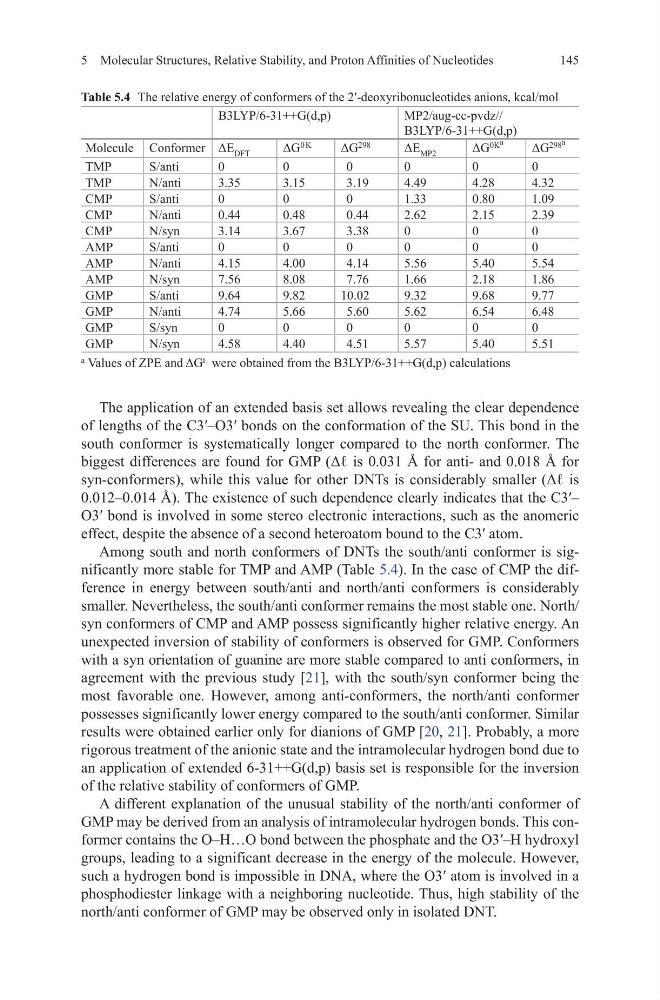
Among south and north conformers of DNTs the south/anti conformer is significantly more stable for TMP and AMP (Table 5.4). In the case of CMP the difference in energy between south/anti and north/anti conformers is considerably
smaller. Nevertheless, the south/anti conformer remains the most stable one. North/
syn conformers of CMP and AMP possess significantly higher relative energy. An
unexpected inversion of stability of conformers is observed for GMP. Conformers
with a syn orientation of guanine are more stable compared to anti conformers, in
agreement with the previous study [21], with the south/syn conformer being the
most favorable one. However, among anti-conformers, the north/anti conformer
possesses significantly lower energy compared to the south/anti conformer. Similar
results were obtained earlier only for dianions of GMP [20, 21]. Probably, a more
rigorous treatment of the anionic state and the intramolecular hydrogen bond due to
an application of extended 6-31++G(d,p) basis set is responsible for the inversion
of the relative stability of conformers of GMP.
A different explanation of the unusual stability of the north/anti conformer of
GMP may be derived from an analysis of intramolecular hydrogen bonds. This conformer contains the O–H…O bond between the phosphate and the O3′–H hydroxyl
groups, leading to a significant decrease in the energy of the molecule. However,
such a hydrogen bond is impossible in DNA, where the O3′ atom is involved in a
phosphodiester linkage with a neighboring nucleotide. Thus, high stability of the
north/anti conformer of GMP may be observed only in isolated DNT.
Table 5.4 The relative energy of conformers of the 2′-deoxyribonucleotides anions, kcal/mol
B3LYP/6-31++G(d,p)
MP2/aug-cc-pvdz//
B3LYP/6-31++G(d,p)
Molecule Conformer ΔE DFT
ΔG
0 K
ΔG
298
ΔE MP2
ΔG
0K a
ΔG
298 a
TMP
S/anti
0
0
0
0
0
0
TMP
N/anti
3.35
3.15
3.19
4.49
4.28
4.32
CMP
S/anti
0
0
0
1.33
0.80
1.09
CMP
N/anti
0.44
0.48
0.44
2.62
2.15
2.39
CMP
N/syn
3.14
3.67
3.38
0
0
0
AMP
S/anti
0
0
0
0
0
0
AMP
N/anti
4.15
4.00
4.14
5.56
5.40
5.54
AMP
N/syn
7.56
8.08
7.76
1.66
2.18
1.86
GMP
S/anti
9.64
9.82
10.02
9.32
9.68
9.77
GMP
N/anti
4.74
5.66
5.60
5.62
6.54
6.48
GMP
S/syn
0
0
0
0
0
0
GMP
N/syn
4.58
4.40
4.51
5.57
5.40
5.51
a
Values of ZPE and ΔG
t
were obtained from the B3LYP/6-31++G(d,p) calculations
5 Molecular Structures, Relative Stability, and Proton Affinities of Nucleotides
The application of an extended basis set allows revealing the clear dependence
of lengths of the C3′–O3′ bonds on the conformation of the SU. This bond in the
south conformer is systematically longer compared to the north conformer. The
biggest differences are found for GMP (Δℓ is 0.031 Å for anti- and 0.018 Å for
syn-conformers), while this value for other DNTs is considerably smaller (Δℓ is
0.012–0.014 Å). The existence of such dependence clearly indicates that the C3′–
O3′ bond is involved in some stereo electronic interactions, such as the anomeric
effect, despite the absence of a second heteroatom bound to the C3′ atom.
Among south and north conformers of DNTs the south/anti conformer is significantly more stable for TMP and AMP (Table 5.4). In the case of CMP the difference in energy between south/anti and north/anti conformers is considerably
smaller. Nevertheless, the south/anti conformer remains the most stable one. North/
syn conformers of CMP and AMP possess significantly higher relative energy. An
unexpected inversion of stability of conformers is observed for GMP. Conformers
with a syn orientation of guanine are more stable compared to anti conformers, in
agreement with the previous study [21], with the south/syn conformer being the
most favorable one. However, among anti-conformers, the north/anti conformer
possesses significantly lower energy compared to the south/anti conformer. Similar
results were obtained earlier only for dianions of GMP [20, 21]. Probably, a more
rigorous treatment of the anionic state and the intramolecular hydrogen bond due to
an application of extended 6-31++G(d,p) basis set is responsible for the inversion
of the relative stability of conformers of GMP.
A different explanation of the unusual stability of the north/anti conformer of
GMP may be derived from an analysis of intramolecular hydrogen bonds. This conformer contains the O–H…O bond between the phosphate and the O3′–H hydroxyl
groups, leading to a significant decrease in the energy of the molecule. However,
such a hydrogen bond is impossible in DNA, where the O3′ atom is involved in a
phosphodiester linkage with a neighboring nucleotide. Thus, high stability of the
north/anti conformer of GMP may be observed only in isolated DNT.
Table 5.4 The relative energy of conformers of the 2′-deoxyribonucleotides anions, kcal/mol
B3LYP/6-31++G(d,p)
MP2/aug-cc-pvdz//
B3LYP/6-31++G(d,p)
Molecule Conformer ΔE DFT
ΔG
0 K
ΔG
298
ΔE MP2
ΔG
0K a
ΔG
298 a
TMP
S/anti
0
0
0
0
0
0
TMP
N/anti
3.35
3.15
3.19
4.49
4.28
4.32
CMP
S/anti
0
0
0
1.33
0.80
1.09
CMP
N/anti
0.44
0.48
0.44
2.62
2.15
2.39
CMP
N/syn
3.14
3.67
3.38
0
0
0
AMP
S/anti
0
0
0
0
0
0
AMP
N/anti
4.15
4.00
4.14
5.56
5.40
5.54
AMP
N/syn
7.56
8.08
7.76
1.66
2.18
1.86
GMP
S/anti
9.64
9.82
10.02
9.32
9.68
9.77
GMP
N/anti
4.74
5.66
5.60
5.62
6.54
6.48
GMP
S/syn
0
0
0
0
0
0
GMP
N/syn
4.58
4.40
4.51
5.57
5.40
5.51
a
Values of ZPE and ΔG
t
were obtained from the B3LYP/6-31++G(d,p) calculations