

4. Measure the YOPRO emission fluorescence intensity of each
sample at emission wavelength of 509 nm, using 491 nm light
for excitation. YOPRO is a DNA-staining fluorescent probe
with a low quantum yield when not bound to DNA, but a
200-fold quantum yield increase when bound. It can only
access the bacterial DNA if the cell has either been permanently
(irreversible electroporation) or transiently disrupted (reversible electroporation). Therefore, the appearance of YOPRO
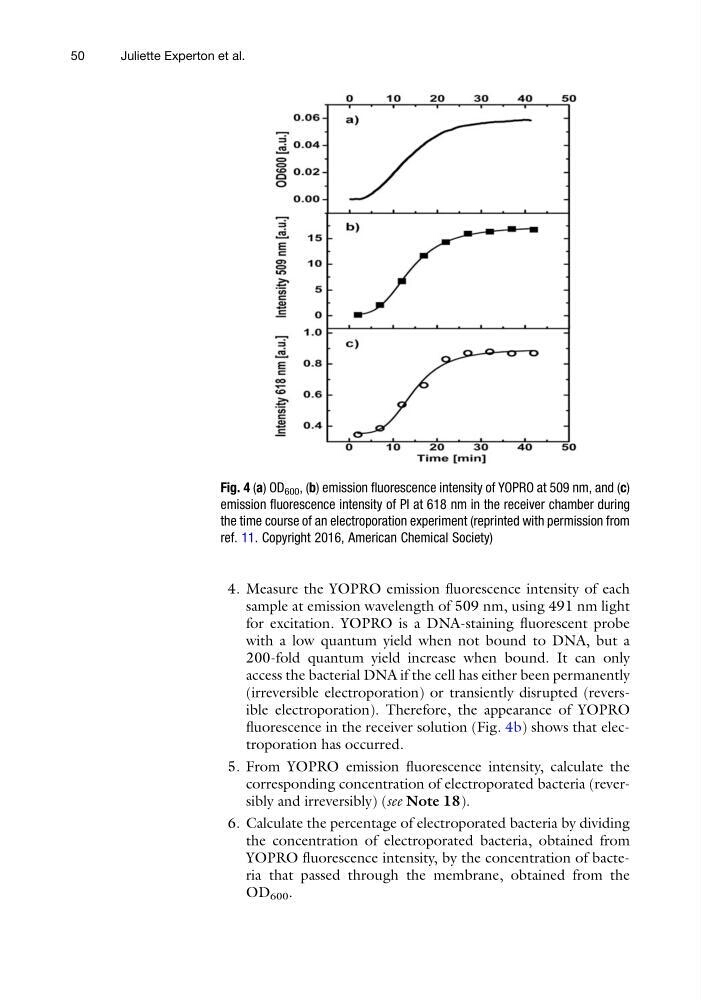
fluorescence in the receiver solution (Fig. 4b) shows that electroporation has occurred.
5. From YOPRO emission fluorescence intensity, calculate the
corresponding concentration of electroporated bacteria (reversibly and irreversibly) (see Note 18).
6. Calculate the percentage of electroporated bacteria by dividing
the concentration of electroporated bacteria, obtained from
YOPRO fluorescence intensity, by the concentration of bacteria that passed through the membrane, obtained from the
OD 600 .
Fig. 4 (a) OD 600 , (b) emission fluorescence intensity of YOPRO at 509 nm, and (c)
emission fluorescence intensity of PI at 618 nm in the receiver chamber during
the time course of an electroporation experiment (reprinted with permission from
ref. 11. Copyright 2016, American Chemical Society)
50
Juliette Experton et al.
sample at emission wavelength of 509 nm, using 491 nm light
for excitation. YOPRO is a DNA-staining fluorescent probe
with a low quantum yield when not bound to DNA, but a
200-fold quantum yield increase when bound. It can only
access the bacterial DNA if the cell has either been permanently
(irreversible electroporation) or transiently disrupted (reversible electroporation). Therefore, the appearance of YOPRO
fluorescence in the receiver solution (Fig. 4b) shows that electroporation has occurred.
5. From YOPRO emission fluorescence intensity, calculate the
corresponding concentration of electroporated bacteria (reversibly and irreversibly) (see Note 18).
6. Calculate the percentage of electroporated bacteria by dividing
the concentration of electroporated bacteria, obtained from
YOPRO fluorescence intensity, by the concentration of bacteria that passed through the membrane, obtained from the
OD 600 .
Fig. 4 (a) OD 600 , (b) emission fluorescence intensity of YOPRO at 509 nm, and (c)
emission fluorescence intensity of PI at 618 nm in the receiver chamber during
the time course of an electroporation experiment (reprinted with permission from
ref. 11. Copyright 2016, American Chemical Society)
50
Juliette Experton et al.