

require a complicated operation to place single cells to the electroporation locations, for example, by using optical tweezers or magnetic tweezers. The long-time manipulation increases cell mortality
rate. The process is not only time and cost consuming but also has
limited throughput at a time. This greatly limits the scale-up and
applications of MEP/NEP technologies.
Microfluidic devices with micro/nanoelectroporation channels
can be fabricated through various routines. These processes can be
cleanroom based micro/nanomanufacturing [2], soft-lithography
[3], non-cleanroom micro/nanomanufacturing [4, 5–7], or a combination of these processes. Injection molding process is commonly
used for mass production of a low-cost plastic product. Andresen
et al. fabricated an injection molded microelectroporation device by
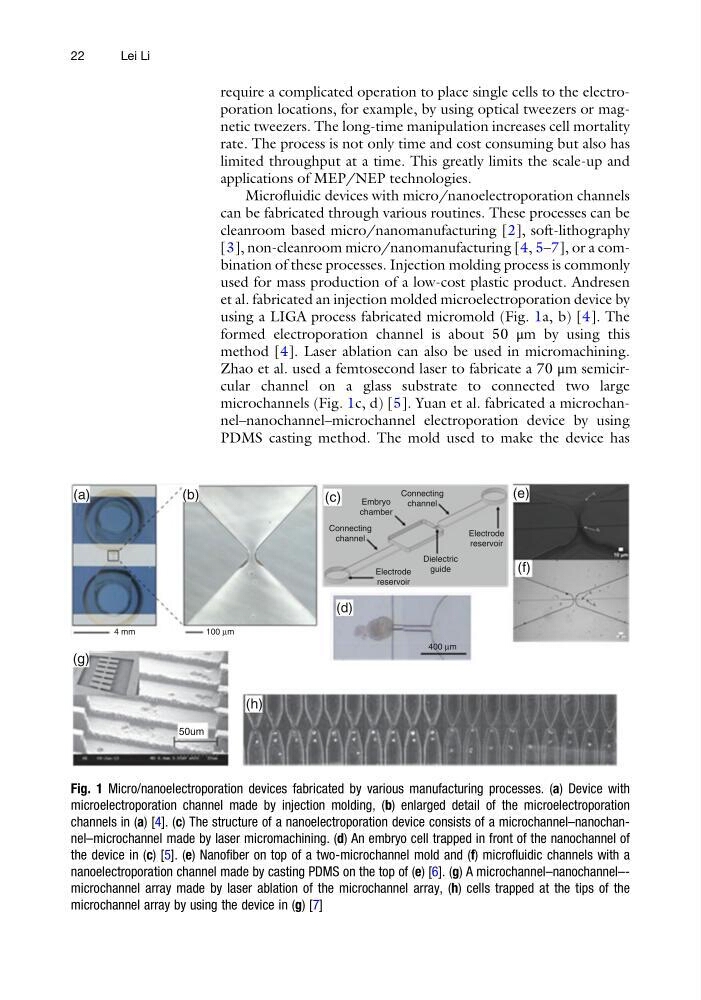
using a LIGA process fabricated micromold (Fig. 1a, b) [4]. The
formed electroporation channel is about 50 μm by using this
method [4]. Laser ablation can also be used in micromachining.
Zhao et al. used a femtosecond laser to fabricate a 70 μm semicircular channel on a glass substrate to connected two large
microchannels (Fig. 1c, d) [5]. Yuan et al. fabricated a microchannel–nanochannel–microchannel electroporation device by using
PDMS casting method. The mold used to make the device has
(a)
4 mm
100 µm
400 µm
50um
(g)
(b)
(c)
Connecting
channel
Embryo
chamber
Dielectric
guide
Connecting
channel
Electrode
reservoir
Electrode
reservoir
(d)
(h)
(e)
(f)
Fig. 1 Micro/nanoelectroporation devices fabricated by various manufacturing processes. (a) Device with
microelectroporation channel made by injection molding, (b) enlarged detail of the microelectroporation
channels in (a) [4]. (c) The structure of a nanoelectroporation device consists of a microchannel–nanochannel–microchannel made by laser micromachining. (d) An embryo cell trapped in front of the nanochannel of
the device in (c) [5]. (e) Nanofiber on top of a two-microchannel mold and (f) microfluidic channels with a
nanoelectroporation channel made by casting PDMS on the top of (e) [6]. (g) A microchannel–nanochannel–microchannel array made by laser ablation of the microchannel array, (h) cells trapped at the tips of the
microchannel array by using the device in (g) [7]
22
Lei Li
rate. The process is not only time and cost consuming but also has
limited throughput at a time. This greatly limits the scale-up and
applications of MEP/NEP technologies.
Microfluidic devices with micro/nanoelectroporation channels
can be fabricated through various routines. These processes can be
cleanroom based micro/nanomanufacturing [2], soft-lithography
[3], non-cleanroom micro/nanomanufacturing [4, 5–7], or a combination of these processes. Injection molding process is commonly
used for mass production of a low-cost plastic product. Andresen
et al. fabricated an injection molded microelectroporation device by
using a LIGA process fabricated micromold (Fig. 1a, b) [4]. The
formed electroporation channel is about 50 μm by using this
method [4]. Laser ablation can also be used in micromachining.
Zhao et al. used a femtosecond laser to fabricate a 70 μm semicircular channel on a glass substrate to connected two large
microchannels (Fig. 1c, d) [5]. Yuan et al. fabricated a microchannel–nanochannel–microchannel electroporation device by using
PDMS casting method. The mold used to make the device has
(a)
4 mm
100 µm
400 µm
50um
(g)
(b)
(c)
Connecting
channel
Embryo
chamber
Dielectric
guide
Connecting
channel
Electrode
reservoir
Electrode
reservoir
(d)
(h)
(e)
(f)
Fig. 1 Micro/nanoelectroporation devices fabricated by various manufacturing processes. (a) Device with
microelectroporation channel made by injection molding, (b) enlarged detail of the microelectroporation
channels in (a) [4]. (c) The structure of a nanoelectroporation device consists of a microchannel–nanochannel–microchannel made by laser micromachining. (d) An embryo cell trapped in front of the nanochannel of
the device in (c) [5]. (e) Nanofiber on top of a two-microchannel mold and (f) microfluidic channels with a
nanoelectroporation channel made by casting PDMS on the top of (e) [6]. (g) A microchannel–nanochannel–microchannel array made by laser ablation of the microchannel array, (h) cells trapped at the tips of the
microchannel array by using the device in (g) [7]
22
Lei Li