

During electroporation, electrical pulses increase the transmembrane potential of cells, leading to the formation of nanopores on the membrane, but the cell membrane is no longer able
to reseal if the nanopores exceed a critical radius [7]. Therefore,
the cell death caused by inappropriate membrane permeation can
easily occur if the electrical parameters are not well optimized.
Traditionally, large voltages between flat electrodes were applied
in electroporation to reach high electric field in cell medium
solution [1], while the current study would like to seek a mild
electric field to achieve the effective transfection efficiency by
electroporation.
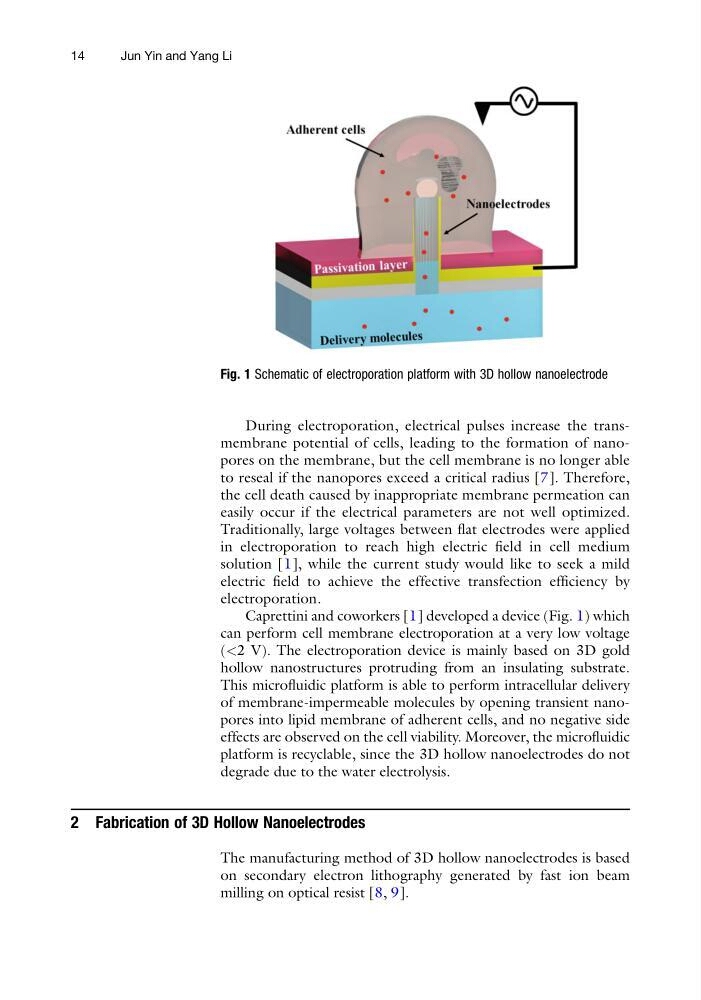
Caprettini and coworkers [1] developed a device (Fig. 1) which
can perform cell membrane electroporation at a very low voltage
(<2 V). The electroporation device is mainly based on 3D gold
hollow nanostructures protruding from an insulating substrate.
This microfluidic platform is able to perform intracellular delivery
of membrane-impermeable molecules by opening transient nanopores into lipid membrane of adherent cells, and no negative side
effects are observed on the cell viability. Moreover, the microfluidic
platform is recyclable, since the 3D hollow nanoelectrodes do not
degrade due to the water electrolysis.
2 Fabrication of 3D Hollow Nanoelectrodes
The manufacturing method of 3D hollow nanoelectrodes is based
on secondary electron lithography generated by fast ion beam
milling on optical resist [8, 9].
Fig. 1 Schematic of electroporation platform with 3D hollow nanoelectrode
14
Jun Yin and Yang Li
to reseal if the nanopores exceed a critical radius [7]. Therefore,
the cell death caused by inappropriate membrane permeation can
easily occur if the electrical parameters are not well optimized.
Traditionally, large voltages between flat electrodes were applied
in electroporation to reach high electric field in cell medium
solution [1], while the current study would like to seek a mild
electric field to achieve the effective transfection efficiency by
electroporation.
Caprettini and coworkers [1] developed a device (Fig. 1) which
can perform cell membrane electroporation at a very low voltage
(<2 V). The electroporation device is mainly based on 3D gold
hollow nanostructures protruding from an insulating substrate.
This microfluidic platform is able to perform intracellular delivery
of membrane-impermeable molecules by opening transient nanopores into lipid membrane of adherent cells, and no negative side
effects are observed on the cell viability. Moreover, the microfluidic
platform is recyclable, since the 3D hollow nanoelectrodes do not
degrade due to the water electrolysis.
2 Fabrication of 3D Hollow Nanoelectrodes
The manufacturing method of 3D hollow nanoelectrodes is based
on secondary electron lithography generated by fast ion beam
milling on optical resist [8, 9].
Fig. 1 Schematic of electroporation platform with 3D hollow nanoelectrode
14
Jun Yin and Yang Li