

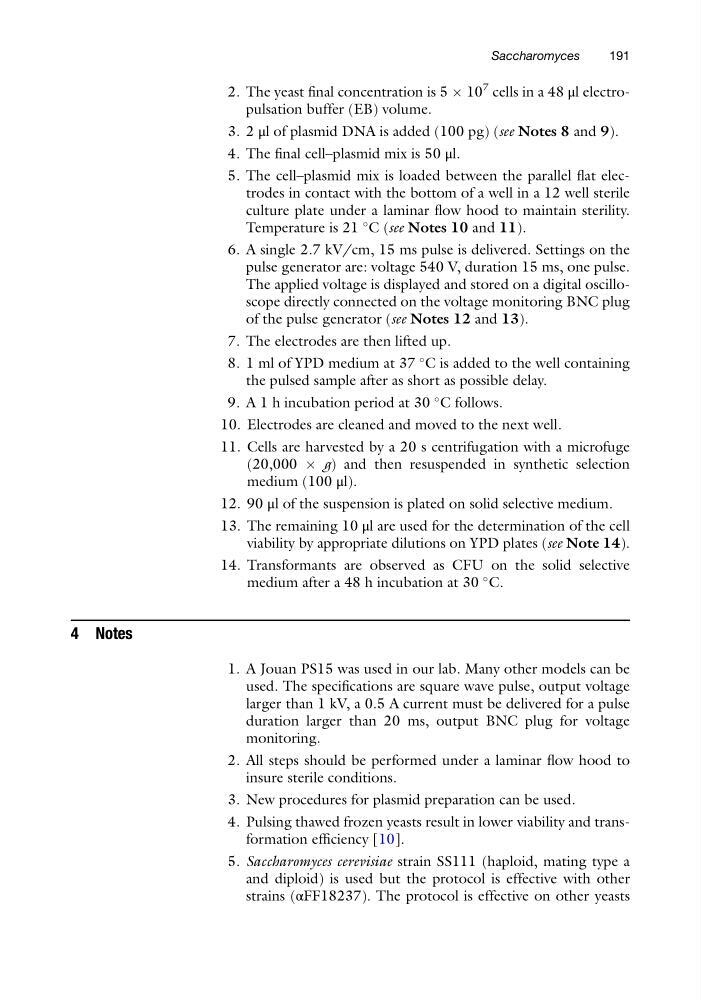
2. The yeast final concentration is 5 Â 10
7 cells in a 48 μl electropulsation buffer (EB) volume.
3. 2 μl of plasmid DNA is added (100 pg) (see Notes 8 and 9).
4. The final cell–plasmid mix is 50 μl.
5. The cell–plasmid mix is loaded between the parallel flat electrodes in contact with the bottom of a well in a 12 well sterile
culture plate under a laminar flow hood to maintain sterility.
Temperature is 21
C (see Notes 10 and 11).
6. A single 2.7 kV/cm, 15 ms pulse is delivered. Settings on the
pulse generator are: voltage 540 V, duration 15 ms, one pulse.
The applied voltage is displayed and stored on a digital oscilloscope directly connected on the voltage monitoring BNC plug
of the pulse generator (see Notes 12 and 13).
7. The electrodes are then lifted up.
8. 1 ml of YPD medium at 37
C is added to the well containing
the pulsed sample after as short as possible delay.
9. A 1 h incubation period at 30
C follows.
10. Electrodes are cleaned and moved to the next well.
11. Cells are harvested by a 20 s centrifugation with a microfuge
(20,000 Â g) and then resuspended in synthetic selection
medium (100 μl).
12. 90 μl of the suspension is plated on solid selective medium.
13. The remaining 10 μl are used for the determination of the cell
viability by appropriate dilutions on YPD plates (see Note 14).
14. Transformants are observed as CFU on the solid selective
medium after a 48 h incubation at 30
C.
4 Notes
1. A Jouan PS15 was used in our lab. Many other models can be
used. The specifications are square wave pulse, output voltage
larger than 1 kV, a 0.5 A current must be delivered for a pulse
duration larger than 20 ms, output BNC plug for voltage
monitoring.
2. All steps should be performed under a laminar flow hood to
insure sterile conditions.
3. New procedures for plasmid preparation can be used.
4. Pulsing thawed frozen yeasts result in lower viability and transformation efficiency [10].
5. Saccharomyces cerevisiae strain SS111 (haploid, mating type a
and diploid) is used but the protocol is effective with other
strains (αFF18237). The protocol is effective on other yeasts
Saccharomyces
191
7 cells in a 48 μl electropulsation buffer (EB) volume.
3. 2 μl of plasmid DNA is added (100 pg) (see Notes 8 and 9).
4. The final cell–plasmid mix is 50 μl.
5. The cell–plasmid mix is loaded between the parallel flat electrodes in contact with the bottom of a well in a 12 well sterile
culture plate under a laminar flow hood to maintain sterility.
Temperature is 21
C (see Notes 10 and 11).
6. A single 2.7 kV/cm, 15 ms pulse is delivered. Settings on the
pulse generator are: voltage 540 V, duration 15 ms, one pulse.
The applied voltage is displayed and stored on a digital oscilloscope directly connected on the voltage monitoring BNC plug
of the pulse generator (see Notes 12 and 13).
7. The electrodes are then lifted up.
8. 1 ml of YPD medium at 37
C is added to the well containing
the pulsed sample after as short as possible delay.
9. A 1 h incubation period at 30
C follows.
10. Electrodes are cleaned and moved to the next well.
11. Cells are harvested by a 20 s centrifugation with a microfuge
(20,000 Â g) and then resuspended in synthetic selection
medium (100 μl).
12. 90 μl of the suspension is plated on solid selective medium.
13. The remaining 10 μl are used for the determination of the cell
viability by appropriate dilutions on YPD plates (see Note 14).
14. Transformants are observed as CFU on the solid selective
medium after a 48 h incubation at 30
C.
4 Notes
1. A Jouan PS15 was used in our lab. Many other models can be
used. The specifications are square wave pulse, output voltage
larger than 1 kV, a 0.5 A current must be delivered for a pulse
duration larger than 20 ms, output BNC plug for voltage
monitoring.
2. All steps should be performed under a laminar flow hood to
insure sterile conditions.
3. New procedures for plasmid preparation can be used.
4. Pulsing thawed frozen yeasts result in lower viability and transformation efficiency [10].
5. Saccharomyces cerevisiae strain SS111 (haploid, mating type a
and diploid) is used but the protocol is effective with other
strains (αFF18237). The protocol is effective on other yeasts
Saccharomyces
191