

3.3 Electroporation
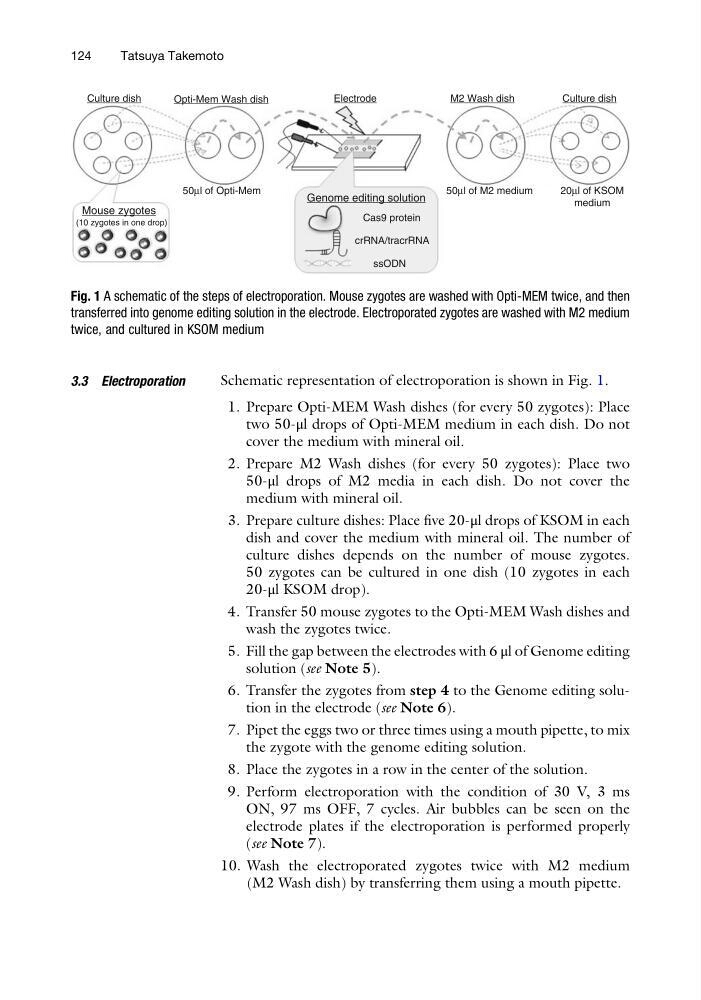
Schematic representation of electroporation is shown in Fig. 1.
1. Prepare Opti-MEM Wash dishes (for every 50 zygotes): Place
two 50-μl drops of Opti-MEM medium in each dish. Do not
cover the medium with mineral oil.
2. Prepare M2 Wash dishes (for every 50 zygotes): Place two
50-μl drops of M2 media in each dish. Do not cover the
medium with mineral oil.
3. Prepare culture dishes: Place five 20-μl drops of KSOM in each
dish and cover the medium with mineral oil. The number of
culture dishes depends on the number of mouse zygotes.
50 zygotes can be cultured in one dish (10 zygotes in each
20-μl KSOM drop).
4. Transfer 50 mouse zygotes to the Opti-MEM Wash dishes and
wash the zygotes twice.
5. Fill the gap between the electrodes with 6 μl of Genome editing
solution (see Note 5).
6. Transfer the zygotes from step 4 to the Genome editing solution in the electrode (see Note 6).
7. Pipet the eggs two or three times using a mouth pipette, to mix
the zygote with the genome editing solution.
8. Place the zygotes in a row in the center of the solution.
9. Perform electroporation with the condition of 30 V, 3 ms
ON, 97 ms OFF, 7 cycles. Air bubbles can be seen on the
electrode plates if the electroporation is performed properly
(see Note 7).
10. Wash the electroporated zygotes twice with M2 medium
(M2 Wash dish) by transferring them using a mouth pipette.
Culture dish
Mouse zygotes
(10 zygotes in one drop)
Genome editing solution
Electrode
Cas9 protein
crRNA/tracrRNA
ssODN
50µl of Opti-Mem
50µl of M2 medium
20µl of KSOM
medium
M2 Wash dish
Culture dish
Opti-Mem Wash dish
Fig. 1 A schematic of the steps of electroporation. Mouse zygotes are washed with Opti-MEM twice, and then
transferred into genome editing solution in the electrode. Electroporated zygotes are washed with M2 medium
twice, and cultured in KSOM medium
124
Tatsuya Takemoto
Schematic representation of electroporation is shown in Fig. 1.
1. Prepare Opti-MEM Wash dishes (for every 50 zygotes): Place
two 50-μl drops of Opti-MEM medium in each dish. Do not
cover the medium with mineral oil.
2. Prepare M2 Wash dishes (for every 50 zygotes): Place two
50-μl drops of M2 media in each dish. Do not cover the
medium with mineral oil.
3. Prepare culture dishes: Place five 20-μl drops of KSOM in each
dish and cover the medium with mineral oil. The number of
culture dishes depends on the number of mouse zygotes.
50 zygotes can be cultured in one dish (10 zygotes in each
20-μl KSOM drop).
4. Transfer 50 mouse zygotes to the Opti-MEM Wash dishes and
wash the zygotes twice.
5. Fill the gap between the electrodes with 6 μl of Genome editing
solution (see Note 5).
6. Transfer the zygotes from step 4 to the Genome editing solution in the electrode (see Note 6).
7. Pipet the eggs two or three times using a mouth pipette, to mix
the zygote with the genome editing solution.
8. Place the zygotes in a row in the center of the solution.
9. Perform electroporation with the condition of 30 V, 3 ms
ON, 97 ms OFF, 7 cycles. Air bubbles can be seen on the
electrode plates if the electroporation is performed properly
(see Note 7).
10. Wash the electroporated zygotes twice with M2 medium
(M2 Wash dish) by transferring them using a mouth pipette.
Culture dish
Mouse zygotes
(10 zygotes in one drop)
Genome editing solution
Electrode
Cas9 protein
crRNA/tracrRNA
ssODN
50µl of Opti-Mem
50µl of M2 medium
20µl of KSOM
medium
M2 Wash dish
Culture dish
Opti-Mem Wash dish
Fig. 1 A schematic of the steps of electroporation. Mouse zygotes are washed with Opti-MEM twice, and then
transferred into genome editing solution in the electrode. Electroporated zygotes are washed with M2 medium
twice, and cultured in KSOM medium
124
Tatsuya Takemoto