

5.3 Rocksalt Single-Phase Region
67
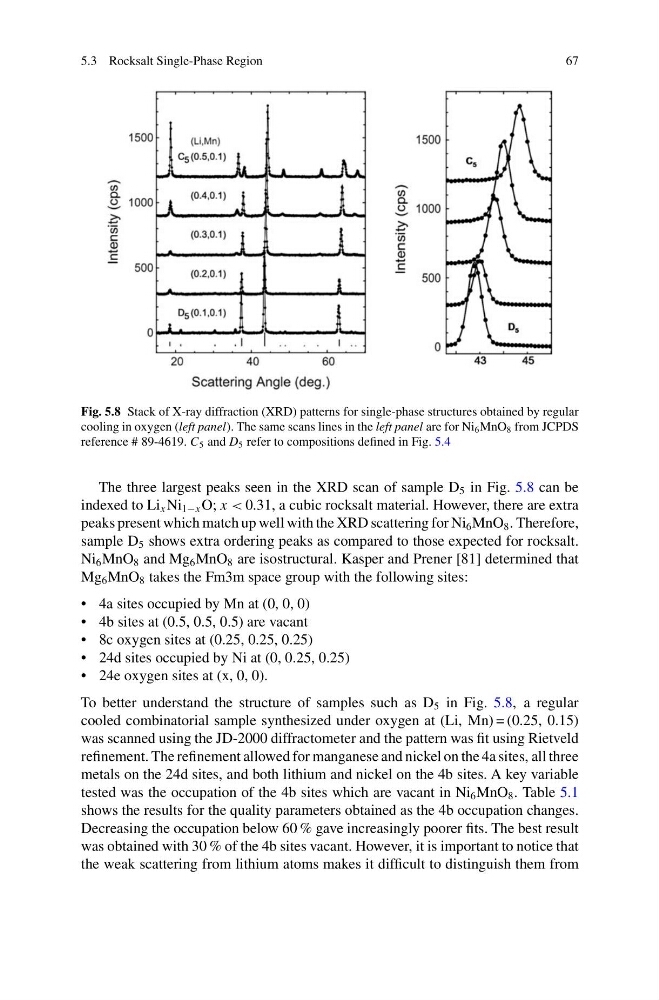
Fig. 5.8 Stack of X-ray diffraction (XRD) patterns for single-phase structures obtained by regular
cooling in oxygen (left panel). The same scans lines in the left panel are for Ni 6 MnO 8 from JCPDS
reference # 89-4619. C 5 and D 5 refer to compositions defined in Fig. 5.4
The three largest peaks seen in the XRD scan of sample D 5 in Fig. 5.8 can be
indexed to Li x Ni 1−x O; x < 0.31, a cubic rocksalt material. However, there are extra
peaks present which match up well with the XRD scattering for Ni 6 MnO 8 . Therefore,
sample D 5 shows extra ordering peaks as compared to those expected for rocksalt.
Ni 6 MnO 8 and Mg 6 MnO 8 are isostructural. Kasper and Prener [81] determined that
Mg 6 MnO 8 takes the Fm3m space group with the following sites:
• 4a sites occupied by Mn at (0, 0, 0)
• 4b sites at (0.5, 0.5, 0.5) are vacant
• 8c oxygen sites at (0.25, 0.25, 0.25)
• 24d sites occupied by Ni at (0, 0.25, 0.25)
• 24e oxygen sites at (x, 0, 0).
To better understand the structure of samples such as D 5 in Fig. 5.8, a regular
cooled combinatorial sample synthesized under oxygen at (Li, Mn) = (0.25, 0.15)
was scanned using the JD-2000 diffractometer and the pattern was fit using Rietveld
refinement. The refinement allowed for manganese and nickel on the 4a sites, all three
metals on the 24d sites, and both lithium and nickel on the 4b sites. A key variable
tested was the occupation of the 4b sites which are vacant in Ni 6 MnO 8 . Table 5.1
shows the results for the quality parameters obtained as the 4b occupation changes.
Decreasing the occupation below 60 % gave increasingly poorer fits. The best result
was obtained with 30 % of the 4b sites vacant. However, it is important to notice that
the weak scattering from lithium atoms makes it difficult to distinguish them from
67
Fig. 5.8 Stack of X-ray diffraction (XRD) patterns for single-phase structures obtained by regular
cooling in oxygen (left panel). The same scans lines in the left panel are for Ni 6 MnO 8 from JCPDS
reference # 89-4619. C 5 and D 5 refer to compositions defined in Fig. 5.4
The three largest peaks seen in the XRD scan of sample D 5 in Fig. 5.8 can be
indexed to Li x Ni 1−x O; x < 0.31, a cubic rocksalt material. However, there are extra
peaks present which match up well with the XRD scattering for Ni 6 MnO 8 . Therefore,
sample D 5 shows extra ordering peaks as compared to those expected for rocksalt.
Ni 6 MnO 8 and Mg 6 MnO 8 are isostructural. Kasper and Prener [81] determined that
Mg 6 MnO 8 takes the Fm3m space group with the following sites:
• 4a sites occupied by Mn at (0, 0, 0)
• 4b sites at (0.5, 0.5, 0.5) are vacant
• 8c oxygen sites at (0.25, 0.25, 0.25)
• 24d sites occupied by Ni at (0, 0.25, 0.25)
• 24e oxygen sites at (x, 0, 0).
To better understand the structure of samples such as D 5 in Fig. 5.8, a regular
cooled combinatorial sample synthesized under oxygen at (Li, Mn) = (0.25, 0.15)
was scanned using the JD-2000 diffractometer and the pattern was fit using Rietveld
refinement. The refinement allowed for manganese and nickel on the 4a sites, all three
metals on the 24d sites, and both lithium and nickel on the 4b sites. A key variable
tested was the occupation of the 4b sites which are vacant in Ni 6 MnO 8 . Table 5.1
shows the results for the quality parameters obtained as the 4b occupation changes.
Decreasing the occupation below 60 % gave increasingly poorer fits. The best result
was obtained with 30 % of the 4b sites vacant. However, it is important to notice that
the weak scattering from lithium atoms makes it difficult to distinguish them from