

30
2 Experimental and Theoretical Considerations
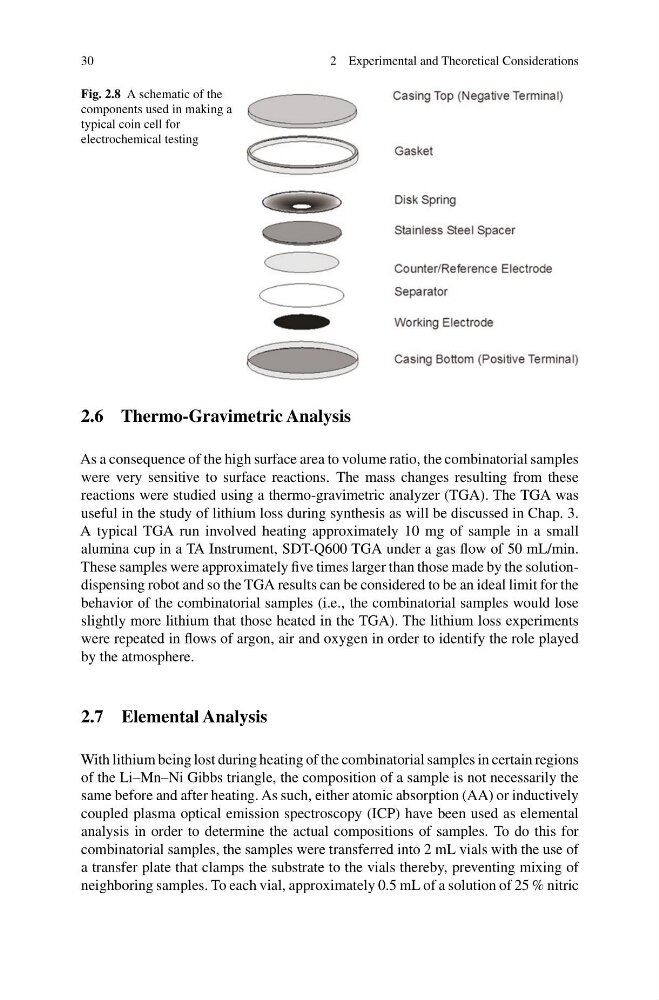
Fig. 2.8 A schematic of the
components used in making a
typical coin cell for
electrochemical testing
2.6 Thermo-Gravimetric Analysis
As a consequence of the high surface area to volume ratio, the combinatorial samples
were very sensitive to surface reactions. The mass changes resulting from these
reactions were studied using a thermo-gravimetric analyzer (TGA). The TGA was
useful in the study of lithium loss during synthesis as will be discussed in Chap. 3.
A typical TGA run involved heating approximately 10 mg of sample in a small
alumina cup in a TA Instrument, SDT-Q600 TGA under a gas flow of 50 mL/min.
These samples were approximately five times larger than those made by the solutiondispensing robot and so the TGA results can be considered to be an ideal limit for the
behavior of the combinatorial samples (i.e., the combinatorial samples would lose
slightly more lithium that those heated in the TGA). The lithium loss experiments
were repeated in flows of argon, air and oxygen in order to identify the role played
by the atmosphere.
2.7 Elemental Analysis
With lithium being lost during heating of the combinatorial samples in certain regions
of the Li–Mn–Ni Gibbs triangle, the composition of a sample is not necessarily the
same before and after heating. As such, either atomic absorption (AA) or inductively
coupled plasma optical emission spectroscopy (ICP) have been used as elemental
analysis in order to determine the actual compositions of samples. To do this for
combinatorial samples, the samples were transferred into 2 mL vials with the use of
a transfer plate that clamps the substrate to the vials thereby, preventing mixing of
neighboring samples. To each vial, approximately 0.5 mL of a solution of 25 % nitric
2 Experimental and Theoretical Considerations
Fig. 2.8 A schematic of the
components used in making a
typical coin cell for
electrochemical testing
2.6 Thermo-Gravimetric Analysis
As a consequence of the high surface area to volume ratio, the combinatorial samples
were very sensitive to surface reactions. The mass changes resulting from these
reactions were studied using a thermo-gravimetric analyzer (TGA). The TGA was
useful in the study of lithium loss during synthesis as will be discussed in Chap. 3.
A typical TGA run involved heating approximately 10 mg of sample in a small
alumina cup in a TA Instrument, SDT-Q600 TGA under a gas flow of 50 mL/min.
These samples were approximately five times larger than those made by the solutiondispensing robot and so the TGA results can be considered to be an ideal limit for the
behavior of the combinatorial samples (i.e., the combinatorial samples would lose
slightly more lithium that those heated in the TGA). The lithium loss experiments
were repeated in flows of argon, air and oxygen in order to identify the role played
by the atmosphere.
2.7 Elemental Analysis
With lithium being lost during heating of the combinatorial samples in certain regions
of the Li–Mn–Ni Gibbs triangle, the composition of a sample is not necessarily the
same before and after heating. As such, either atomic absorption (AA) or inductively
coupled plasma optical emission spectroscopy (ICP) have been used as elemental
analysis in order to determine the actual compositions of samples. To do this for
combinatorial samples, the samples were transferred into 2 mL vials with the use of
a transfer plate that clamps the substrate to the vials thereby, preventing mixing of
neighboring samples. To each vial, approximately 0.5 mL of a solution of 25 % nitric