

134
10 Conclusions and Future Works
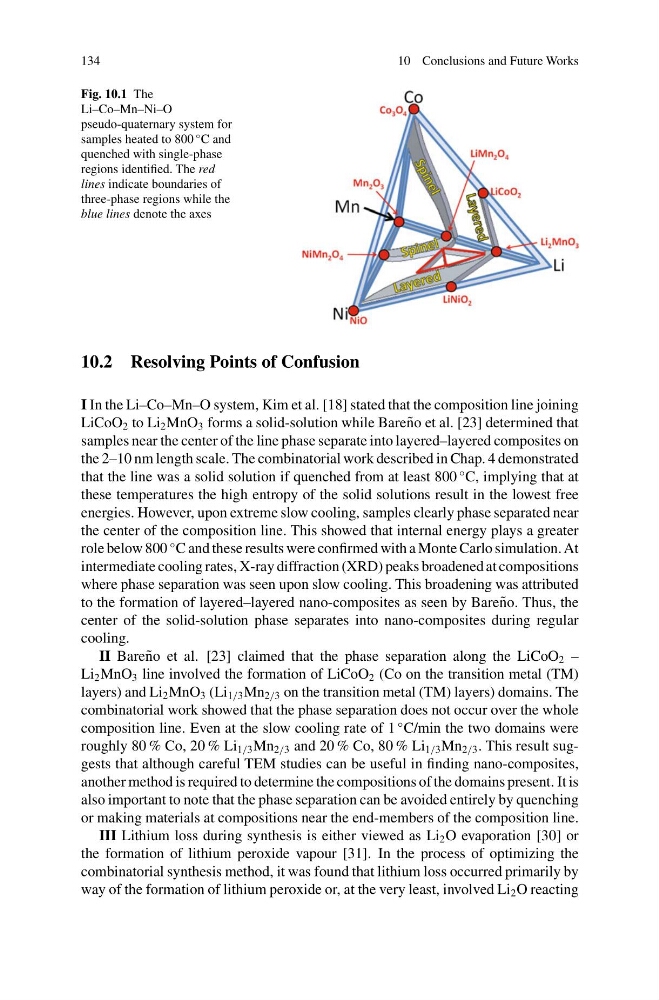
Fig. 10.1 The
Li–Co–Mn–Ni–O
pseudo-quaternary system for
samples heated to 800
◦ C and
quenched with single-phase
regions identified. The red
lines indicate boundaries of
three-phase regions while the
blue lines denote the axes
10.2 Resolving Points of Confusion
I In the Li–Co–Mn–O system, Kim et al. [18] stated that the composition line joining
LiCoO 2 to Li 2 MnO 3 forms a solid-solution while Bare˜ no et al. [23] determined that
samples near the center of the line phase separate into layered–layered composites on
the 2–10 nm length scale. The combinatorial work described in Chap. 4 demonstrated
that the line was a solid solution if quenched from at least 800
◦ C, implying that at
these temperatures the high entropy of the solid solutions result in the lowest free
energies. However, upon extreme slow cooling, samples clearly phase separated near
the center of the composition line. This showed that internal energy plays a greater
role below 800
◦ C and these results were confirmed with a Monte Carlo simulation. At
intermediate cooling rates, X-ray diffraction (XRD) peaks broadened at compositions
where phase separation was seen upon slow cooling. This broadening was attributed
to the formation of layered–layered nano-composites as seen by Bare˜ no. Thus, the
center of the solid-solution phase separates into nano-composites during regular
cooling.
II Bare˜ no et al. [23] claimed that the phase separation along the LiCoO 2 –
Li 2 MnO 3 line involved the formation of LiCoO 2 (Co on the transition metal (TM)
layers) and Li 2 MnO 3 (Li 1/3 Mn 2/3 on the transition metal (TM) layers) domains. The
combinatorial work showed that the phase separation does not occur over the whole
composition line. Even at the slow cooling rate of 1
◦ C/min the two domains were
roughly 80 % Co, 20 % Li 1/3 Mn 2/3 and 20 % Co, 80 % Li 1/3 Mn 2/3 . This result suggests that although careful TEM studies can be useful in finding nano-composites,
another method is required to determine the compositions of the domains present. It is
also important to note that the phase separation can be avoided entirely by quenching
or making materials at compositions near the end-members of the composition line.
III Lithium loss during synthesis is either viewed as Li 2 O evaporation [30] or
the formation of lithium peroxide vapour [31]. In the process of optimizing the
combinatorial synthesis method, it was found that lithium loss occurred primarily by
way of the formation of lithium peroxide or, at the very least, involved Li 2 O reacting
10 Conclusions and Future Works
Fig. 10.1 The
Li–Co–Mn–Ni–O
pseudo-quaternary system for
samples heated to 800
◦ C and
quenched with single-phase
regions identified. The red
lines indicate boundaries of
three-phase regions while the
blue lines denote the axes
10.2 Resolving Points of Confusion
I In the Li–Co–Mn–O system, Kim et al. [18] stated that the composition line joining
LiCoO 2 to Li 2 MnO 3 forms a solid-solution while Bare˜ no et al. [23] determined that
samples near the center of the line phase separate into layered–layered composites on
the 2–10 nm length scale. The combinatorial work described in Chap. 4 demonstrated
that the line was a solid solution if quenched from at least 800
◦ C, implying that at
these temperatures the high entropy of the solid solutions result in the lowest free
energies. However, upon extreme slow cooling, samples clearly phase separated near
the center of the composition line. This showed that internal energy plays a greater
role below 800
◦ C and these results were confirmed with a Monte Carlo simulation. At
intermediate cooling rates, X-ray diffraction (XRD) peaks broadened at compositions
where phase separation was seen upon slow cooling. This broadening was attributed
to the formation of layered–layered nano-composites as seen by Bare˜ no. Thus, the
center of the solid-solution phase separates into nano-composites during regular
cooling.
II Bare˜ no et al. [23] claimed that the phase separation along the LiCoO 2 –
Li 2 MnO 3 line involved the formation of LiCoO 2 (Co on the transition metal (TM)
layers) and Li 2 MnO 3 (Li 1/3 Mn 2/3 on the transition metal (TM) layers) domains. The
combinatorial work showed that the phase separation does not occur over the whole
composition line. Even at the slow cooling rate of 1
◦ C/min the two domains were
roughly 80 % Co, 20 % Li 1/3 Mn 2/3 and 20 % Co, 80 % Li 1/3 Mn 2/3 . This result suggests that although careful TEM studies can be useful in finding nano-composites,
another method is required to determine the compositions of the domains present. It is
also important to note that the phase separation can be avoided entirely by quenching
or making materials at compositions near the end-members of the composition line.
III Lithium loss during synthesis is either viewed as Li 2 O evaporation [30] or
the formation of lithium peroxide vapour [31]. In the process of optimizing the
combinatorial synthesis method, it was found that lithium loss occurred primarily by
way of the formation of lithium peroxide or, at the very least, involved Li 2 O reacting