

82
R. de Nalda et al.
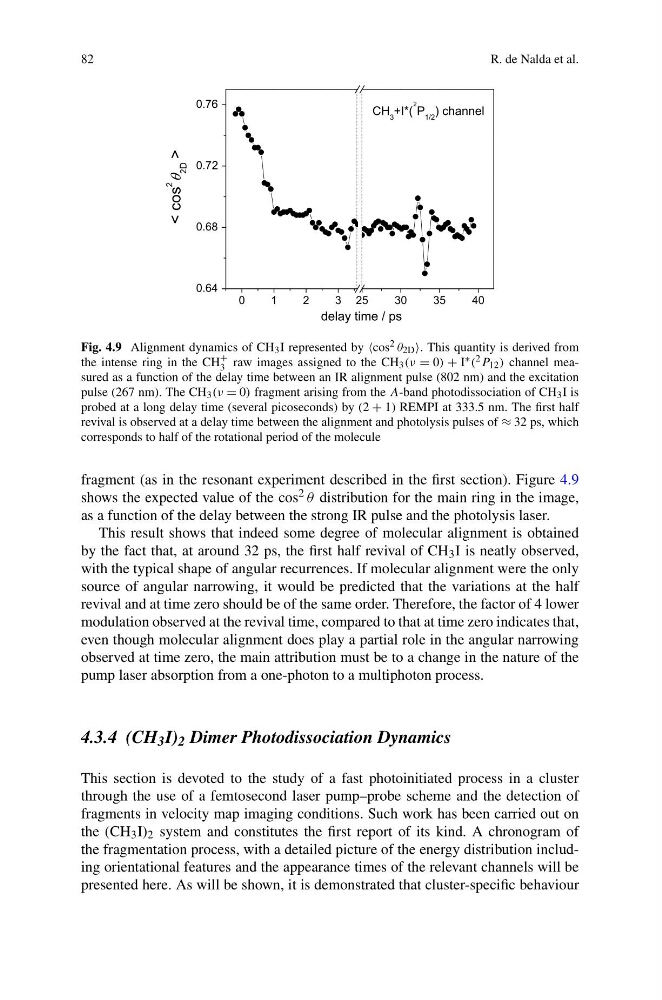
Fig. 4.9 Alignment dynamics of CH 3 I represented by cos 2 θ 2D . This quantity is derived from
the intense ring in the CH
+
3 raw images assigned to the CH 3 (ν = 0) + I ∗ ( 2 P 12 ) channel measured as a function of the delay time between an IR alignment pulse (802 nm) and the excitation
pulse (267 nm). The CH 3 (ν = 0) fragment arising from the A-band photodissociation of CH 3 I is
probed at a long delay time (several picoseconds) by (2 + 1) REMPI at 333.5 nm. The first half
revival is observed at a delay time between the alignment and photolysis pulses of ≈ 32 ps, which
corresponds to half of the rotational period of the molecule
fragment (as in the resonant experiment described in the first section). Figure 4.9
shows the expected value of the cos 2 θ distribution for the main ring in the image,
as a function of the delay between the strong IR pulse and the photolysis laser.
This result shows that indeed some degree of molecular alignment is obtained
by the fact that, at around 32 ps, the first half revival of CH 3 I is neatly observed,
with the typical shape of angular recurrences. If molecular alignment were the only
source of angular narrowing, it would be predicted that the variations at the half
revival and at time zero should be of the same order. Therefore, the factor of 4 lower
modulation observed at the revival time, compared to that at time zero indicates that,
even though molecular alignment does play a partial role in the angular narrowing
observed at time zero, the main attribution must be to a change in the nature of the
pump laser absorption from a one-photon to a multiphoton process.
4.3.4 (CH 3 I) 2 Dimer Photodissociation Dynamics
This section is devoted to the study of a fast photoinitiated process in a cluster
through the use of a femtosecond laser pump–probe scheme and the detection of
fragments in velocity map imaging conditions. Such work has been carried out on
the (CH 3 I) 2 system and constitutes the first report of its kind. A chronogram of
the fragmentation process, with a detailed picture of the energy distribution including orientational features and the appearance times of the relevant channels will be
presented here. As will be shown, it is demonstrated that cluster-specific behaviour
R. de Nalda et al.
Fig. 4.9 Alignment dynamics of CH 3 I represented by cos 2 θ 2D . This quantity is derived from
the intense ring in the CH
+
3 raw images assigned to the CH 3 (ν = 0) + I ∗ ( 2 P 12 ) channel measured as a function of the delay time between an IR alignment pulse (802 nm) and the excitation
pulse (267 nm). The CH 3 (ν = 0) fragment arising from the A-band photodissociation of CH 3 I is
probed at a long delay time (several picoseconds) by (2 + 1) REMPI at 333.5 nm. The first half
revival is observed at a delay time between the alignment and photolysis pulses of ≈ 32 ps, which
corresponds to half of the rotational period of the molecule
fragment (as in the resonant experiment described in the first section). Figure 4.9
shows the expected value of the cos 2 θ distribution for the main ring in the image,
as a function of the delay between the strong IR pulse and the photolysis laser.
This result shows that indeed some degree of molecular alignment is obtained
by the fact that, at around 32 ps, the first half revival of CH 3 I is neatly observed,
with the typical shape of angular recurrences. If molecular alignment were the only
source of angular narrowing, it would be predicted that the variations at the half
revival and at time zero should be of the same order. Therefore, the factor of 4 lower
modulation observed at the revival time, compared to that at time zero indicates that,
even though molecular alignment does play a partial role in the angular narrowing
observed at time zero, the main attribution must be to a change in the nature of the
pump laser absorption from a one-photon to a multiphoton process.
4.3.4 (CH 3 I) 2 Dimer Photodissociation Dynamics
This section is devoted to the study of a fast photoinitiated process in a cluster
through the use of a femtosecond laser pump–probe scheme and the detection of
fragments in velocity map imaging conditions. Such work has been carried out on
the (CH 3 I) 2 system and constitutes the first report of its kind. A chronogram of
the fragmentation process, with a detailed picture of the energy distribution including orientational features and the appearance times of the relevant channels will be
presented here. As will be shown, it is demonstrated that cluster-specific behaviour