

78
R. de Nalda et al.
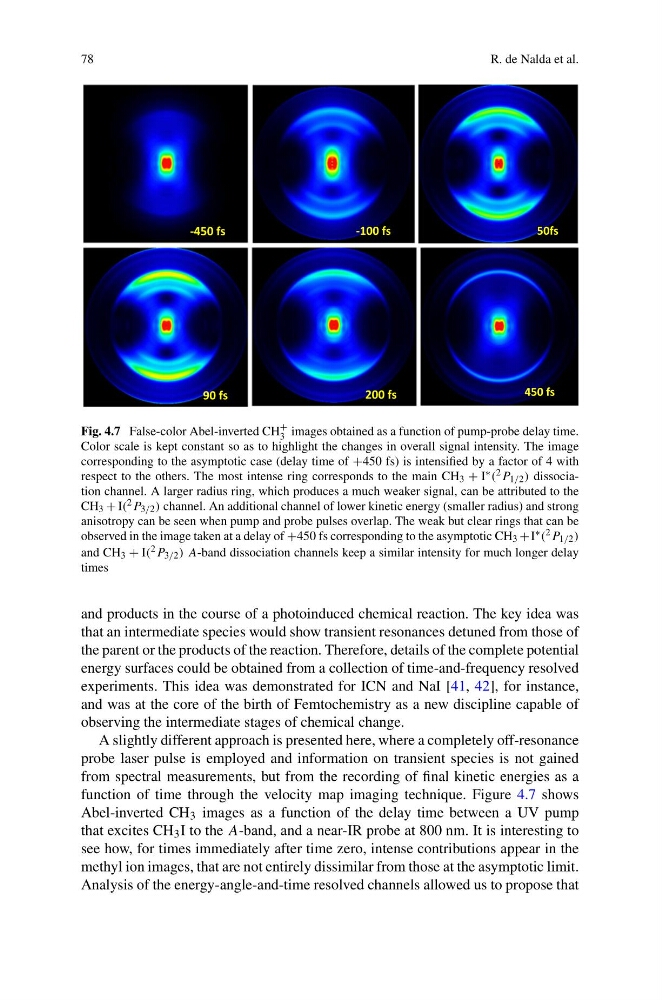
Fig. 4.7 False-color Abel-inverted CH
+
3 images obtained as a function of pump-probe delay time.
Color scale is kept constant so as to highlight the changes in overall signal intensity. The image
corresponding to the asymptotic case (delay time of +450 fs) is intensified by a factor of 4 with
respect to the others. The most intense ring corresponds to the main CH 3 + I ∗ ( 2 P 1/2 ) dissociation channel. A larger radius ring, which produces a much weaker signal, can be attributed to the
CH 3 + I( 2 P 3/2 ) channel. An additional channel of lower kinetic energy (smaller radius) and strong
anisotropy can be seen when pump and probe pulses overlap. The weak but clear rings that can be
observed in the image taken at a delay of +450 fs corresponding to the asymptotic CH 3 + I ∗ ( 2 P 1/2 )
and CH 3 + I( 2 P 3/2 ) A-band dissociation channels keep a similar intensity for much longer delay
times
and products in the course of a photoinduced chemical reaction. The key idea was
that an intermediate species would show transient resonances detuned from those of
the parent or the products of the reaction. Therefore, details of the complete potential
energy surfaces could be obtained from a collection of time-and-frequency resolved
experiments. This idea was demonstrated for ICN and NaI [41, 42], for instance,
and was at the core of the birth of Femtochemistry as a new discipline capable of
observing the intermediate stages of chemical change.
A slightly different approach is presented here, where a completely off-resonance
probe laser pulse is employed and information on transient species is not gained
from spectral measurements, but from the recording of final kinetic energies as a
function of time through the velocity map imaging technique. Figure 4.7 shows
Abel-inverted CH 3 images as a function of the delay time between a UV pump
that excites CH 3 I to the A-band, and a near-IR probe at 800 nm. It is interesting to
see how, for times immediately after time zero, intense contributions appear in the
methyl ion images, that are not entirely dissimilar from those at the asymptotic limit.
Analysis of the energy-angle-and-time resolved channels allowed us to propose that
R. de Nalda et al.
Fig. 4.7 False-color Abel-inverted CH
+
3 images obtained as a function of pump-probe delay time.
Color scale is kept constant so as to highlight the changes in overall signal intensity. The image
corresponding to the asymptotic case (delay time of +450 fs) is intensified by a factor of 4 with
respect to the others. The most intense ring corresponds to the main CH 3 + I ∗ ( 2 P 1/2 ) dissociation channel. A larger radius ring, which produces a much weaker signal, can be attributed to the
CH 3 + I( 2 P 3/2 ) channel. An additional channel of lower kinetic energy (smaller radius) and strong
anisotropy can be seen when pump and probe pulses overlap. The weak but clear rings that can be
observed in the image taken at a delay of +450 fs corresponding to the asymptotic CH 3 + I ∗ ( 2 P 1/2 )
and CH 3 + I( 2 P 3/2 ) A-band dissociation channels keep a similar intensity for much longer delay
times
and products in the course of a photoinduced chemical reaction. The key idea was
that an intermediate species would show transient resonances detuned from those of
the parent or the products of the reaction. Therefore, details of the complete potential
energy surfaces could be obtained from a collection of time-and-frequency resolved
experiments. This idea was demonstrated for ICN and NaI [41, 42], for instance,
and was at the core of the birth of Femtochemistry as a new discipline capable of
observing the intermediate stages of chemical change.
A slightly different approach is presented here, where a completely off-resonance
probe laser pulse is employed and information on transient species is not gained
from spectral measurements, but from the recording of final kinetic energies as a
function of time through the velocity map imaging technique. Figure 4.7 shows
Abel-inverted CH 3 images as a function of the delay time between a UV pump
that excites CH 3 I to the A-band, and a near-IR probe at 800 nm. It is interesting to
see how, for times immediately after time zero, intense contributions appear in the
methyl ion images, that are not entirely dissimilar from those at the asymptotic limit.
Analysis of the energy-angle-and-time resolved channels allowed us to propose that