

4 Femtosecond Photodissociation Dynamics by Velocity Map Imaging
75
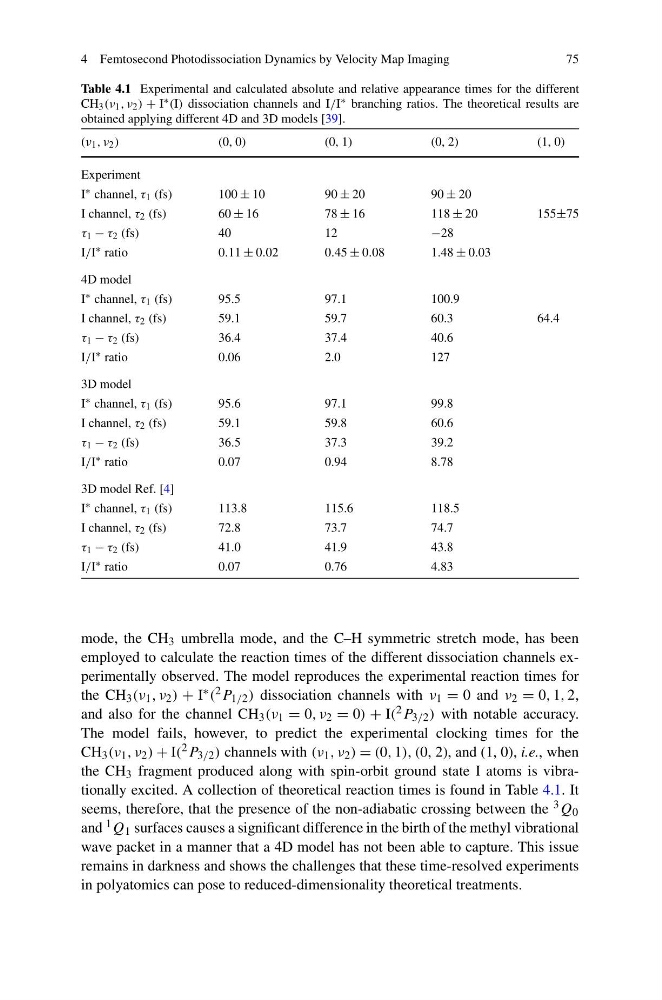
Table 4.1 Experimental and calculated absolute and relative appearance times for the different
CH 3 (ν 1 , ν 2 ) + I ∗ (I) dissociation channels and I/I ∗ branching ratios. The theoretical results are
obtained applying different 4D and 3D models [39].
(ν 1 , ν 2 )
(0, 0)
(0, 1)
(0, 2)
(1, 0)
Experiment
I ∗ channel, τ 1 (fs)
100 ± 10
90 ± 20
90 ± 20
I channel, τ 2 (fs)
60 ± 16
78 ± 16
118 ± 20
155±75
τ 1 − τ 2 (fs)
40
12
−28
I/I ∗ ratio
0.11 ± 0.02
0.45 ± 0.08
1.48 ± 0.03
4D model
I ∗ channel, τ 1 (fs)
95.5
97.1
100.9
I channel, τ 2 (fs)
59.1
59.7
60.3
64.4
τ 1 − τ 2 (fs)
36.4
37.4
40.6
I/I ∗ ratio
0.06
2.0
127
3D model
I ∗ channel, τ 1 (fs)
95.6
97.1
99.8
I channel, τ 2 (fs)
59.1
59.8
60.6
τ 1 − τ 2 (fs)
36.5
37.3
39.2
I/I ∗ ratio
0.07
0.94
8.78
3D model Ref. [4]
I ∗ channel, τ 1 (fs)
113.8
115.6
118.5
I channel, τ 2 (fs)
72.8
73.7
74.7
τ 1 − τ 2 (fs)
41.0
41.9
43.8
I/I ∗ ratio
0.07
0.76
4.83
mode, the CH 3 umbrella mode, and the C–H symmetric stretch mode, has been
employed to calculate the reaction times of the different dissociation channels experimentally observed. The model reproduces the experimental reaction times for
the CH 3 (ν 1 , ν 2 ) + I ∗ ( 2 P 1/2 ) dissociation channels with ν 1 = 0 and ν 2 = 0, 1, 2,
and also for the channel CH 3 (ν 1 = 0, ν 2 = 0) + I( 2 P 3/2 ) with notable accuracy.
The model fails, however, to predict the experimental clocking times for the
CH 3 (ν 1 , ν 2 ) + I( 2 P 3/2 ) channels with (ν 1 , ν 2 ) = (0, 1), (0, 2), and (1, 0), i.e., when
the CH 3 fragment produced along with spin-orbit ground state I atoms is vibrationally excited. A collection of theoretical reaction times is found in Table 4.1. It
seems, therefore, that the presence of the non-adiabatic crossing between the 3 Q 0
and 1 Q 1 surfaces causes a significant difference in the birth of the methyl vibrational
wave packet in a manner that a 4D model has not been able to capture. This issue
remains in darkness and shows the challenges that these time-resolved experiments
in polyatomics can pose to reduced-dimensionality theoretical treatments.
75
Table 4.1 Experimental and calculated absolute and relative appearance times for the different
CH 3 (ν 1 , ν 2 ) + I ∗ (I) dissociation channels and I/I ∗ branching ratios. The theoretical results are
obtained applying different 4D and 3D models [39].
(ν 1 , ν 2 )
(0, 0)
(0, 1)
(0, 2)
(1, 0)
Experiment
I ∗ channel, τ 1 (fs)
100 ± 10
90 ± 20
90 ± 20
I channel, τ 2 (fs)
60 ± 16
78 ± 16
118 ± 20
155±75
τ 1 − τ 2 (fs)
40
12
−28
I/I ∗ ratio
0.11 ± 0.02
0.45 ± 0.08
1.48 ± 0.03
4D model
I ∗ channel, τ 1 (fs)
95.5
97.1
100.9
I channel, τ 2 (fs)
59.1
59.7
60.3
64.4
τ 1 − τ 2 (fs)
36.4
37.4
40.6
I/I ∗ ratio
0.06
2.0
127
3D model
I ∗ channel, τ 1 (fs)
95.6
97.1
99.8
I channel, τ 2 (fs)
59.1
59.8
60.6
τ 1 − τ 2 (fs)
36.5
37.3
39.2
I/I ∗ ratio
0.07
0.94
8.78
3D model Ref. [4]
I ∗ channel, τ 1 (fs)
113.8
115.6
118.5
I channel, τ 2 (fs)
72.8
73.7
74.7
τ 1 − τ 2 (fs)
41.0
41.9
43.8
I/I ∗ ratio
0.07
0.76
4.83
mode, the CH 3 umbrella mode, and the C–H symmetric stretch mode, has been
employed to calculate the reaction times of the different dissociation channels experimentally observed. The model reproduces the experimental reaction times for
the CH 3 (ν 1 , ν 2 ) + I ∗ ( 2 P 1/2 ) dissociation channels with ν 1 = 0 and ν 2 = 0, 1, 2,
and also for the channel CH 3 (ν 1 = 0, ν 2 = 0) + I( 2 P 3/2 ) with notable accuracy.
The model fails, however, to predict the experimental clocking times for the
CH 3 (ν 1 , ν 2 ) + I( 2 P 3/2 ) channels with (ν 1 , ν 2 ) = (0, 1), (0, 2), and (1, 0), i.e., when
the CH 3 fragment produced along with spin-orbit ground state I atoms is vibrationally excited. A collection of theoretical reaction times is found in Table 4.1. It
seems, therefore, that the presence of the non-adiabatic crossing between the 3 Q 0
and 1 Q 1 surfaces causes a significant difference in the birth of the methyl vibrational
wave packet in a manner that a 4D model has not been able to capture. This issue
remains in darkness and shows the challenges that these time-resolved experiments
in polyatomics can pose to reduced-dimensionality theoretical treatments.