

4 Femtosecond Photodissociation Dynamics by Velocity Map Imaging
63
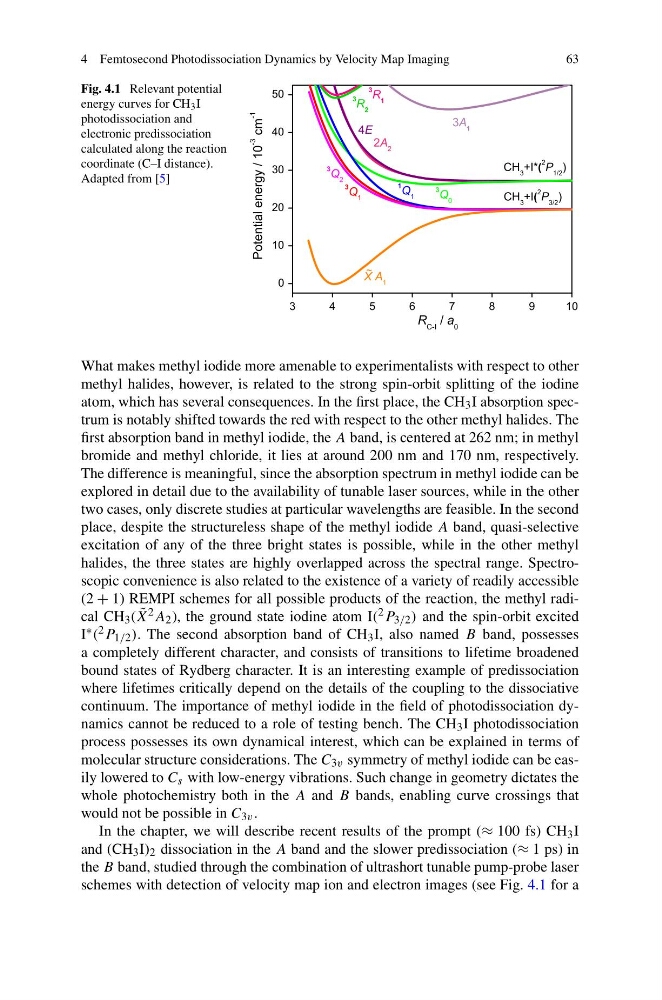
Fig. 4.1 Relevant potential
energy curves for CH 3 I
photodissociation and
electronic predissociation
calculated along the reaction
coordinate (C–I distance).
Adapted from [5]
What makes methyl iodide more amenable to experimentalists with respect to other
methyl halides, however, is related to the strong spin-orbit splitting of the iodine
atom, which has several consequences. In the first place, the CH 3 I absorption spectrum is notably shifted towards the red with respect to the other methyl halides. The
first absorption band in methyl iodide, the A band, is centered at 262 nm; in methyl
bromide and methyl chloride, it lies at around 200 nm and 170 nm, respectively.
The difference is meaningful, since the absorption spectrum in methyl iodide can be
explored in detail due to the availability of tunable laser sources, while in the other
two cases, only discrete studies at particular wavelengths are feasible. In the second
place, despite the structureless shape of the methyl iodide A band, quasi-selective
excitation of any of the three bright states is possible, while in the other methyl
halides, the three states are highly overlapped across the spectral range. Spectroscopic convenience is also related to the existence of a variety of readily accessible
(2 + 1) REMPI schemes for all possible products of the reaction, the methyl radical CH 3 ( ˜
X 2 A 2 ), the ground state iodine atom I( 2 P 3/2 ) and the spin-orbit excited
I ∗ ( 2 P 1/2 ). The second absorption band of CH 3 I, also named B band, possesses
a completely different character, and consists of transitions to lifetime broadened
bound states of Rydberg character. It is an interesting example of predissociation
where lifetimes critically depend on the details of the coupling to the dissociative
continuum. The importance of methyl iodide in the field of photodissociation dynamics cannot be reduced to a role of testing bench. The CH 3 I photodissociation
process possesses its own dynamical interest, which can be explained in terms of
molecular structure considerations. The C 3v symmetry of methyl iodide can be easily lowered to C s with low-energy vibrations. Such change in geometry dictates the
whole photochemistry both in the A and B bands, enabling curve crossings that
would not be possible in C 3v .
In the chapter, we will describe recent results of the prompt (≈ 100 fs) CH 3 I
and (CH 3 I) 2 dissociation in the A band and the slower predissociation (≈ 1 ps) in
the B band, studied through the combination of ultrashort tunable pump-probe laser
schemes with detection of velocity map ion and electron images (see Fig. 4.1 for a
63
Fig. 4.1 Relevant potential
energy curves for CH 3 I
photodissociation and
electronic predissociation
calculated along the reaction
coordinate (C–I distance).
Adapted from [5]
What makes methyl iodide more amenable to experimentalists with respect to other
methyl halides, however, is related to the strong spin-orbit splitting of the iodine
atom, which has several consequences. In the first place, the CH 3 I absorption spectrum is notably shifted towards the red with respect to the other methyl halides. The
first absorption band in methyl iodide, the A band, is centered at 262 nm; in methyl
bromide and methyl chloride, it lies at around 200 nm and 170 nm, respectively.
The difference is meaningful, since the absorption spectrum in methyl iodide can be
explored in detail due to the availability of tunable laser sources, while in the other
two cases, only discrete studies at particular wavelengths are feasible. In the second
place, despite the structureless shape of the methyl iodide A band, quasi-selective
excitation of any of the three bright states is possible, while in the other methyl
halides, the three states are highly overlapped across the spectral range. Spectroscopic convenience is also related to the existence of a variety of readily accessible
(2 + 1) REMPI schemes for all possible products of the reaction, the methyl radical CH 3 ( ˜
X 2 A 2 ), the ground state iodine atom I( 2 P 3/2 ) and the spin-orbit excited
I ∗ ( 2 P 1/2 ). The second absorption band of CH 3 I, also named B band, possesses
a completely different character, and consists of transitions to lifetime broadened
bound states of Rydberg character. It is an interesting example of predissociation
where lifetimes critically depend on the details of the coupling to the dissociative
continuum. The importance of methyl iodide in the field of photodissociation dynamics cannot be reduced to a role of testing bench. The CH 3 I photodissociation
process possesses its own dynamical interest, which can be explained in terms of
molecular structure considerations. The C 3v symmetry of methyl iodide can be easily lowered to C s with low-energy vibrations. Such change in geometry dictates the
whole photochemistry both in the A and B bands, enabling curve crossings that
would not be possible in C 3v .
In the chapter, we will describe recent results of the prompt (≈ 100 fs) CH 3 I
and (CH 3 I) 2 dissociation in the A band and the slower predissociation (≈ 1 ps) in
the B band, studied through the combination of ultrashort tunable pump-probe laser
schemes with detection of velocity map ion and electron images (see Fig. 4.1 for a