

3 Ultrafast Dynamics of Hydrogen Atoms in Hydrocarbon Molecules
51
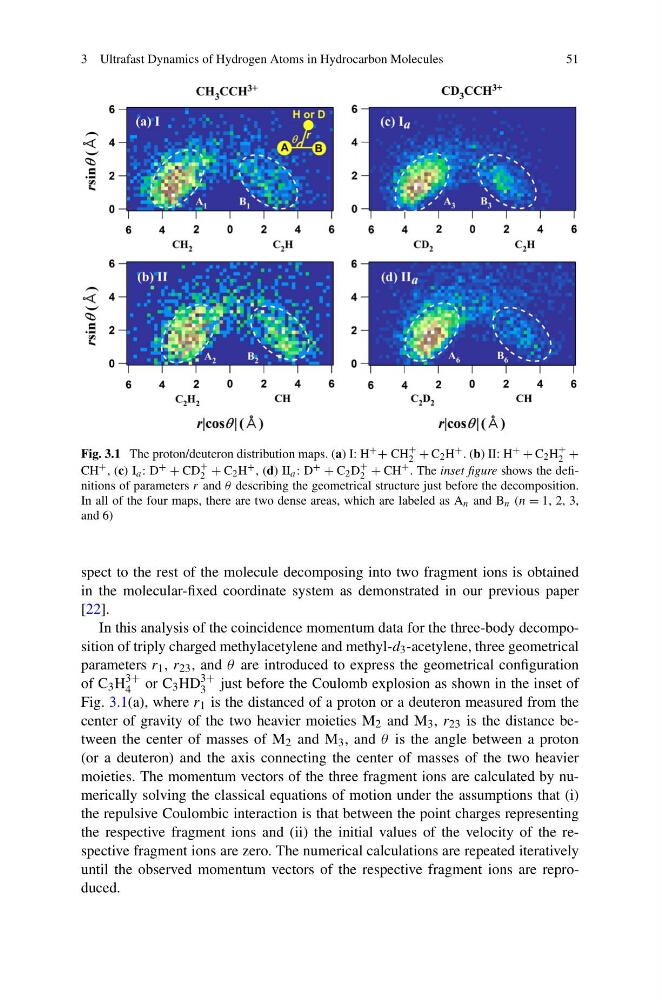
Fig. 3.1 The proton/deuteron distribution maps. (a) I: H + + CH
+
2 + C 2 H + . (b) II: H + + C 2 H
+
2 +
CH
+ , (c) I a : D + + CD
+
2 + C 2 H + , (d) II a : D + + C 2 D
+
2 + CH
+ . The inset figure shows the definitions of parameters r and θ describing the geometrical structure just before the decomposition.
In all of the four maps, there are two dense areas, which are labeled as A n and B n (n = 1, 2, 3,
and 6)
spect to the rest of the molecule decomposing into two fragment ions is obtained
in the molecular-fixed coordinate system as demonstrated in our previous paper
[22].
In this analysis of the coincidence momentum data for the three-body decomposition of triply charged methylacetylene and methyl-d 3 -acetylene, three geometrical
parameters r 1 , r 23 , and θ are introduced to express the geometrical configuration
of C 3 H
3+
4 or C 3 HD
3+
3 just before the Coulomb explosion as shown in the inset of
Fig. 3.1(a), where r 1 is the distanced of a proton or a deuteron measured from the
center of gravity of the two heavier moieties M 2 and M 3 , r 23 is the distance between the center of masses of M 2 and M 3 , and θ is the angle between a proton
(or a deuteron) and the axis connecting the center of masses of the two heavier
moieties. The momentum vectors of the three fragment ions are calculated by numerically solving the classical equations of motion under the assumptions that (i)
the repulsive Coulombic interaction is that between the point charges representing
the respective fragment ions and (ii) the initial values of the velocity of the respective fragment ions are zero. The numerical calculations are repeated iteratively
until the observed momentum vectors of the respective fragment ions are reproduced.
51
Fig. 3.1 The proton/deuteron distribution maps. (a) I: H + + CH
+
2 + C 2 H + . (b) II: H + + C 2 H
+
2 +
CH
+ , (c) I a : D + + CD
+
2 + C 2 H + , (d) II a : D + + C 2 D
+
2 + CH
+ . The inset figure shows the definitions of parameters r and θ describing the geometrical structure just before the decomposition.
In all of the four maps, there are two dense areas, which are labeled as A n and B n (n = 1, 2, 3,
and 6)
spect to the rest of the molecule decomposing into two fragment ions is obtained
in the molecular-fixed coordinate system as demonstrated in our previous paper
[22].
In this analysis of the coincidence momentum data for the three-body decomposition of triply charged methylacetylene and methyl-d 3 -acetylene, three geometrical
parameters r 1 , r 23 , and θ are introduced to express the geometrical configuration
of C 3 H
3+
4 or C 3 HD
3+
3 just before the Coulomb explosion as shown in the inset of
Fig. 3.1(a), where r 1 is the distanced of a proton or a deuteron measured from the
center of gravity of the two heavier moieties M 2 and M 3 , r 23 is the distance between the center of masses of M 2 and M 3 , and θ is the angle between a proton
(or a deuteron) and the axis connecting the center of masses of the two heavier
moieties. The momentum vectors of the three fragment ions are calculated by numerically solving the classical equations of motion under the assumptions that (i)
the repulsive Coulombic interaction is that between the point charges representing
the respective fragment ions and (ii) the initial values of the velocity of the respective fragment ions are zero. The numerical calculations are repeated iteratively
until the observed momentum vectors of the respective fragment ions are reproduced.