

16
A. Rouzée et al.
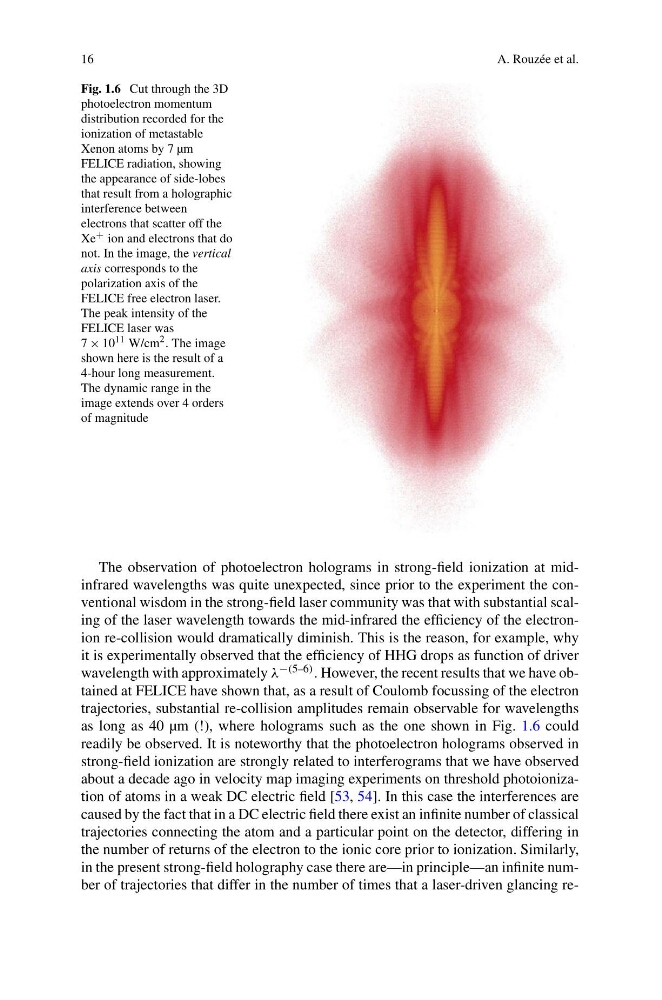
Fig. 1.6 Cut through the 3D
photoelectron momentum
distribution recorded for the
ionization of metastable
Xenon atoms by 7 µm
FELICE radiation, showing
the appearance of side-lobes
that result from a holographic
interference between
electrons that scatter off the
Xe + ion and electrons that do
not. In the image, the vertical
axis corresponds to the
polarization axis of the
FELICE free electron laser.
The peak intensity of the
FELICE laser was
7 × 10 11 W/cm
2 . The image
shown here is the result of a
4-hour long measurement.
The dynamic range in the
image extends over 4 orders
of magnitude
The observation of photoelectron holograms in strong-field ionization at midinfrared wavelengths was quite unexpected, since prior to the experiment the conventional wisdom in the strong-field laser community was that with substantial scaling of the laser wavelength towards the mid-infrared the efficiency of the electronion re-collision would dramatically diminish. This is the reason, for example, why
it is experimentally observed that the efficiency of HHG drops as function of driver
wavelength with approximately λ −(5–6) . However, the recent results that we have obtained at FELICE have shown that, as a result of Coulomb focussing of the electron
trajectories, substantial re-collision amplitudes remain observable for wavelengths
as long as 40 µm (!), where holograms such as the one shown in Fig. 1.6 could
readily be observed. It is noteworthy that the photoelectron holograms observed in
strong-field ionization are strongly related to interferograms that we have observed
about a decade ago in velocity map imaging experiments on threshold photoionization of atoms in a weak DC electric field [53, 54]. In this case the interferences are
caused by the fact that in a DC electric field there exist an infinite number of classical
trajectories connecting the atom and a particular point on the detector, differing in
the number of returns of the electron to the ionic core prior to ionization. Similarly,
in the present strong-field holography case there are—in principle—an infinite number of trajectories that differ in the number of times that a laser-driven glancing re-
A. Rouzée et al.
Fig. 1.6 Cut through the 3D
photoelectron momentum
distribution recorded for the
ionization of metastable
Xenon atoms by 7 µm
FELICE radiation, showing
the appearance of side-lobes
that result from a holographic
interference between
electrons that scatter off the
Xe + ion and electrons that do
not. In the image, the vertical
axis corresponds to the
polarization axis of the
FELICE free electron laser.
The peak intensity of the
FELICE laser was
7 × 10 11 W/cm
2 . The image
shown here is the result of a
4-hour long measurement.
The dynamic range in the
image extends over 4 orders
of magnitude
The observation of photoelectron holograms in strong-field ionization at midinfrared wavelengths was quite unexpected, since prior to the experiment the conventional wisdom in the strong-field laser community was that with substantial scaling of the laser wavelength towards the mid-infrared the efficiency of the electronion re-collision would dramatically diminish. This is the reason, for example, why
it is experimentally observed that the efficiency of HHG drops as function of driver
wavelength with approximately λ −(5–6) . However, the recent results that we have obtained at FELICE have shown that, as a result of Coulomb focussing of the electron
trajectories, substantial re-collision amplitudes remain observable for wavelengths
as long as 40 µm (!), where holograms such as the one shown in Fig. 1.6 could
readily be observed. It is noteworthy that the photoelectron holograms observed in
strong-field ionization are strongly related to interferograms that we have observed
about a decade ago in velocity map imaging experiments on threshold photoionization of atoms in a weak DC electric field [53, 54]. In this case the interferences are
caused by the fact that in a DC electric field there exist an infinite number of classical
trajectories connecting the atom and a particular point on the detector, differing in
the number of returns of the electron to the ionic core prior to ionization. Similarly,
in the present strong-field holography case there are—in principle—an infinite number of trajectories that differ in the number of times that a laser-driven glancing re-