

11 Optical Diagnostics with Ultrafast and Strong Field Raman Techniques
265
11.2 Optical Diagnostic by Means of Femtosecond Spectroscopy
11.2.1 Temperature and Concentration Measurement in Gas
Mixtures Using Rotational Coherence Spectroscopy
Techniques
11.2.1.1 Raman Induced Polarization Spectroscopy (RIPS)
Principles In a RIPS experiment, the principle of the measurement relies on the
observation of the depolarization experienced by a weak probe pulse, due to the
birefringence resulting from the alignment rephasing of the molecules induced by
the pump pulse. In a homodyne detection scheme, the detected RIPS signal is given
by [1, 2]
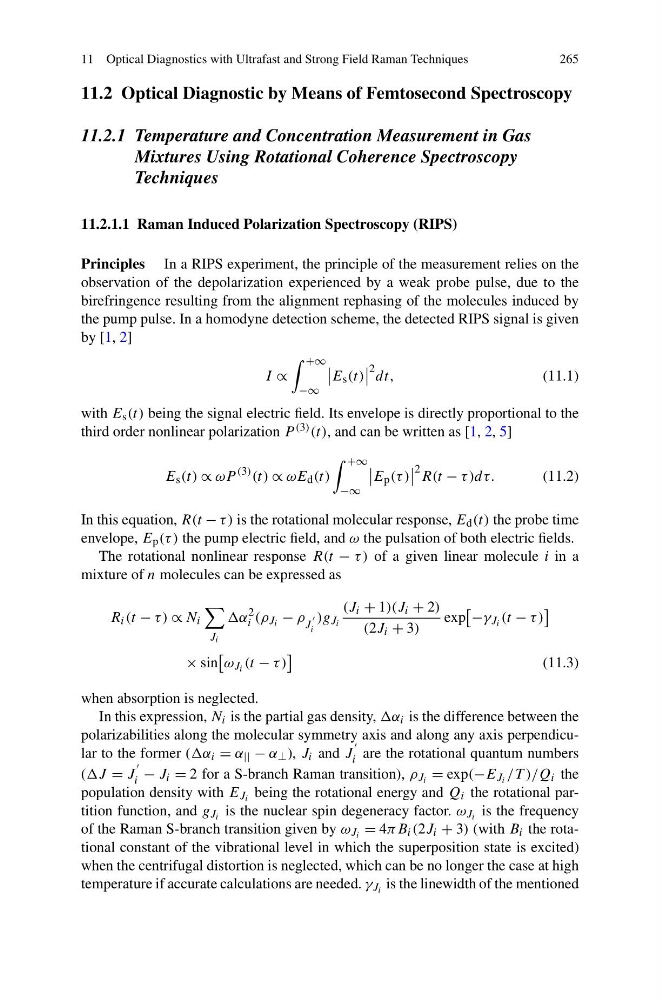
I ∝
+∞
−∞
E s (t)
2 dt,
(11.1)
with E s (t) being the signal electric field. Its envelope is directly proportional to the
third order nonlinear polarization P (3) (t), and can be written as [1, 2, 5]
E s (t) ∝ ωP
(3) (t) ∝ ωE d (t)
+∞
−∞
E p (τ )
2 R(t − τ )dτ.
(11.2)
In this equation, R(t − τ ) is the rotational molecular response, E d (t) the probe time
envelope, E p (τ ) the pump electric field, and ω the pulsation of both electric fields.
The rotational nonlinear response R(t − τ ) of a given linear molecule i in a
mixture of n molecules can be expressed as
R i (t − τ ) ∝ N i
J i
α
2
i (ρ J i − ρ J
i
)g J i
(J i + 1)(J i + 2)
(2J i + 3)
exp
−γ J i (t − τ )
× sin
ω J i (t − τ )
(11.3)
when absorption is neglected.
In this expression, N i is the partial gas density, α i is the difference between the
polarizabilities along the molecular symmetry axis and along any axis perpendicular to the former (α i = α || − α ⊥ ), J i and J
i are the rotational quantum numbers
(J = J
i − J i = 2 for a S-branch Raman transition), ρ J i = exp(−E J i /T )/Q i the
population density with E J i being the rotational energy and Q i the rotational partition function, and g J i is the nuclear spin degeneracy factor. ω J i is the frequency
of the Raman S-branch transition given by ω J i = 4πB i (2J i + 3) (with B i the rotational constant of the vibrational level in which the superposition state is excited)
when the centrifugal distortion is neglected, which can be no longer the case at high
temperature if accurate calculations are needed. γ J i is the linewidth of the mentioned
265
11.2 Optical Diagnostic by Means of Femtosecond Spectroscopy
11.2.1 Temperature and Concentration Measurement in Gas
Mixtures Using Rotational Coherence Spectroscopy
Techniques
11.2.1.1 Raman Induced Polarization Spectroscopy (RIPS)
Principles In a RIPS experiment, the principle of the measurement relies on the
observation of the depolarization experienced by a weak probe pulse, due to the
birefringence resulting from the alignment rephasing of the molecules induced by
the pump pulse. In a homodyne detection scheme, the detected RIPS signal is given
by [1, 2]
I ∝
+∞
−∞
E s (t)
2 dt,
(11.1)
with E s (t) being the signal electric field. Its envelope is directly proportional to the
third order nonlinear polarization P (3) (t), and can be written as [1, 2, 5]
E s (t) ∝ ωP
(3) (t) ∝ ωE d (t)
+∞
−∞
E p (τ )
2 R(t − τ )dτ.
(11.2)
In this equation, R(t − τ ) is the rotational molecular response, E d (t) the probe time
envelope, E p (τ ) the pump electric field, and ω the pulsation of both electric fields.
The rotational nonlinear response R(t − τ ) of a given linear molecule i in a
mixture of n molecules can be expressed as
R i (t − τ ) ∝ N i
J i
α
2
i (ρ J i − ρ J
i
)g J i
(J i + 1)(J i + 2)
(2J i + 3)
exp
−γ J i (t − τ )
× sin
ω J i (t − τ )
(11.3)
when absorption is neglected.
In this expression, N i is the partial gas density, α i is the difference between the
polarizabilities along the molecular symmetry axis and along any axis perpendicular to the former (α i = α || − α ⊥ ), J i and J
i are the rotational quantum numbers
(J = J
i − J i = 2 for a S-branch Raman transition), ρ J i = exp(−E J i /T )/Q i the
population density with E J i being the rotational energy and Q i the rotational partition function, and g J i is the nuclear spin degeneracy factor. ω J i is the frequency
of the Raman S-branch transition given by ω J i = 4πB i (2J i + 3) (with B i the rotational constant of the vibrational level in which the superposition state is excited)
when the centrifugal distortion is neglected, which can be no longer the case at high
temperature if accurate calculations are needed. γ J i is the linewidth of the mentioned