

10 Surface-Aligned Femtochemistry: Dynamics on Oxide Surfaces
237
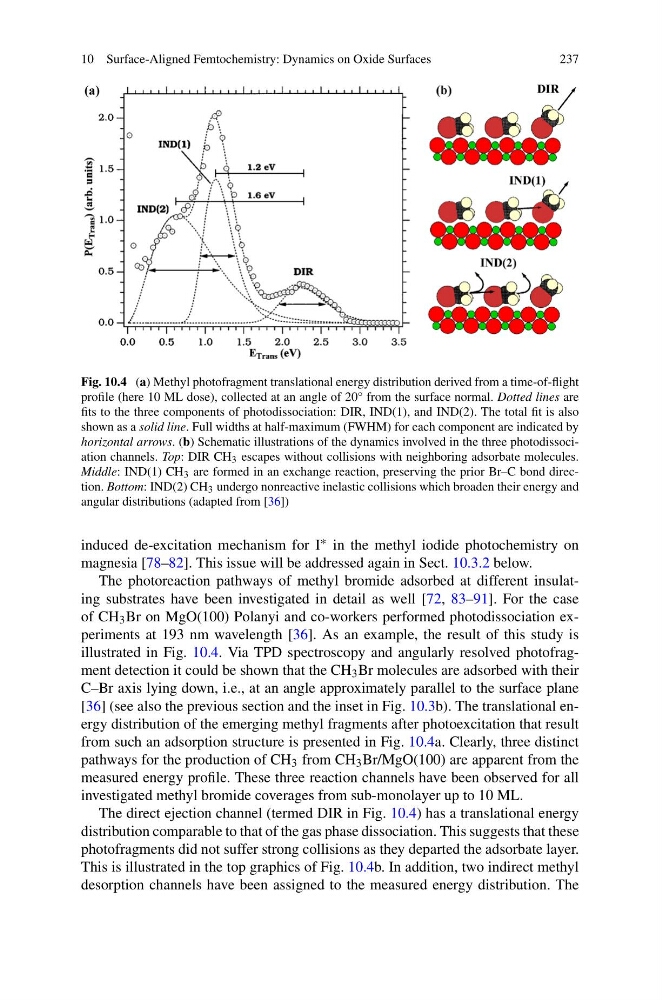
Fig. 10.4 (a) Methyl photofragment translational energy distribution derived from a time-of-flight
profile (here 10 ML dose), collected at an angle of 20° from the surface normal. Dotted lines are
fits to the three components of photodissociation: DIR, IND(1), and IND(2). The total fit is also
shown as a solid line. Full widths at half-maximum (FWHM) for each component are indicated by
horizontal arrows. (b) Schematic illustrations of the dynamics involved in the three photodissociation channels. Top: DIR CH 3 escapes without collisions with neighboring adsorbate molecules.
Middle: IND(1) CH 3 are formed in an exchange reaction, preserving the prior Br–C bond direction. Bottom: IND(2) CH 3 undergo nonreactive inelastic collisions which broaden their energy and
angular distributions (adapted from [36])
induced de-excitation mechanism for I ∗ in the methyl iodide photochemistry on
magnesia [78–82]. This issue will be addressed again in Sect. 10.3.2 below.
The photoreaction pathways of methyl bromide adsorbed at different insulating substrates have been investigated in detail as well [72, 83–91]. For the case
of CH 3 Br on MgO(100) Polanyi and co-workers performed photodissociation experiments at 193 nm wavelength [36]. As an example, the result of this study is
illustrated in Fig. 10.4. Via TPD spectroscopy and angularly resolved photofragment detection it could be shown that the CH 3 Br molecules are adsorbed with their
C–Br axis lying down, i.e., at an angle approximately parallel to the surface plane
[36] (see also the previous section and the inset in Fig. 10.3b). The translational energy distribution of the emerging methyl fragments after photoexcitation that result
from such an adsorption structure is presented in Fig. 10.4a. Clearly, three distinct
pathways for the production of CH 3 from CH 3 Br/MgO(100) are apparent from the
measured energy profile. These three reaction channels have been observed for all
investigated methyl bromide coverages from sub-monolayer up to 10 ML.
The direct ejection channel (termed DIR in Fig. 10.4) has a translational energy
distribution comparable to that of the gas phase dissociation. This suggests that these
photofragments did not suffer strong collisions as they departed the adsorbate layer.
This is illustrated in the top graphics of Fig. 10.4b. In addition, two indirect methyl
desorption channels have been assigned to the measured energy distribution. The
237
Fig. 10.4 (a) Methyl photofragment translational energy distribution derived from a time-of-flight
profile (here 10 ML dose), collected at an angle of 20° from the surface normal. Dotted lines are
fits to the three components of photodissociation: DIR, IND(1), and IND(2). The total fit is also
shown as a solid line. Full widths at half-maximum (FWHM) for each component are indicated by
horizontal arrows. (b) Schematic illustrations of the dynamics involved in the three photodissociation channels. Top: DIR CH 3 escapes without collisions with neighboring adsorbate molecules.
Middle: IND(1) CH 3 are formed in an exchange reaction, preserving the prior Br–C bond direction. Bottom: IND(2) CH 3 undergo nonreactive inelastic collisions which broaden their energy and
angular distributions (adapted from [36])
induced de-excitation mechanism for I ∗ in the methyl iodide photochemistry on
magnesia [78–82]. This issue will be addressed again in Sect. 10.3.2 below.
The photoreaction pathways of methyl bromide adsorbed at different insulating substrates have been investigated in detail as well [72, 83–91]. For the case
of CH 3 Br on MgO(100) Polanyi and co-workers performed photodissociation experiments at 193 nm wavelength [36]. As an example, the result of this study is
illustrated in Fig. 10.4. Via TPD spectroscopy and angularly resolved photofragment detection it could be shown that the CH 3 Br molecules are adsorbed with their
C–Br axis lying down, i.e., at an angle approximately parallel to the surface plane
[36] (see also the previous section and the inset in Fig. 10.3b). The translational energy distribution of the emerging methyl fragments after photoexcitation that result
from such an adsorption structure is presented in Fig. 10.4a. Clearly, three distinct
pathways for the production of CH 3 from CH 3 Br/MgO(100) are apparent from the
measured energy profile. These three reaction channels have been observed for all
investigated methyl bromide coverages from sub-monolayer up to 10 ML.
The direct ejection channel (termed DIR in Fig. 10.4) has a translational energy
distribution comparable to that of the gas phase dissociation. This suggests that these
photofragments did not suffer strong collisions as they departed the adsorbate layer.
This is illustrated in the top graphics of Fig. 10.4b. In addition, two indirect methyl
desorption channels have been assigned to the measured energy distribution. The