

9 On the Investigation of Excited State Dynamics with (Pump-)Degenerate
217
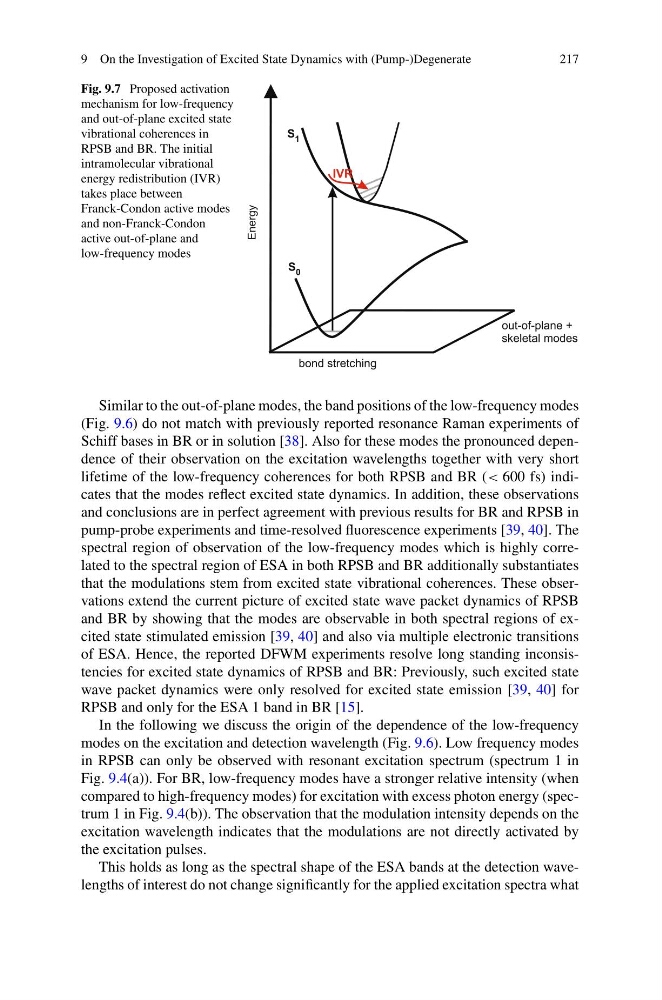
Fig. 9.7 Proposed activation
mechanism for low-frequency
and out-of-plane excited state
vibrational coherences in
RPSB and BR. The initial
intramolecular vibrational
energy redistribution (IVR)
takes place between
Franck-Condon active modes
and non-Franck-Condon
active out-of-plane and
low-frequency modes
Similar to the out-of-plane modes, the band positions of the low-frequency modes
(Fig. 9.6) do not match with previously reported resonance Raman experiments of
Schiff bases in BR or in solution [38]. Also for these modes the pronounced dependence of their observation on the excitation wavelengths together with very short
lifetime of the low-frequency coherences for both RPSB and BR (< 600 fs) indicates that the modes reflect excited state dynamics. In addition, these observations
and conclusions are in perfect agreement with previous results for BR and RPSB in
pump-probe experiments and time-resolved fluorescence experiments [39, 40]. The
spectral region of observation of the low-frequency modes which is highly correlated to the spectral region of ESA in both RPSB and BR additionally substantiates
that the modulations stem from excited state vibrational coherences. These observations extend the current picture of excited state wave packet dynamics of RPSB
and BR by showing that the modes are observable in both spectral regions of excited state stimulated emission [39, 40] and also via multiple electronic transitions
of ESA. Hence, the reported DFWM experiments resolve long standing inconsistencies for excited state dynamics of RPSB and BR: Previously, such excited state
wave packet dynamics were only resolved for excited state emission [39, 40] for
RPSB and only for the ESA 1 band in BR [15].
In the following we discuss the origin of the dependence of the low-frequency
modes on the excitation and detection wavelength (Fig. 9.6). Low frequency modes
in RPSB can only be observed with resonant excitation spectrum (spectrum 1 in
Fig. 9.4(a)). For BR, low-frequency modes have a stronger relative intensity (when
compared to high-frequency modes) for excitation with excess photon energy (spectrum 1 in Fig. 9.4(b)). The observation that the modulation intensity depends on the
excitation wavelength indicates that the modulations are not directly activated by
the excitation pulses.
This holds as long as the spectral shape of the ESA bands at the detection wavelengths of interest do not change significantly for the applied excitation spectra what
217
Fig. 9.7 Proposed activation
mechanism for low-frequency
and out-of-plane excited state
vibrational coherences in
RPSB and BR. The initial
intramolecular vibrational
energy redistribution (IVR)
takes place between
Franck-Condon active modes
and non-Franck-Condon
active out-of-plane and
low-frequency modes
Similar to the out-of-plane modes, the band positions of the low-frequency modes
(Fig. 9.6) do not match with previously reported resonance Raman experiments of
Schiff bases in BR or in solution [38]. Also for these modes the pronounced dependence of their observation on the excitation wavelengths together with very short
lifetime of the low-frequency coherences for both RPSB and BR (< 600 fs) indicates that the modes reflect excited state dynamics. In addition, these observations
and conclusions are in perfect agreement with previous results for BR and RPSB in
pump-probe experiments and time-resolved fluorescence experiments [39, 40]. The
spectral region of observation of the low-frequency modes which is highly correlated to the spectral region of ESA in both RPSB and BR additionally substantiates
that the modulations stem from excited state vibrational coherences. These observations extend the current picture of excited state wave packet dynamics of RPSB
and BR by showing that the modes are observable in both spectral regions of excited state stimulated emission [39, 40] and also via multiple electronic transitions
of ESA. Hence, the reported DFWM experiments resolve long standing inconsistencies for excited state dynamics of RPSB and BR: Previously, such excited state
wave packet dynamics were only resolved for excited state emission [39, 40] for
RPSB and only for the ESA 1 band in BR [15].
In the following we discuss the origin of the dependence of the low-frequency
modes on the excitation and detection wavelength (Fig. 9.6). Low frequency modes
in RPSB can only be observed with resonant excitation spectrum (spectrum 1 in
Fig. 9.4(a)). For BR, low-frequency modes have a stronger relative intensity (when
compared to high-frequency modes) for excitation with excess photon energy (spectrum 1 in Fig. 9.4(b)). The observation that the modulation intensity depends on the
excitation wavelength indicates that the modulations are not directly activated by
the excitation pulses.
This holds as long as the spectral shape of the ESA bands at the detection wavelengths of interest do not change significantly for the applied excitation spectra what