

188
M. Dantus and C.L. Kalcic
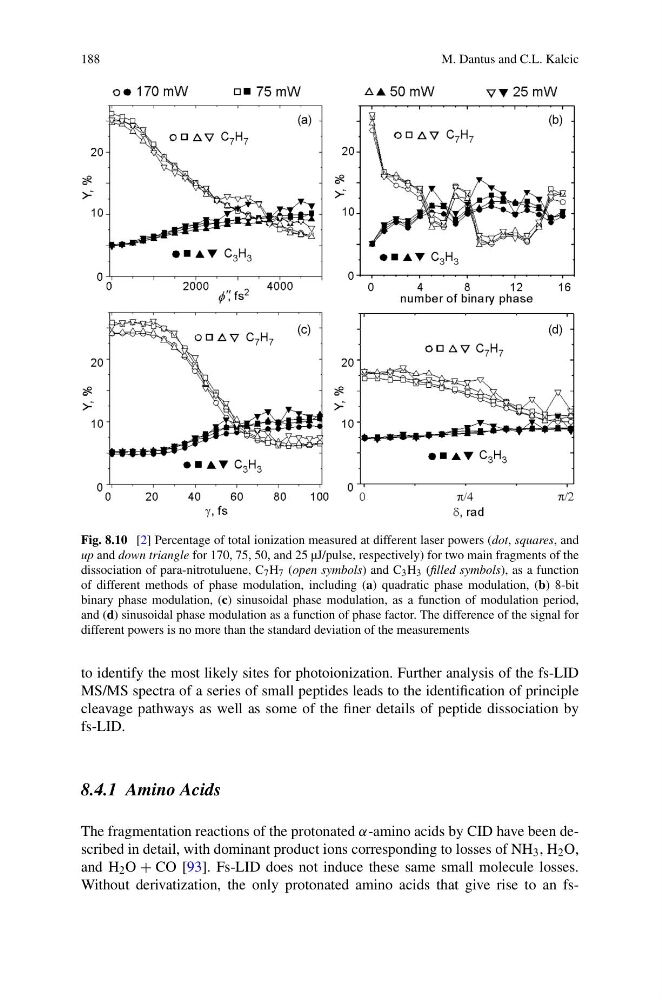
Fig. 8.10 [2] Percentage of total ionization measured at different laser powers (dot, squares, and
up and down triangle for 170, 75, 50, and 25 µJ/pulse, respectively) for two main fragments of the
dissociation of para-nitrotuluene, C 7 H 7 (open symbols) and C 3 H 3 (filled symbols), as a function
of different methods of phase modulation, including (a) quadratic phase modulation, (b) 8-bit
binary phase modulation, (c) sinusoidal phase modulation, as a function of modulation period,
and (d) sinusoidal phase modulation as a function of phase factor. The difference of the signal for
different powers is no more than the standard deviation of the measurements
to identify the most likely sites for photoionization. Further analysis of the fs-LID
MS/MS spectra of a series of small peptides leads to the identification of principle
cleavage pathways as well as some of the finer details of peptide dissociation by
fs-LID.
8.4.1 Amino Acids
The fragmentation reactions of the protonated α-amino acids by CID have been described in detail, with dominant product ions corresponding to losses of NH 3 , H 2 O,
and H 2 O + CO [93]. Fs-LID does not induce these same small molecule losses.
Without derivatization, the only protonated amino acids that give rise to an fs-
M. Dantus and C.L. Kalcic
Fig. 8.10 [2] Percentage of total ionization measured at different laser powers (dot, squares, and
up and down triangle for 170, 75, 50, and 25 µJ/pulse, respectively) for two main fragments of the
dissociation of para-nitrotuluene, C 7 H 7 (open symbols) and C 3 H 3 (filled symbols), as a function
of different methods of phase modulation, including (a) quadratic phase modulation, (b) 8-bit
binary phase modulation, (c) sinusoidal phase modulation, as a function of modulation period,
and (d) sinusoidal phase modulation as a function of phase factor. The difference of the signal for
different powers is no more than the standard deviation of the measurements
to identify the most likely sites for photoionization. Further analysis of the fs-LID
MS/MS spectra of a series of small peptides leads to the identification of principle
cleavage pathways as well as some of the finer details of peptide dissociation by
fs-LID.
8.4.1 Amino Acids
The fragmentation reactions of the protonated α-amino acids by CID have been described in detail, with dominant product ions corresponding to losses of NH 3 , H 2 O,
and H 2 O + CO [93]. Fs-LID does not induce these same small molecule losses.
Without derivatization, the only protonated amino acids that give rise to an fs-