

8 Ultrafast Ionization and Fragmentation: From Small Molecules
181
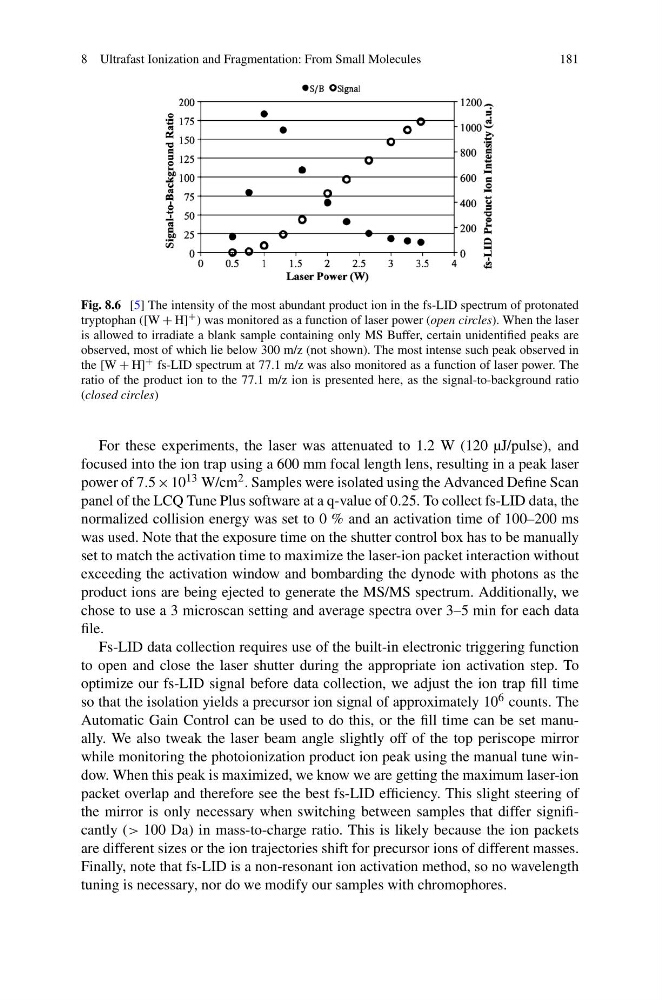
Fig. 8.6 [5] The intensity of the most abundant product ion in the fs-LID spectrum of protonated
tryptophan ([W + H] + ) was monitored as a function of laser power (open circles). When the laser
is allowed to irradiate a blank sample containing only MS Buffer, certain unidentified peaks are
observed, most of which lie below 300 m/z (not shown). The most intense such peak observed in
the [W + H] + fs-LID spectrum at 77.1 m/z was also monitored as a function of laser power. The
ratio of the product ion to the 77.1 m/z ion is presented here, as the signal-to-background ratio
(closed circles)
For these experiments, the laser was attenuated to 1.2 W (120 µJ/pulse), and
focused into the ion trap using a 600 mm focal length lens, resulting in a peak laser
power of 7.5 × 10 13 W/cm 2 . Samples were isolated using the Advanced Define Scan
panel of the LCQ Tune Plus software at a q-value of 0.25. To collect fs-LID data, the
normalized collision energy was set to 0 % and an activation time of 100–200 ms
was used. Note that the exposure time on the shutter control box has to be manually
set to match the activation time to maximize the laser-ion packet interaction without
exceeding the activation window and bombarding the dynode with photons as the
product ions are being ejected to generate the MS/MS spectrum. Additionally, we
chose to use a 3 microscan setting and average spectra over 3–5 min for each data
file.
Fs-LID data collection requires use of the built-in electronic triggering function
to open and close the laser shutter during the appropriate ion activation step. To
optimize our fs-LID signal before data collection, we adjust the ion trap fill time
so that the isolation yields a precursor ion signal of approximately 10 6 counts. The
Automatic Gain Control can be used to do this, or the fill time can be set manually. We also tweak the laser beam angle slightly off of the top periscope mirror
while monitoring the photoionization product ion peak using the manual tune window. When this peak is maximized, we know we are getting the maximum laser-ion
packet overlap and therefore see the best fs-LID efficiency. This slight steering of
the mirror is only necessary when switching between samples that differ significantly (> 100 Da) in mass-to-charge ratio. This is likely because the ion packets
are different sizes or the ion trajectories shift for precursor ions of different masses.
Finally, note that fs-LID is a non-resonant ion activation method, so no wavelength
tuning is necessary, nor do we modify our samples with chromophores.
181
Fig. 8.6 [5] The intensity of the most abundant product ion in the fs-LID spectrum of protonated
tryptophan ([W + H] + ) was monitored as a function of laser power (open circles). When the laser
is allowed to irradiate a blank sample containing only MS Buffer, certain unidentified peaks are
observed, most of which lie below 300 m/z (not shown). The most intense such peak observed in
the [W + H] + fs-LID spectrum at 77.1 m/z was also monitored as a function of laser power. The
ratio of the product ion to the 77.1 m/z ion is presented here, as the signal-to-background ratio
(closed circles)
For these experiments, the laser was attenuated to 1.2 W (120 µJ/pulse), and
focused into the ion trap using a 600 mm focal length lens, resulting in a peak laser
power of 7.5 × 10 13 W/cm 2 . Samples were isolated using the Advanced Define Scan
panel of the LCQ Tune Plus software at a q-value of 0.25. To collect fs-LID data, the
normalized collision energy was set to 0 % and an activation time of 100–200 ms
was used. Note that the exposure time on the shutter control box has to be manually
set to match the activation time to maximize the laser-ion packet interaction without
exceeding the activation window and bombarding the dynode with photons as the
product ions are being ejected to generate the MS/MS spectrum. Additionally, we
chose to use a 3 microscan setting and average spectra over 3–5 min for each data
file.
Fs-LID data collection requires use of the built-in electronic triggering function
to open and close the laser shutter during the appropriate ion activation step. To
optimize our fs-LID signal before data collection, we adjust the ion trap fill time
so that the isolation yields a precursor ion signal of approximately 10 6 counts. The
Automatic Gain Control can be used to do this, or the fill time can be set manually. We also tweak the laser beam angle slightly off of the top periscope mirror
while monitoring the photoionization product ion peak using the manual tune window. When this peak is maximized, we know we are getting the maximum laser-ion
packet overlap and therefore see the best fs-LID efficiency. This slight steering of
the mirror is only necessary when switching between samples that differ significantly (> 100 Da) in mass-to-charge ratio. This is likely because the ion packets
are different sizes or the ion trajectories shift for precursor ions of different masses.
Finally, note that fs-LID is a non-resonant ion activation method, so no wavelength
tuning is necessary, nor do we modify our samples with chromophores.