

102
R. Spesyvtsev et al.
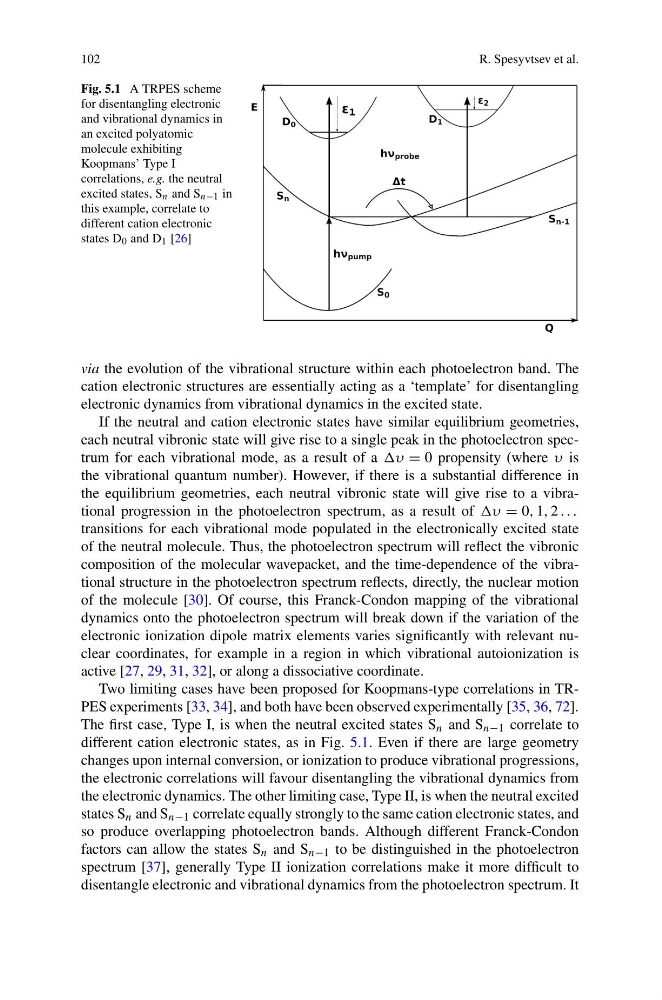
Fig. 5.1 A TRPES scheme
for disentangling electronic
and vibrational dynamics in
an excited polyatomic
molecule exhibiting
Koopmans’ Type I
correlations, e.g. the neutral
excited states, S n and S n−1 in
this example, correlate to
different cation electronic
states D 0 and D 1 [26]
via the evolution of the vibrational structure within each photoelectron band. The
cation electronic structures are essentially acting as a ‘template’ for disentangling
electronic dynamics from vibrational dynamics in the excited state.
If the neutral and cation electronic states have similar equilibrium geometries,
each neutral vibronic state will give rise to a single peak in the photoelectron spectrum for each vibrational mode, as a result of a υ = 0 propensity (where υ is
the vibrational quantum number). However, if there is a substantial difference in
the equilibrium geometries, each neutral vibronic state will give rise to a vibrational progression in the photoelectron spectrum, as a result of υ = 0, 1, 2 . . .
transitions for each vibrational mode populated in the electronically excited state
of the neutral molecule. Thus, the photoelectron spectrum will reflect the vibronic
composition of the molecular wavepacket, and the time-dependence of the vibrational structure in the photoelectron spectrum reflects, directly, the nuclear motion
of the molecule [30]. Of course, this Franck-Condon mapping of the vibrational
dynamics onto the photoelectron spectrum will break down if the variation of the
electronic ionization dipole matrix elements varies significantly with relevant nuclear coordinates, for example in a region in which vibrational autoionization is
active [27, 29, 31, 32], or along a dissociative coordinate.
Two limiting cases have been proposed for Koopmans-type correlations in TRPES experiments [33, 34], and both have been observed experimentally [35, 36, 72].
The first case, Type I, is when the neutral excited states S n and S n−1 correlate to
different cation electronic states, as in Fig. 5.1. Even if there are large geometry
changes upon internal conversion, or ionization to produce vibrational progressions,
the electronic correlations will favour disentangling the vibrational dynamics from
the electronic dynamics. The other limiting case, Type II, is when the neutral excited
states S n and S n−1 correlate equally strongly to the same cation electronic states, and
so produce overlapping photoelectron bands. Although different Franck-Condon
factors can allow the states S n and S n−1 to be distinguished in the photoelectron
spectrum [37], generally Type II ionization correlations make it more difficult to
disentangle electronic and vibrational dynamics from the photoelectron spectrum. It
R. Spesyvtsev et al.
Fig. 5.1 A TRPES scheme
for disentangling electronic
and vibrational dynamics in
an excited polyatomic
molecule exhibiting
Koopmans’ Type I
correlations, e.g. the neutral
excited states, S n and S n−1 in
this example, correlate to
different cation electronic
states D 0 and D 1 [26]
via the evolution of the vibrational structure within each photoelectron band. The
cation electronic structures are essentially acting as a ‘template’ for disentangling
electronic dynamics from vibrational dynamics in the excited state.
If the neutral and cation electronic states have similar equilibrium geometries,
each neutral vibronic state will give rise to a single peak in the photoelectron spectrum for each vibrational mode, as a result of a υ = 0 propensity (where υ is
the vibrational quantum number). However, if there is a substantial difference in
the equilibrium geometries, each neutral vibronic state will give rise to a vibrational progression in the photoelectron spectrum, as a result of υ = 0, 1, 2 . . .
transitions for each vibrational mode populated in the electronically excited state
of the neutral molecule. Thus, the photoelectron spectrum will reflect the vibronic
composition of the molecular wavepacket, and the time-dependence of the vibrational structure in the photoelectron spectrum reflects, directly, the nuclear motion
of the molecule [30]. Of course, this Franck-Condon mapping of the vibrational
dynamics onto the photoelectron spectrum will break down if the variation of the
electronic ionization dipole matrix elements varies significantly with relevant nuclear coordinates, for example in a region in which vibrational autoionization is
active [27, 29, 31, 32], or along a dissociative coordinate.
Two limiting cases have been proposed for Koopmans-type correlations in TRPES experiments [33, 34], and both have been observed experimentally [35, 36, 72].
The first case, Type I, is when the neutral excited states S n and S n−1 correlate to
different cation electronic states, as in Fig. 5.1. Even if there are large geometry
changes upon internal conversion, or ionization to produce vibrational progressions,
the electronic correlations will favour disentangling the vibrational dynamics from
the electronic dynamics. The other limiting case, Type II, is when the neutral excited
states S n and S n−1 correlate equally strongly to the same cation electronic states, and
so produce overlapping photoelectron bands. Although different Franck-Condon
factors can allow the states S n and S n−1 to be distinguished in the photoelectron
spectrum [37], generally Type II ionization correlations make it more difficult to
disentangle electronic and vibrational dynamics from the photoelectron spectrum. It