

84
R. de Nalda et al.
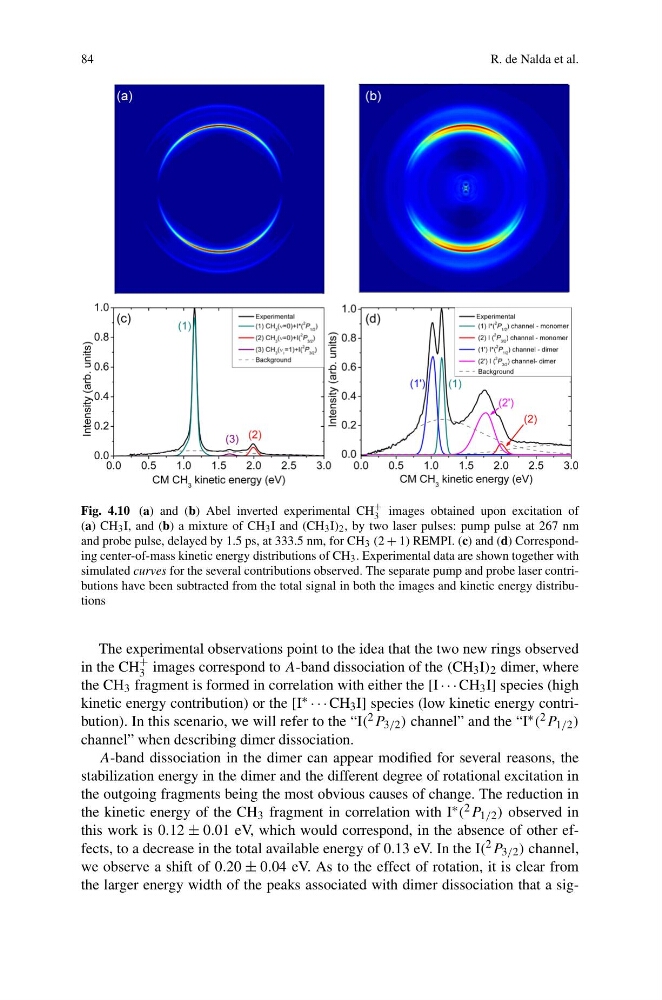
Fig. 4.10 (a) and (b) Abel inverted experimental CH
+
3 images obtained upon excitation of
(a) CH 3 I, and (b) a mixture of CH 3 I and (CH 3 I) 2 , by two laser pulses: pump pulse at 267 nm
and probe pulse, delayed by 1.5 ps, at 333.5 nm, for CH 3 (2 + 1) REMPI. (c) and (d) Corresponding center-of-mass kinetic energy distributions of CH 3 . Experimental data are shown together with
simulated curves for the several contributions observed. The separate pump and probe laser contributions have been subtracted from the total signal in both the images and kinetic energy distributions
The experimental observations point to the idea that the two new rings observed
in the CH
+
3 images correspond to A-band dissociation of the (CH 3 I) 2 dimer, where
the CH 3 fragment is formed in correlation with either the [I · · · CH 3 I] species (high
kinetic energy contribution) or the [I ∗ · · · CH 3 I] species (low kinetic energy contribution). In this scenario, we will refer to the “I( 2 P 3/2 ) channel” and the “I ∗ ( 2 P 1/2 )
channel” when describing dimer dissociation.
A-band dissociation in the dimer can appear modified for several reasons, the
stabilization energy in the dimer and the different degree of rotational excitation in
the outgoing fragments being the most obvious causes of change. The reduction in
the kinetic energy of the CH 3 fragment in correlation with I ∗ ( 2 P 1/2 ) observed in
this work is 0.12 ± 0.01 eV, which would correspond, in the absence of other effects, to a decrease in the total available energy of 0.13 eV. In the I( 2 P 3/2 ) channel,
we observe a shift of 0.20 ± 0.04 eV. As to the effect of rotation, it is clear from
the larger energy width of the peaks associated with dimer dissociation that a sig-
R. de Nalda et al.
Fig. 4.10 (a) and (b) Abel inverted experimental CH
+
3 images obtained upon excitation of
(a) CH 3 I, and (b) a mixture of CH 3 I and (CH 3 I) 2 , by two laser pulses: pump pulse at 267 nm
and probe pulse, delayed by 1.5 ps, at 333.5 nm, for CH 3 (2 + 1) REMPI. (c) and (d) Corresponding center-of-mass kinetic energy distributions of CH 3 . Experimental data are shown together with
simulated curves for the several contributions observed. The separate pump and probe laser contributions have been subtracted from the total signal in both the images and kinetic energy distributions
The experimental observations point to the idea that the two new rings observed
in the CH
+
3 images correspond to A-band dissociation of the (CH 3 I) 2 dimer, where
the CH 3 fragment is formed in correlation with either the [I · · · CH 3 I] species (high
kinetic energy contribution) or the [I ∗ · · · CH 3 I] species (low kinetic energy contribution). In this scenario, we will refer to the “I( 2 P 3/2 ) channel” and the “I ∗ ( 2 P 1/2 )
channel” when describing dimer dissociation.
A-band dissociation in the dimer can appear modified for several reasons, the
stabilization energy in the dimer and the different degree of rotational excitation in
the outgoing fragments being the most obvious causes of change. The reduction in
the kinetic energy of the CH 3 fragment in correlation with I ∗ ( 2 P 1/2 ) observed in
this work is 0.12 ± 0.01 eV, which would correspond, in the absence of other effects, to a decrease in the total available energy of 0.13 eV. In the I( 2 P 3/2 ) channel,
we observe a shift of 0.20 ± 0.04 eV. As to the effect of rotation, it is clear from
the larger energy width of the peaks associated with dimer dissociation that a sig-