

2.9 Computational Note: The Determination of Electronic Excited States
77
2.3 In molecules where S 1 and T 1 are close in energy, the “inverse” ISC from T 1 to S 1
may be characterized by a non-negligible rate constant K invI SC . Compute K invI SC for
acetone, according to the following data/assumptions: (i) the molecule is isolated,
so that its energy is constant, and in particular E = 1 eV above the ZPE of T 1 ;
(ii) the lifetimes of S 1 and T 1 are long enough to reach microcanonical equilibrium
before decaying to S 0 ; (iii) the adiabatic (i.e., minimum-minimum) energy difference
between S 1 and T 1 is ΔE = 0.25 eV; (iv) S 1 and T 1 have the same vibrational
frequencies; (v) the rate constant for the ISC S 1 → T 1 is K I SC = 3.5 ns
−1 .
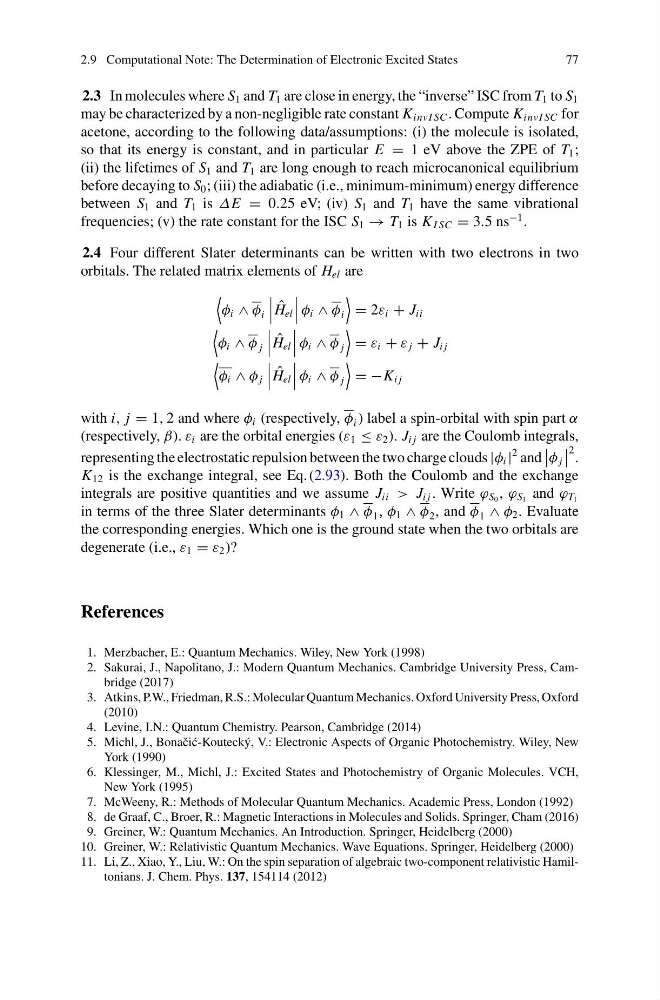
2.4 Four different Slater determinants can be written with two electrons in two
orbitals. The related matrix elements of H el are
φ i ∧ φ i
ˆ
H el
φ i ∧ φ i
= 2ε i + J ii
φ i ∧ φ j
ˆ
H el
φ i ∧ φ j
= ε i + ε j + J i j
φ i ∧ φ j
ˆ
H el
φ i ∧ φ j
= −K i j
with i, j = 1, 2 and where φ i (respectively, φ i ) label a spin-orbital with spin part α
(respectively, β). ε i are the orbital energies (ε 1 ≤ ε 2 ). J i j are the Coulomb integrals,
representing the electrostatic repulsion between the two charge clouds |φ i |
2 and
φ j
2 .
K 12 is the exchange integral, see Eq. (2.93). Both the Coulomb and the exchange
integrals are positive quantities and we assume J ii > J i j . Write ϕ S 0 , ϕ S 1 and ϕ T 1
in terms of the three Slater determinants φ 1 ∧ φ 1 , φ 1 ∧ φ 2 , and φ 1 ∧ φ 2 . Evaluate
the corresponding energies. Which one is the ground state when the two orbitals are
degenerate (i.e., ε 1 = ε 2 )?
References
1. Merzbacher, E.: Quantum Mechanics. Wiley, New York (1998)
2. Sakurai, J., Napolitano, J.: Modern Quantum Mechanics. Cambridge University Press, Cambridge (2017)
3. Atkins, P.W., Friedman, R.S.: Molecular Quantum Mechanics. Oxford University Press, Oxford
(2010)
4. Levine, I.N.: Quantum Chemistry. Pearson, Cambridge (2014)
5. Michl, J., Bonaˇ ci´ c-Koutecký, V.: Electronic Aspects of Organic Photochemistry. Wiley, New
York (1990)
6. Klessinger, M., Michl, J.: Excited States and Photochemistry of Organic Molecules. VCH,
New York (1995)
7. McWeeny, R.: Methods of Molecular Quantum Mechanics. Academic Press, London (1992)
8. de Graaf, C., Broer, R.: Magnetic Interactions in Molecules and Solids. Springer, Cham (2016)
9. Greiner, W.: Quantum Mechanics. An Introduction. Springer, Heidelberg (2000)
10. Greiner, W.: Relativistic Quantum Mechanics. Wave Equations. Springer, Heidelberg (2000)
11. Li, Z., Xiao, Y., Liu, W.: On the spin separation of algebraic two-component relativistic Hamiltonians. J. Chem. Phys. 137, 154114 (2012)
77
2.3 In molecules where S 1 and T 1 are close in energy, the “inverse” ISC from T 1 to S 1
may be characterized by a non-negligible rate constant K invI SC . Compute K invI SC for
acetone, according to the following data/assumptions: (i) the molecule is isolated,
so that its energy is constant, and in particular E = 1 eV above the ZPE of T 1 ;
(ii) the lifetimes of S 1 and T 1 are long enough to reach microcanonical equilibrium
before decaying to S 0 ; (iii) the adiabatic (i.e., minimum-minimum) energy difference
between S 1 and T 1 is ΔE = 0.25 eV; (iv) S 1 and T 1 have the same vibrational
frequencies; (v) the rate constant for the ISC S 1 → T 1 is K I SC = 3.5 ns
−1 .
2.4 Four different Slater determinants can be written with two electrons in two
orbitals. The related matrix elements of H el are
φ i ∧ φ i
ˆ
H el
φ i ∧ φ i
= 2ε i + J ii
φ i ∧ φ j
ˆ
H el
φ i ∧ φ j
= ε i + ε j + J i j
φ i ∧ φ j
ˆ
H el
φ i ∧ φ j
= −K i j
with i, j = 1, 2 and where φ i (respectively, φ i ) label a spin-orbital with spin part α
(respectively, β). ε i are the orbital energies (ε 1 ≤ ε 2 ). J i j are the Coulomb integrals,
representing the electrostatic repulsion between the two charge clouds |φ i |
2 and
φ j
2 .
K 12 is the exchange integral, see Eq. (2.93). Both the Coulomb and the exchange
integrals are positive quantities and we assume J ii > J i j . Write ϕ S 0 , ϕ S 1 and ϕ T 1
in terms of the three Slater determinants φ 1 ∧ φ 1 , φ 1 ∧ φ 2 , and φ 1 ∧ φ 2 . Evaluate
the corresponding energies. Which one is the ground state when the two orbitals are
degenerate (i.e., ε 1 = ε 2 )?
References
1. Merzbacher, E.: Quantum Mechanics. Wiley, New York (1998)
2. Sakurai, J., Napolitano, J.: Modern Quantum Mechanics. Cambridge University Press, Cambridge (2017)
3. Atkins, P.W., Friedman, R.S.: Molecular Quantum Mechanics. Oxford University Press, Oxford
(2010)
4. Levine, I.N.: Quantum Chemistry. Pearson, Cambridge (2014)
5. Michl, J., Bonaˇ ci´ c-Koutecký, V.: Electronic Aspects of Organic Photochemistry. Wiley, New
York (1990)
6. Klessinger, M., Michl, J.: Excited States and Photochemistry of Organic Molecules. VCH,
New York (1995)
7. McWeeny, R.: Methods of Molecular Quantum Mechanics. Academic Press, London (1992)
8. de Graaf, C., Broer, R.: Magnetic Interactions in Molecules and Solids. Springer, Cham (2016)
9. Greiner, W.: Quantum Mechanics. An Introduction. Springer, Heidelberg (2000)
10. Greiner, W.: Relativistic Quantum Mechanics. Wave Equations. Springer, Heidelberg (2000)
11. Li, Z., Xiao, Y., Liu, W.: On the spin separation of algebraic two-component relativistic Hamiltonians. J. Chem. Phys. 137, 154114 (2012)