

1.5 Quantum Yields
13
Here the rates can be expressed as molecules or moles per unit time (mol·s
−1 ), or,
as usual in chemistry, also per unit volume (mol·s
−1 L
−1 ). In the latter case we have
instantaneous and local rates and quantum yields, which can change in time and
space as functions of the sample conditions (concentrations, temperature, etc).
Since all the excited molecules A
∗ will eventually undergo one of the events that
transform or deactivate the excited state, the sum of the quantum yields of the primary
processes must equal one:
X ∈ primar y processes
Φ X = 1
(1.38)
Of course none of the yields Φ X can be larger than one. This rule can help distinguishing primary and secondary processes.
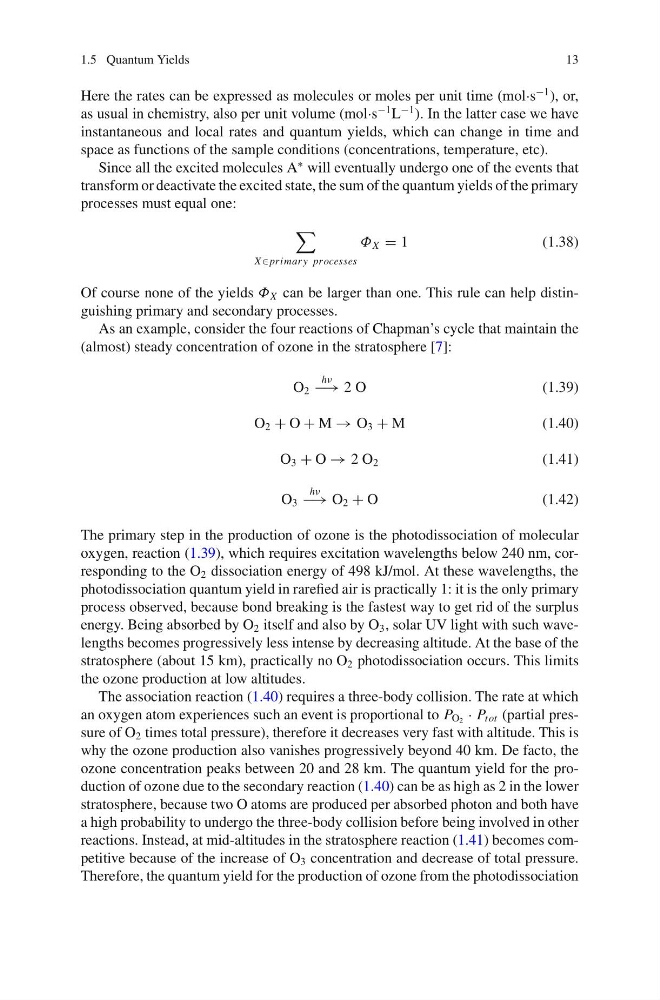
As an example, consider the four reactions of Chapman’s cycle that maintain the
(almost) steady concentration of ozone in the stratosphere [7]:
O 2
hν
−→ 2 O
(1.39)
O 2 + O + M → O 3 + M
(1.40)
O 3 + O → 2 O 2
(1.41)
O 3
hν
−→ O 2 + O
(1.42)
The primary step in the production of ozone is the photodissociation of molecular
oxygen, reaction (1.39), which requires excitation wavelengths below 240 nm, corresponding to the O 2 dissociation energy of 498 kJ/mol. At these wavelengths, the
photodissociation quantum yield in rarefied air is practically 1: it is the only primary
process observed, because bond breaking is the fastest way to get rid of the surplus
energy. Being absorbed by O 2 itself and also by O 3 , solar UV light with such wavelengths becomes progressively less intense by decreasing altitude. At the base of the
stratosphere (about 15 km), practically no O 2 photodissociation occurs. This limits
the ozone production at low altitudes.
The association reaction (1.40) requires a three-body collision. The rate at which
an oxygen atom experiences such an event is proportional to P O 2 · P tot (partial pressure of O 2 times total pressure), therefore it decreases very fast with altitude. This is
why the ozone production also vanishes progressively beyond 40 km. De facto, the
ozone concentration peaks between 20 and 28 km. The quantum yield for the production of ozone due to the secondary reaction (1.40) can be as high as 2 in the lower
stratosphere, because two O atoms are produced per absorbed photon and both have
a high probability to undergo the three-body collision before being involved in other
reactions. Instead, at mid-altitudes in the stratosphere reaction (1.41) becomes competitive because of the increase of O 3 concentration and decrease of total pressure.
Therefore, the quantum yield for the production of ozone from the photodissociation
13
Here the rates can be expressed as molecules or moles per unit time (mol·s
−1 ), or,
as usual in chemistry, also per unit volume (mol·s
−1 L
−1 ). In the latter case we have
instantaneous and local rates and quantum yields, which can change in time and
space as functions of the sample conditions (concentrations, temperature, etc).
Since all the excited molecules A
∗ will eventually undergo one of the events that
transform or deactivate the excited state, the sum of the quantum yields of the primary
processes must equal one:
X ∈ primar y processes
Φ X = 1
(1.38)
Of course none of the yields Φ X can be larger than one. This rule can help distinguishing primary and secondary processes.
As an example, consider the four reactions of Chapman’s cycle that maintain the
(almost) steady concentration of ozone in the stratosphere [7]:
O 2
hν
−→ 2 O
(1.39)
O 2 + O + M → O 3 + M
(1.40)
O 3 + O → 2 O 2
(1.41)
O 3
hν
−→ O 2 + O
(1.42)
The primary step in the production of ozone is the photodissociation of molecular
oxygen, reaction (1.39), which requires excitation wavelengths below 240 nm, corresponding to the O 2 dissociation energy of 498 kJ/mol. At these wavelengths, the
photodissociation quantum yield in rarefied air is practically 1: it is the only primary
process observed, because bond breaking is the fastest way to get rid of the surplus
energy. Being absorbed by O 2 itself and also by O 3 , solar UV light with such wavelengths becomes progressively less intense by decreasing altitude. At the base of the
stratosphere (about 15 km), practically no O 2 photodissociation occurs. This limits
the ozone production at low altitudes.
The association reaction (1.40) requires a three-body collision. The rate at which
an oxygen atom experiences such an event is proportional to P O 2 · P tot (partial pressure of O 2 times total pressure), therefore it decreases very fast with altitude. This is
why the ozone production also vanishes progressively beyond 40 km. De facto, the
ozone concentration peaks between 20 and 28 km. The quantum yield for the production of ozone due to the secondary reaction (1.40) can be as high as 2 in the lower
stratosphere, because two O atoms are produced per absorbed photon and both have
a high probability to undergo the three-body collision before being involved in other
reactions. Instead, at mid-altitudes in the stratosphere reaction (1.41) becomes competitive because of the increase of O 3 concentration and decrease of total pressure.
Therefore, the quantum yield for the production of ozone from the photodissociation