

Appendix C
The Dirac δ Function and the Normalization of
Continuum States
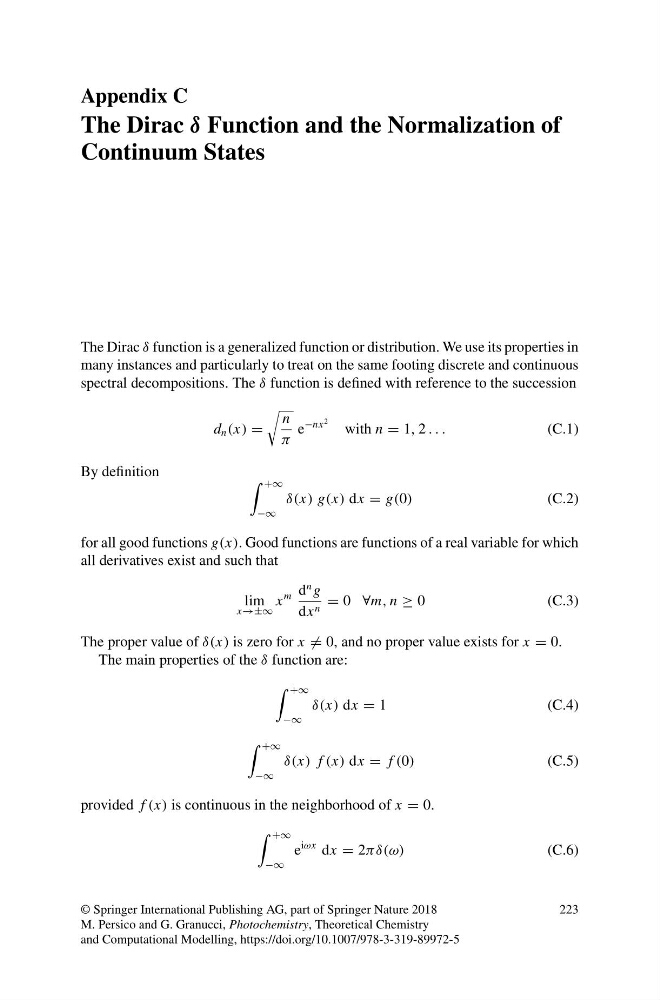
The Dirac δ function is a generalized function or distribution. We use its properties in
many instances and particularly to treat on the same footing discrete and continuous
spectral decompositions. The δ function is defined with reference to the succession
d n (x) =
n
π
e
−nx
2
with n = 1, 2 . . .
(C.1)
By definition
+∞
−∞
δ(x) g(x) dx = g(0)
(C.2)
for all good functions g(x). Good functions are functions of a real variable for which
all derivatives exist and such that
lim
x→±∞
x
m d
n g
dx n = 0 ∀m, n ≥ 0
( C . 3 )
The proper value of δ(x) is zero for x = 0, and no proper value exists for x = 0.
The main properties of the δ function are:
+∞
−∞
δ(x) dx = 1
( C . 4 )
+∞
−∞
δ(x) f (x) dx = f (0)
(C.5)
provided f (x) is continuous in the neighborhood of x = 0.
+∞
−∞
e
iωx dx = 2πδ(ω)
(C.6)
© Springer International Publishing AG, part of Springer Nature 2018
M. Persico and G. Granucci, Photochemistry, Theoretical Chemistry
and Computational Modelling, https://doi.org/10.1007/978-3-319-89972-5
223
The Dirac δ Function and the Normalization of
Continuum States
The Dirac δ function is a generalized function or distribution. We use its properties in
many instances and particularly to treat on the same footing discrete and continuous
spectral decompositions. The δ function is defined with reference to the succession
d n (x) =
n
π
e
−nx
2
with n = 1, 2 . . .
(C.1)
By definition
+∞
−∞
δ(x) g(x) dx = g(0)
(C.2)
for all good functions g(x). Good functions are functions of a real variable for which
all derivatives exist and such that
lim
x→±∞
x
m d
n g
dx n = 0 ∀m, n ≥ 0
( C . 3 )
The proper value of δ(x) is zero for x = 0, and no proper value exists for x = 0.
The main properties of the δ function are:
+∞
−∞
δ(x) dx = 1
( C . 4 )
+∞
−∞
δ(x) f (x) dx = f (0)
(C.5)
provided f (x) is continuous in the neighborhood of x = 0.
+∞
−∞
e
iωx dx = 2πδ(ω)
(C.6)
© Springer International Publishing AG, part of Springer Nature 2018
M. Persico and G. Granucci, Photochemistry, Theoretical Chemistry
and Computational Modelling, https://doi.org/10.1007/978-3-319-89972-5
223