

210
6 Charge and Energy Transfer Processes
Table 6.4 Wavelengths (nm) of S 1 and T 1 0–0 bands
compound
S 1
T 1
A
Anthracene
378
681
B
Perylene
435
795
C
Tetracene
477
954
D
Pentacene
536
1440
E
Rubrene
519
1033
6.3 The wavelengths of the 0–0 bands of the S 0 − S 1 and S 0 − T 1 transitions are
listed in Table 6.4 for five polynuclear aromatic hydrocarbons. Which donor–acceptor
pairs satisfy the energy requisites to exhibit FRET? Same question for triplet sensitization. Which compounds are likely to undergo singlet fission? And which triplet–
triplet annihilation?
6.4 Prove Eq. (6.62). Can we write a similar relationship for the oscillator strengths?
6.5 Consider an array on n identical chromophores put at the n vertices of a regular
polygon, and the n corresponding diabatic states η i of energy E ex in which the
excitation is localized in chromophore i (excitons). Assume their transition dipoles
are all parallel and the coupling between the excitons is of Förster type. What is the
form of the bright state? We shall apply the approximation that the only important
couplings are those between first neighbors, with strength V . How good is this
approximation, depending on n? Is the bright state an eigenstate within the subspace
spanned by the excitons? What is its energy?
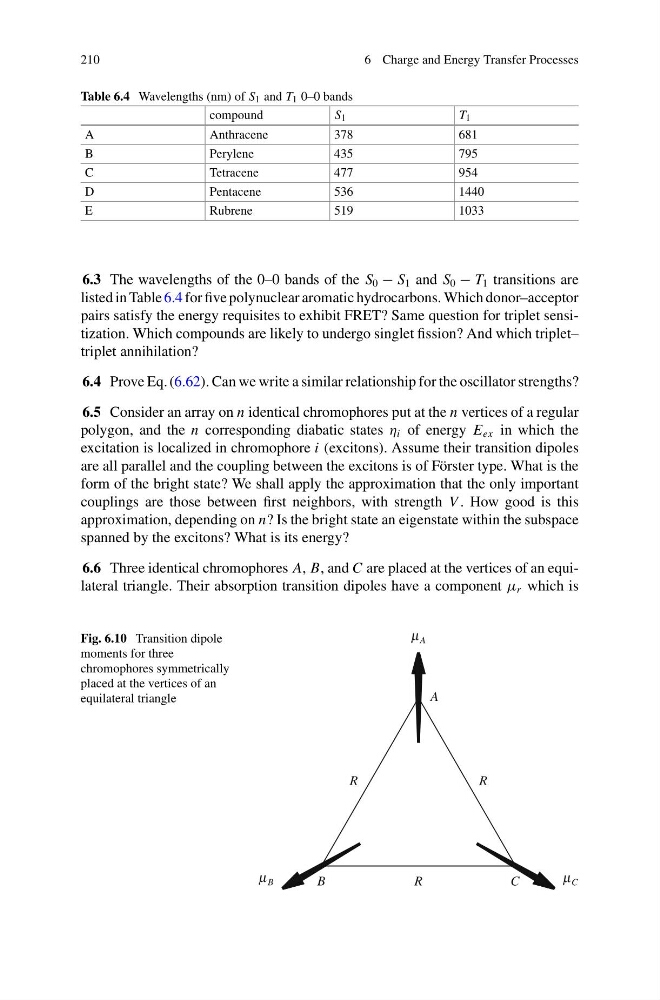
6.6 Three identical chromophores A, B, and C are placed at the vertices of an equilateral triangle. Their absorption transition dipoles have a component μ r which is
Fig. 6.10 Transition dipole
moments for three
chromophores symmetrically
placed at the vertices of an
equilateral triangle
C
B
A
C
B
A
R
R
R
6 Charge and Energy Transfer Processes
Table 6.4 Wavelengths (nm) of S 1 and T 1 0–0 bands
compound
S 1
T 1
A
Anthracene
378
681
B
Perylene
435
795
C
Tetracene
477
954
D
Pentacene
536
1440
E
Rubrene
519
1033
6.3 The wavelengths of the 0–0 bands of the S 0 − S 1 and S 0 − T 1 transitions are
listed in Table 6.4 for five polynuclear aromatic hydrocarbons. Which donor–acceptor
pairs satisfy the energy requisites to exhibit FRET? Same question for triplet sensitization. Which compounds are likely to undergo singlet fission? And which triplet–
triplet annihilation?
6.4 Prove Eq. (6.62). Can we write a similar relationship for the oscillator strengths?
6.5 Consider an array on n identical chromophores put at the n vertices of a regular
polygon, and the n corresponding diabatic states η i of energy E ex in which the
excitation is localized in chromophore i (excitons). Assume their transition dipoles
are all parallel and the coupling between the excitons is of Förster type. What is the
form of the bright state? We shall apply the approximation that the only important
couplings are those between first neighbors, with strength V . How good is this
approximation, depending on n? Is the bright state an eigenstate within the subspace
spanned by the excitons? What is its energy?
6.6 Three identical chromophores A, B, and C are placed at the vertices of an equilateral triangle. Their absorption transition dipoles have a component μ r which is
Fig. 6.10 Transition dipole
moments for three
chromophores symmetrically
placed at the vertices of an
equilateral triangle
C
B
A
C
B
A
R
R
R