

180
6 Charge and Energy Transfer Processes
where R X , M X , and C X are the radius, mass, and concentration (number density) of
the spheres. In a mixture, the number of collisions between spheres of the X and Y
types is
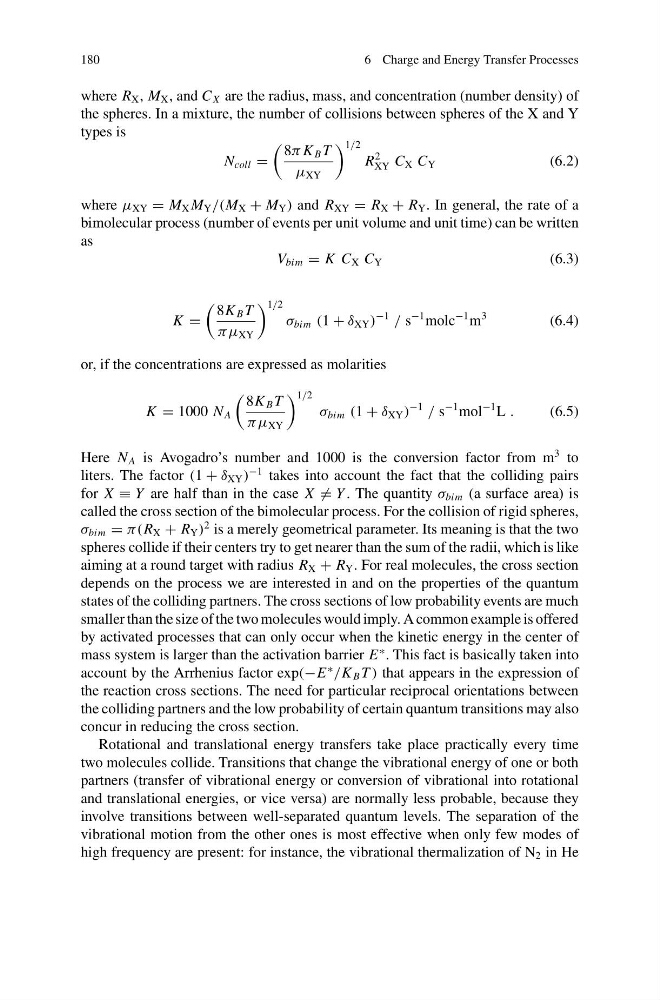
N coll =
8π K B T
μ XY
1/2
R
2
XY C X C Y
(6.2)
where μ XY = M X M Y /(M X + M Y ) and R XY = R X + R Y . In general, the rate of a
bimolecular process (number of events per unit volume and unit time) can be written
as
V bim = K C X C Y
(6.3)
K =
8K B T
πμ XY
1/2
σ bim (1 + δ XY )
−1
/ s
−1 molc
−1 m
3
(6.4)
or, if the concentrations are expressed as molarities
K = 1000 N A
8K B T
πμ XY
1/2
σ bim (1 + δ XY )
−1
/ s
−1 mol
−1 L .
(6.5)
Here N A is Avogadro’s number and 1000 is the conversion factor from m
3 to
liters. The factor (1 + δ XY )
−1 takes into account the fact that the colliding pairs
for X ≡ Y are half than in the case X = Y . The quantity σ bim (a surface area) is
called the cross section of the bimolecular process. For the collision of rigid spheres,
σ bim = π(R X + R Y )
2 is a merely geometrical parameter. Its meaning is that the two
spheres collide if their centers try to get nearer than the sum of the radii, which is like
aiming at a round target with radius R X + R Y . For real molecules, the cross section
depends on the process we are interested in and on the properties of the quantum
states of the colliding partners. The cross sections of low probability events are much
smaller than the size of the two molecules would imply. A common example is offered
by activated processes that can only occur when the kinetic energy in the center of
mass system is larger than the activation barrier E
∗ . This fact is basically taken into
account by the Arrhenius factor exp(−E
∗
/K B T ) that appears in the expression of
the reaction cross sections. The need for particular reciprocal orientations between
the colliding partners and the low probability of certain quantum transitions may also
concur in reducing the cross section.
Rotational and translational energy transfers take place practically every time
two molecules collide. Transitions that change the vibrational energy of one or both
partners (transfer of vibrational energy or conversion of vibrational into rotational
and translational energies, or vice versa) are normally less probable, because they
involve transitions between well-separated quantum levels. The separation of the
vibrational motion from the other ones is most effective when only few modes of
high frequency are present: for instance, the vibrational thermalization of N 2 in He
6 Charge and Energy Transfer Processes
where R X , M X , and C X are the radius, mass, and concentration (number density) of
the spheres. In a mixture, the number of collisions between spheres of the X and Y
types is
N coll =
8π K B T
μ XY
1/2
R
2
XY C X C Y
(6.2)
where μ XY = M X M Y /(M X + M Y ) and R XY = R X + R Y . In general, the rate of a
bimolecular process (number of events per unit volume and unit time) can be written
as
V bim = K C X C Y
(6.3)
K =
8K B T
πμ XY
1/2
σ bim (1 + δ XY )
−1
/ s
−1 molc
−1 m
3
(6.4)
or, if the concentrations are expressed as molarities
K = 1000 N A
8K B T
πμ XY
1/2
σ bim (1 + δ XY )
−1
/ s
−1 mol
−1 L .
(6.5)
Here N A is Avogadro’s number and 1000 is the conversion factor from m
3 to
liters. The factor (1 + δ XY )
−1 takes into account the fact that the colliding pairs
for X ≡ Y are half than in the case X = Y . The quantity σ bim (a surface area) is
called the cross section of the bimolecular process. For the collision of rigid spheres,
σ bim = π(R X + R Y )
2 is a merely geometrical parameter. Its meaning is that the two
spheres collide if their centers try to get nearer than the sum of the radii, which is like
aiming at a round target with radius R X + R Y . For real molecules, the cross section
depends on the process we are interested in and on the properties of the quantum
states of the colliding partners. The cross sections of low probability events are much
smaller than the size of the two molecules would imply. A common example is offered
by activated processes that can only occur when the kinetic energy in the center of
mass system is larger than the activation barrier E
∗ . This fact is basically taken into
account by the Arrhenius factor exp(−E
∗
/K B T ) that appears in the expression of
the reaction cross sections. The need for particular reciprocal orientations between
the colliding partners and the low probability of certain quantum transitions may also
concur in reducing the cross section.
Rotational and translational energy transfers take place practically every time
two molecules collide. Transitions that change the vibrational energy of one or both
partners (transfer of vibrational energy or conversion of vibrational into rotational
and translational energies, or vice versa) are normally less probable, because they
involve transitions between well-separated quantum levels. The separation of the
vibrational motion from the other ones is most effective when only few modes of
high frequency are present: for instance, the vibrational thermalization of N 2 in He