

128
4 Wavepacket Dynamics and Geometrical Relaxation
as the Gaussian wavepacket mimics well the wavepacket behavior, at least for short
times: trajectories with P > P soon or later will be at the forefront of the swarm,
while those with P < P will lag behind, which produces a broadening of the swarm
corresponding to a positive result for the average (4.19). To counteract this broadening effect, one needs a potential with positive curvature, such as to decrease the
momentum in regions where (R − R)(P − P) > 0 and to increase it when the
two factors are opposite in sign. The curvature that exactly annihilates the broadening
effect is by definition that of the harmonic oscillator of which the wavepacket is an
eigenfunction. Larger curvatures have a narrowing effect and smaller curvatures, as
in our model, permit a temporary broadening (see the animations referred to above).
Negative curvatures occur at saddle points, such as one finds in n → π
∗ or
π → π
∗ excited states along the double-bond torsional coordinate of imines or azocompounds. In that case, the wavepacket initially broadens and then splits in two
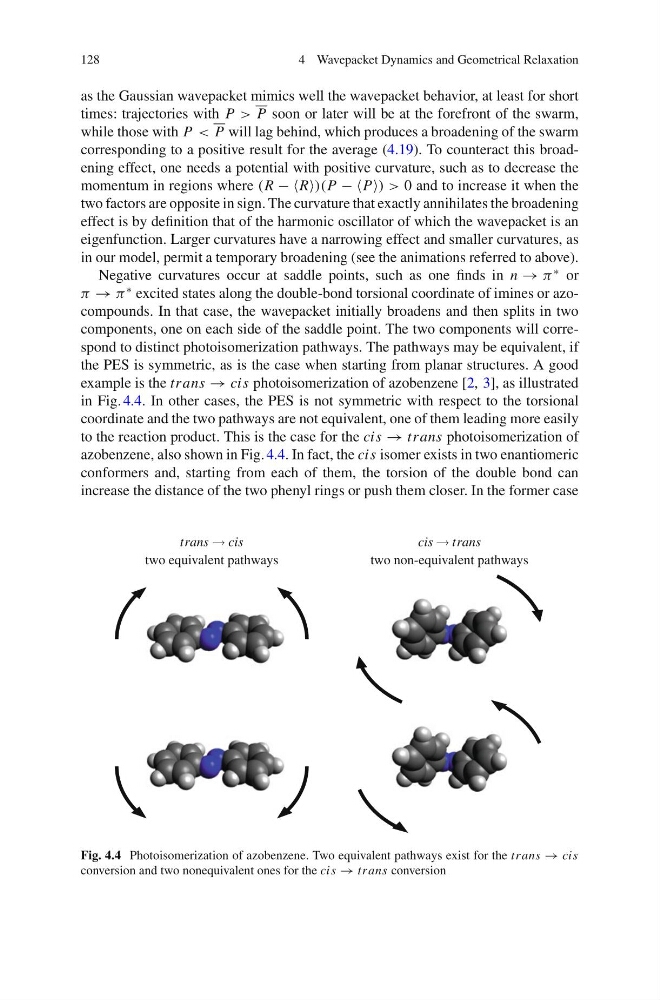
components, one on each side of the saddle point. The two components will correspond to distinct photoisomerization pathways. The pathways may be equivalent, if
the PES is symmetric, as is the case when starting from planar structures. A good
example is the trans → cis photoisomerization of azobenzene [2, 3], as illustrated
in Fig. 4.4. In other cases, the PES is not symmetric with respect to the torsional
coordinate and the two pathways are not equivalent, one of them leading more easily
to the reaction product. This is the case for the cis → trans photoisomerization of
azobenzene, also shown in Fig. 4.4. In fact, the cis isomer exists in two enantiomeric
conformers and, starting from each of them, the torsion of the double bond can
increase the distance of the two phenyl rings or push them closer. In the former case
two non-equivalent pathways
cis → trans
two equivalent pathways
trans → cis
Fig. 4.4 Photoisomerization of azobenzene. Two equivalent pathways exist for the trans → cis
conversion and two nonequivalent ones for the cis → trans conversion
4 Wavepacket Dynamics and Geometrical Relaxation
as the Gaussian wavepacket mimics well the wavepacket behavior, at least for short
times: trajectories with P > P soon or later will be at the forefront of the swarm,
while those with P < P will lag behind, which produces a broadening of the swarm
corresponding to a positive result for the average (4.19). To counteract this broadening effect, one needs a potential with positive curvature, such as to decrease the
momentum in regions where (R − R)(P − P) > 0 and to increase it when the
two factors are opposite in sign. The curvature that exactly annihilates the broadening
effect is by definition that of the harmonic oscillator of which the wavepacket is an
eigenfunction. Larger curvatures have a narrowing effect and smaller curvatures, as
in our model, permit a temporary broadening (see the animations referred to above).
Negative curvatures occur at saddle points, such as one finds in n → π
∗ or
π → π
∗ excited states along the double-bond torsional coordinate of imines or azocompounds. In that case, the wavepacket initially broadens and then splits in two
components, one on each side of the saddle point. The two components will correspond to distinct photoisomerization pathways. The pathways may be equivalent, if
the PES is symmetric, as is the case when starting from planar structures. A good
example is the trans → cis photoisomerization of azobenzene [2, 3], as illustrated
in Fig. 4.4. In other cases, the PES is not symmetric with respect to the torsional
coordinate and the two pathways are not equivalent, one of them leading more easily
to the reaction product. This is the case for the cis → trans photoisomerization of
azobenzene, also shown in Fig. 4.4. In fact, the cis isomer exists in two enantiomeric
conformers and, starting from each of them, the torsion of the double bond can
increase the distance of the two phenyl rings or push them closer. In the former case
two non-equivalent pathways
cis → trans
two equivalent pathways
trans → cis
Fig. 4.4 Photoisomerization of azobenzene. Two equivalent pathways exist for the trans → cis
conversion and two nonequivalent ones for the cis → trans conversion