

114
3 Electronic Excitation and Decay
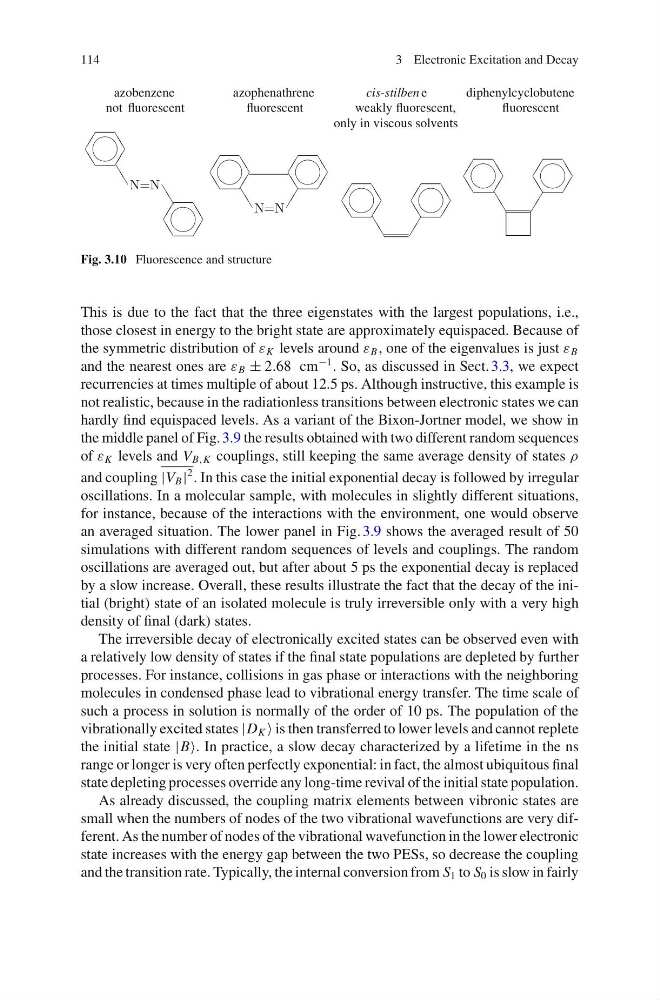
azobenzene
azophenathrene
cis-stilben e
diphenylcyclobutene
not fluorescent
fluorescent
weakly fluorescent,
fluorescent
only in viscous solvents
N=N
N=N
Fig. 3.10 Fluorescence and structure
This is due to the fact that the three eigenstates with the largest populations, i.e.,
those closest in energy to the bright state are approximately equispaced. Because of
the symmetric distribution of ε K levels around ε B , one of the eigenvalues is just ε B
and the nearest ones are ε B ± 2.68 cm
−1 . So, as discussed in Sect. 3.3, we expect
recurrencies at times multiple of about 12.5 ps. Although instructive, this example is
not realistic, because in the radiationless transitions between electronic states we can
hardly find equispaced levels. As a variant of the Bixon-Jortner model, we show in
the middle panel of Fig. 3.9 the results obtained with two different random sequences
of ε K levels and V B,K couplings, still keeping the same average density of states ρ
and coupling |V B |
2 . In this case the initial exponential decay is followed by irregular
oscillations. In a molecular sample, with molecules in slightly different situations,
for instance, because of the interactions with the environment, one would observe
an averaged situation. The lower panel in Fig. 3.9 shows the averaged result of 50
simulations with different random sequences of levels and couplings. The random
oscillations are averaged out, but after about 5 ps the exponential decay is replaced
by a slow increase. Overall, these results illustrate the fact that the decay of the initial (bright) state of an isolated molecule is truly irreversible only with a very high
density of final (dark) states.
The irreversible decay of electronically excited states can be observed even with
a relatively low density of states if the final state populations are depleted by further
processes. For instance, collisions in gas phase or interactions with the neighboring
molecules in condensed phase lead to vibrational energy transfer. The time scale of
such a process in solution is normally of the order of 10 ps. The population of the
vibrationally excited states |D K is then transferred to lower levels and cannot replete
the initial state |B. In practice, a slow decay characterized by a lifetime in the ns
range or longer is very often perfectly exponential: in fact, the almost ubiquitous final
state depleting processes override any long-time revival of the initial state population.
As already discussed, the coupling matrix elements between vibronic states are
small when the numbers of nodes of the two vibrational wavefunctions are very different. As the number of nodes of the vibrational wavefunction in the lower electronic
state increases with the energy gap between the two PESs, so decrease the coupling
and the transition rate. Typically, the internal conversion from S 1 to S 0 is slow in fairly
3 Electronic Excitation and Decay
azobenzene
azophenathrene
cis-stilben e
diphenylcyclobutene
not fluorescent
fluorescent
weakly fluorescent,
fluorescent
only in viscous solvents
N=N
N=N
Fig. 3.10 Fluorescence and structure
This is due to the fact that the three eigenstates with the largest populations, i.e.,
those closest in energy to the bright state are approximately equispaced. Because of
the symmetric distribution of ε K levels around ε B , one of the eigenvalues is just ε B
and the nearest ones are ε B ± 2.68 cm
−1 . So, as discussed in Sect. 3.3, we expect
recurrencies at times multiple of about 12.5 ps. Although instructive, this example is
not realistic, because in the radiationless transitions between electronic states we can
hardly find equispaced levels. As a variant of the Bixon-Jortner model, we show in
the middle panel of Fig. 3.9 the results obtained with two different random sequences
of ε K levels and V B,K couplings, still keeping the same average density of states ρ
and coupling |V B |
2 . In this case the initial exponential decay is followed by irregular
oscillations. In a molecular sample, with molecules in slightly different situations,
for instance, because of the interactions with the environment, one would observe
an averaged situation. The lower panel in Fig. 3.9 shows the averaged result of 50
simulations with different random sequences of levels and couplings. The random
oscillations are averaged out, but after about 5 ps the exponential decay is replaced
by a slow increase. Overall, these results illustrate the fact that the decay of the initial (bright) state of an isolated molecule is truly irreversible only with a very high
density of final (dark) states.
The irreversible decay of electronically excited states can be observed even with
a relatively low density of states if the final state populations are depleted by further
processes. For instance, collisions in gas phase or interactions with the neighboring
molecules in condensed phase lead to vibrational energy transfer. The time scale of
such a process in solution is normally of the order of 10 ps. The population of the
vibrationally excited states |D K is then transferred to lower levels and cannot replete
the initial state |B. In practice, a slow decay characterized by a lifetime in the ns
range or longer is very often perfectly exponential: in fact, the almost ubiquitous final
state depleting processes override any long-time revival of the initial state population.
As already discussed, the coupling matrix elements between vibronic states are
small when the numbers of nodes of the two vibrational wavefunctions are very different. As the number of nodes of the vibrational wavefunction in the lower electronic
state increases with the energy gap between the two PESs, so decrease the coupling
and the transition rate. Typically, the internal conversion from S 1 to S 0 is slow in fairly