

102
3 Electronic Excitation and Decay
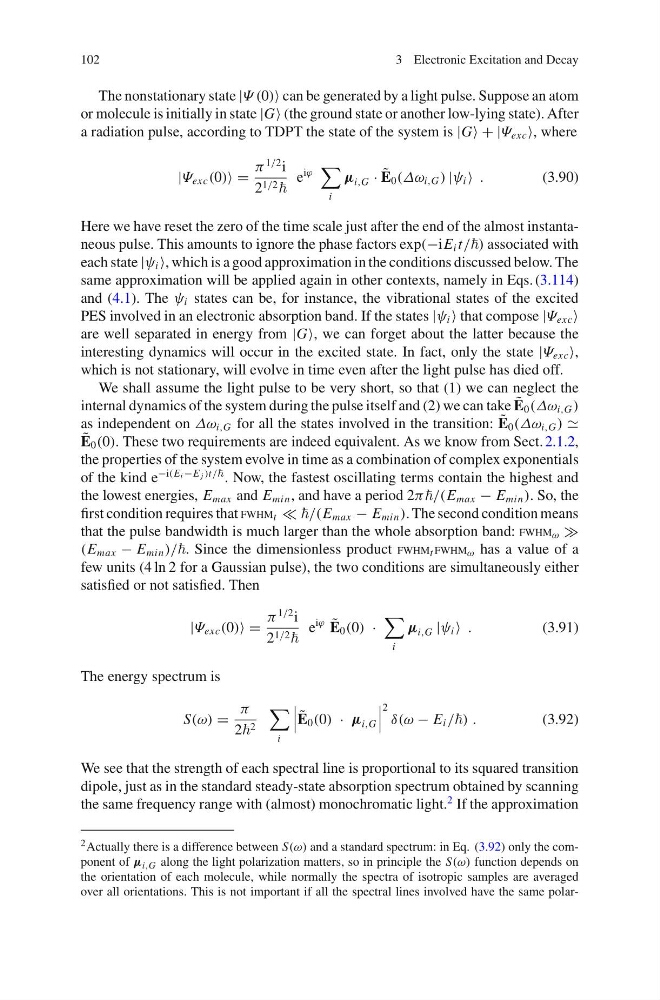
The nonstationary state |Ψ (0) can be generated by a light pulse. Suppose an atom
or molecule is initially in state |G (the ground state or another low-lying state). After
a radiation pulse, according to TDPT the state of the system is |G + |Ψ exc , where
|Ψ exc (0) =
π
1/2 i
2 1/2
e
iϕ
i
µ i,G · ˜
E 0 (Δω i,G ) |ψ i .
(3.90)
Here we have reset the zero of the time scale just after the end of the almost instantaneous pulse. This amounts to ignore the phase factors exp(−iE i t/) associated with
each state |ψ i , which is a good approximation in the conditions discussed below. The
same approximation will be applied again in other contexts, namely in Eqs. (3.114)
and (4.1). The ψ i states can be, for instance, the vibrational states of the excited
PES involved in an electronic absorption band. If the states |ψ i that compose |Ψ exc
are well separated in energy from |G, we can forget about the latter because the
interesting dynamics will occur in the excited state. In fact, only the state |Ψ exc ,
which is not stationary, will evolve in time even after the light pulse has died off.
We shall assume the light pulse to be very short, so that (1) we can neglect the
internal dynamics of the system during the pulse itself and (2) we can take ˜
E 0 (Δω i,G )
as independent on Δω i,G for all the states involved in the transition: ˜
E 0 (Δω i,G )
˜
E 0 (0). These two requirements are indeed equivalent. As we know from Sect. 2.1.2,
the properties of the system evolve in time as a combination of complex exponentials
of the kind e
−i(E i −E j )t/ . Now, the fastest oscillating terms contain the highest and
the lowest energies, E max and E min , and have a period 2π /(E max − E min ). So, the
first condition requires that FWHM t /(E max − E min ). The second condition means
that the pulse bandwidth is much larger than the whole absorption band: FWHM ω
(E max − E min )/. Since the dimensionless product FWHM t FWHM ω has a value of a
few units (4 ln 2 for a Gaussian pulse), the two conditions are simultaneously either
satisfied or not satisfied. Then
|Ψ exc (0) =
π
1/2 i
2 1/2
e
iϕ ˜
E 0 (0) ·
i
µ i,G |ψ i .
(3.91)
The energy spectrum is
S(ω) =
π
2 2
i
˜
E 0 (0) · µ i,G
2 δ(ω − E i /) .
(3.92)
We see that the strength of each spectral line is proportional to its squared transition
dipole, just as in the standard steady-state absorption spectrum obtained by scanning
the same frequency range with (almost) monochromatic light.
2 If the approximation
2 Actually there is a difference between S(ω) and a standard spectrum: in Eq. (3.92) only the component of µ i,G along the light polarization matters, so in principle the S(ω) function depends on
the orientation of each molecule, while normally the spectra of isotropic samples are averaged
over all orientations. This is not important if all the spectral lines involved have the same polar-
3 Electronic Excitation and Decay
The nonstationary state |Ψ (0) can be generated by a light pulse. Suppose an atom
or molecule is initially in state |G (the ground state or another low-lying state). After
a radiation pulse, according to TDPT the state of the system is |G + |Ψ exc , where
|Ψ exc (0) =
π
1/2 i
2 1/2
e
iϕ
i
µ i,G · ˜
E 0 (Δω i,G ) |ψ i .
(3.90)
Here we have reset the zero of the time scale just after the end of the almost instantaneous pulse. This amounts to ignore the phase factors exp(−iE i t/) associated with
each state |ψ i , which is a good approximation in the conditions discussed below. The
same approximation will be applied again in other contexts, namely in Eqs. (3.114)
and (4.1). The ψ i states can be, for instance, the vibrational states of the excited
PES involved in an electronic absorption band. If the states |ψ i that compose |Ψ exc
are well separated in energy from |G, we can forget about the latter because the
interesting dynamics will occur in the excited state. In fact, only the state |Ψ exc ,
which is not stationary, will evolve in time even after the light pulse has died off.
We shall assume the light pulse to be very short, so that (1) we can neglect the
internal dynamics of the system during the pulse itself and (2) we can take ˜
E 0 (Δω i,G )
as independent on Δω i,G for all the states involved in the transition: ˜
E 0 (Δω i,G )
˜
E 0 (0). These two requirements are indeed equivalent. As we know from Sect. 2.1.2,
the properties of the system evolve in time as a combination of complex exponentials
of the kind e
−i(E i −E j )t/ . Now, the fastest oscillating terms contain the highest and
the lowest energies, E max and E min , and have a period 2π /(E max − E min ). So, the
first condition requires that FWHM t /(E max − E min ). The second condition means
that the pulse bandwidth is much larger than the whole absorption band: FWHM ω
(E max − E min )/. Since the dimensionless product FWHM t FWHM ω has a value of a
few units (4 ln 2 for a Gaussian pulse), the two conditions are simultaneously either
satisfied or not satisfied. Then
|Ψ exc (0) =
π
1/2 i
2 1/2
e
iϕ ˜
E 0 (0) ·
i
µ i,G |ψ i .
(3.91)
The energy spectrum is
S(ω) =
π
2 2
i
˜
E 0 (0) · µ i,G
2 δ(ω − E i /) .
(3.92)
We see that the strength of each spectral line is proportional to its squared transition
dipole, just as in the standard steady-state absorption spectrum obtained by scanning
the same frequency range with (almost) monochromatic light.
2 If the approximation
2 Actually there is a difference between S(ω) and a standard spectrum: in Eq. (3.92) only the component of µ i,G along the light polarization matters, so in principle the S(ω) function depends on
the orientation of each molecule, while normally the spectra of isotropic samples are averaged
over all orientations. This is not important if all the spectral lines involved have the same polar-