

94
3 Electronic Excitation and Decay
UV or visible light. However, this condition is incompatible with thermodynamical
equilibrium, so we need another kind of j → i transitions to balance absorption and
emission. In the equation
N j A ji + N j B i j U ν (ν i j ) = N i B i j U ν (ν i j )
(3.63)
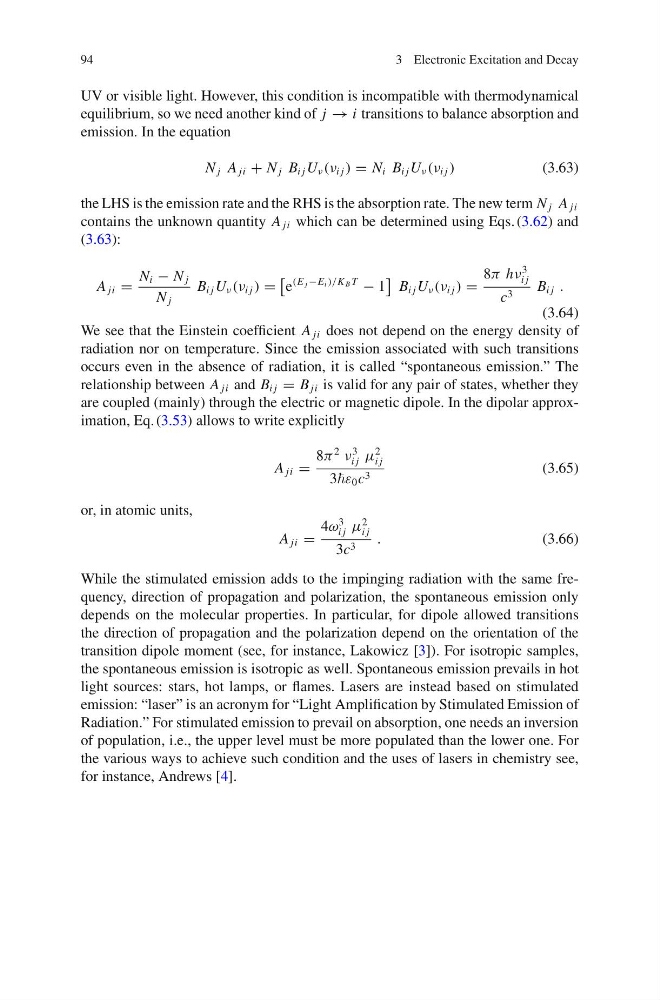
the LHS is the emission rate and the RHS is the absorption rate. The new term N j A ji
contains the unknown quantity A ji which can be determined using Eqs. (3.62) and
(3.63):
A ji =
N i − N j
N j
B i j U ν (ν i j ) =
e
(E j −E i )/K B T
− 1
B i j U ν (ν i j ) =
8π hν
3
i j
c 3
B i j .
(3.64)
We see that the Einstein coefficient A ji does not depend on the energy density of
radiation nor on temperature. Since the emission associated with such transitions
occurs even in the absence of radiation, it is called “spontaneous emission.” The
relationship between A ji and B i j = B ji is valid for any pair of states, whether they
are coupled (mainly) through the electric or magnetic dipole. In the dipolar approximation, Eq. (3.53) allows to write explicitly
A ji =
8π
2
ν
3
i j μ
2
i j
3ε 0 c 3
(3.65)
or, in atomic units,
A ji =
4ω
3
i j μ
2
i j
3c 3 .
(3.66)
While the stimulated emission adds to the impinging radiation with the same frequency, direction of propagation and polarization, the spontaneous emission only
depends on the molecular properties. In particular, for dipole allowed transitions
the direction of propagation and the polarization depend on the orientation of the
transition dipole moment (see, for instance, Lakowicz [3]). For isotropic samples,
the spontaneous emission is isotropic as well. Spontaneous emission prevails in hot
light sources: stars, hot lamps, or flames. Lasers are instead based on stimulated
emission: “laser” is an acronym for “Light Amplification by Stimulated Emission of
Radiation.” For stimulated emission to prevail on absorption, one needs an inversion
of population, i.e., the upper level must be more populated than the lower one. For
the various ways to achieve such condition and the uses of lasers in chemistry see,
for instance, Andrews [4].
3 Electronic Excitation and Decay
UV or visible light. However, this condition is incompatible with thermodynamical
equilibrium, so we need another kind of j → i transitions to balance absorption and
emission. In the equation
N j A ji + N j B i j U ν (ν i j ) = N i B i j U ν (ν i j )
(3.63)
the LHS is the emission rate and the RHS is the absorption rate. The new term N j A ji
contains the unknown quantity A ji which can be determined using Eqs. (3.62) and
(3.63):
A ji =
N i − N j
N j
B i j U ν (ν i j ) =
e
(E j −E i )/K B T
− 1
B i j U ν (ν i j ) =
8π hν
3
i j
c 3
B i j .
(3.64)
We see that the Einstein coefficient A ji does not depend on the energy density of
radiation nor on temperature. Since the emission associated with such transitions
occurs even in the absence of radiation, it is called “spontaneous emission.” The
relationship between A ji and B i j = B ji is valid for any pair of states, whether they
are coupled (mainly) through the electric or magnetic dipole. In the dipolar approximation, Eq. (3.53) allows to write explicitly
A ji =
8π
2
ν
3
i j μ
2
i j
3ε 0 c 3
(3.65)
or, in atomic units,
A ji =
4ω
3
i j μ
2
i j
3c 3 .
(3.66)
While the stimulated emission adds to the impinging radiation with the same frequency, direction of propagation and polarization, the spontaneous emission only
depends on the molecular properties. In particular, for dipole allowed transitions
the direction of propagation and the polarization depend on the orientation of the
transition dipole moment (see, for instance, Lakowicz [3]). For isotropic samples,
the spontaneous emission is isotropic as well. Spontaneous emission prevails in hot
light sources: stars, hot lamps, or flames. Lasers are instead based on stimulated
emission: “laser” is an acronym for “Light Amplification by Stimulated Emission of
Radiation.” For stimulated emission to prevail on absorption, one needs an inversion
of population, i.e., the upper level must be more populated than the lower one. For
the various ways to achieve such condition and the uses of lasers in chemistry see,
for instance, Andrews [4].