

46
3 Layout on Several Rows
Constraints (3.62) and (3.63) define the distances between all pairs of departments. Note that these constraints will be effective only for pairs of departments
that are not in the same row (because if two departments are in the same row, their
distance will be set by constraints (3.61)).
Constraints (3.64) give a trivial lower bound for the distance between the
departments and the left boundary of the layout, and constraints (3.65) require the
betweenness variables to be binary.
The reader may have noticed that this MILO model does not account for the
vertical component of the distance between departments. This can be done by
introducing y variables and including the appropriate constraints based on the
modelling in Sect. 3.2.2.
3.4 Multi-Row Facility Layout with Departments of Equal
Length
This section considers the special case of the MRFLP in which the departments
all have the same length. This means that we can set the lengths of all the
departments equal to 1 without loss of generality. We also assume here that the
set R = {1, 2, . . . , m} of rows available for placing the departments is given. This
special case is called the multi-row equidistant facility layout problem (MREFLP)
and is also known as the equidistant MRFLP. We point out that the formulations in
this section can be specialized to the double-row case (DREFLP).
Before stating the formulations for the MREFLP, we present in Sect. 3.4.1
some theoretical results that derive from its special structure, namely that all the
department lengths are equal. We use these results to write the formulations in the
subsequent sections.
3.4.1 Properties of Optimal Solutions for the MREFLP
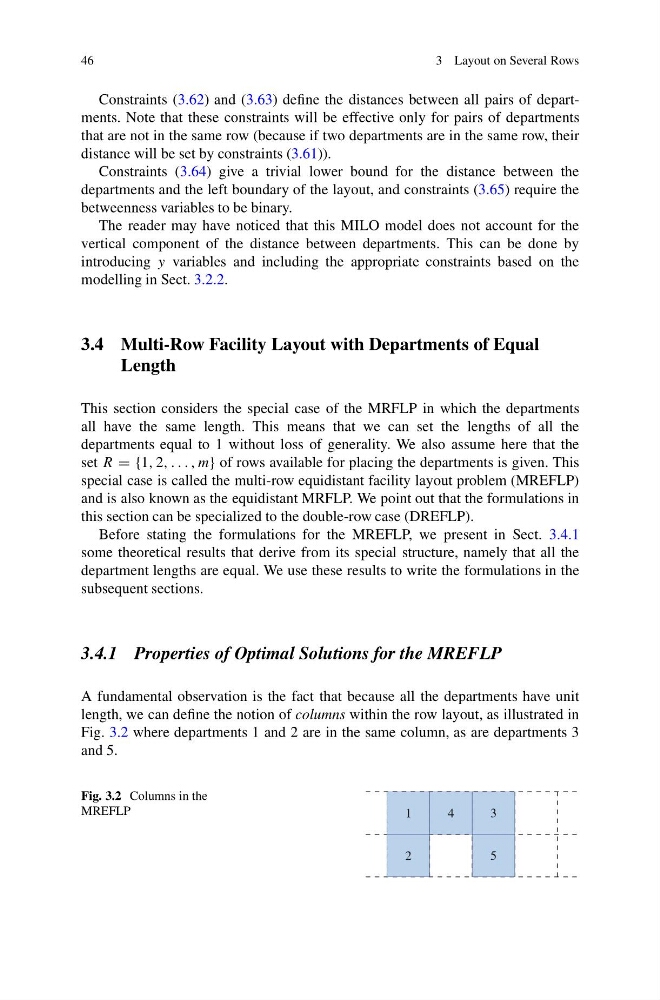
A fundamental observation is the fact that because all the departments have unit
length, we can define the notion of columns within the row layout, as illustrated in
Fig. 3.2 where departments 1 and 2 are in the same column, as are departments 3
and 5.
Fig. 3.2 Columns in the
MREFLP
1
4
3
2
5
3 Layout on Several Rows
Constraints (3.62) and (3.63) define the distances between all pairs of departments. Note that these constraints will be effective only for pairs of departments
that are not in the same row (because if two departments are in the same row, their
distance will be set by constraints (3.61)).
Constraints (3.64) give a trivial lower bound for the distance between the
departments and the left boundary of the layout, and constraints (3.65) require the
betweenness variables to be binary.
The reader may have noticed that this MILO model does not account for the
vertical component of the distance between departments. This can be done by
introducing y variables and including the appropriate constraints based on the
modelling in Sect. 3.2.2.
3.4 Multi-Row Facility Layout with Departments of Equal
Length
This section considers the special case of the MRFLP in which the departments
all have the same length. This means that we can set the lengths of all the
departments equal to 1 without loss of generality. We also assume here that the
set R = {1, 2, . . . , m} of rows available for placing the departments is given. This
special case is called the multi-row equidistant facility layout problem (MREFLP)
and is also known as the equidistant MRFLP. We point out that the formulations in
this section can be specialized to the double-row case (DREFLP).
Before stating the formulations for the MREFLP, we present in Sect. 3.4.1
some theoretical results that derive from its special structure, namely that all the
department lengths are equal. We use these results to write the formulations in the
subsequent sections.
3.4.1 Properties of Optimal Solutions for the MREFLP
A fundamental observation is the fact that because all the departments have unit
length, we can define the notion of columns within the row layout, as illustrated in
Fig. 3.2 where departments 1 and 2 are in the same column, as are departments 3
and 5.
Fig. 3.2 Columns in the
MREFLP
1
4
3
2
5