

3.2 Multi-Row Facility Layout
39
where w i is the width of department i, and for each pair i < j,
α ij =
1, if departments i and j are in the same row
0, otherwise.
This model allows departments to have different widths, but the width of each row
must be (at least) the largest width of the departments it contains. If we assume that
every department can be assigned to every row, then we may simplify the problem by
considering all the departments to have the same width, and this is straightforward
to formulate using MILO.
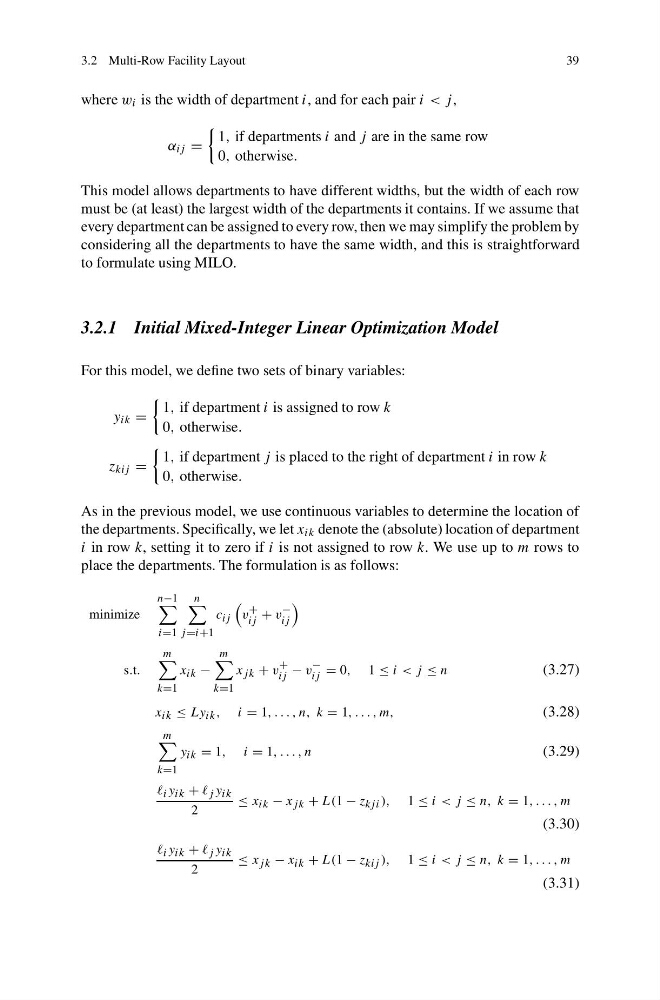
3.2.1 Initial Mixed-Integer Linear Optimization Model
For this model, we define two sets of binary variables:
y ik =
1, if department i is assigned to row k
0, otherwise.
z kij =
1, if department j is placed to the right of department i in row k
0, otherwise.
As in the previous model, we use continuous variables to determine the location of
the departments. Specifically, we let x ik denote the (absolute) location of department
i in row k, setting it to zero if i is not assigned to row k. We use up to m rows to
place the departments. The formulation is as follows:
minimize
n−1
i=1
n
j =i+1
c ij
v
+
ij + v
−
ij
s.t.
m
k=1
x ik −
m
k=1
x jk + v
+
ij − v
−
ij = 0, 1 ≤ i < j ≤ n
(3.27)
x ik ≤ Ly ik , i = 1, . . . , n, k = 1, . . . , m,
(3.28)
m
k=1
y ik = 1, i = 1, . . . , n
(3.29)
i y ik + j y ik
2
≤ x ik − x jk + L(1 − z kj i ), 1 ≤ i < j ≤ n, k = 1, . . . , m
(3.30)
i y ik + j y ik
2
≤ x jk − x ik + L(1 − z kij ), 1 ≤ i < j ≤ n, k = 1, . . . , m
(3.31)
39
where w i is the width of department i, and for each pair i < j,
α ij =
1, if departments i and j are in the same row
0, otherwise.
This model allows departments to have different widths, but the width of each row
must be (at least) the largest width of the departments it contains. If we assume that
every department can be assigned to every row, then we may simplify the problem by
considering all the departments to have the same width, and this is straightforward
to formulate using MILO.
3.2.1 Initial Mixed-Integer Linear Optimization Model
For this model, we define two sets of binary variables:
y ik =
1, if department i is assigned to row k
0, otherwise.
z kij =
1, if department j is placed to the right of department i in row k
0, otherwise.
As in the previous model, we use continuous variables to determine the location of
the departments. Specifically, we let x ik denote the (absolute) location of department
i in row k, setting it to zero if i is not assigned to row k. We use up to m rows to
place the departments. The formulation is as follows:
minimize
n−1
i=1
n
j =i+1
c ij
v
+
ij + v
−
ij
s.t.
m
k=1
x ik −
m
k=1
x jk + v
+
ij − v
−
ij = 0, 1 ≤ i < j ≤ n
(3.27)
x ik ≤ Ly ik , i = 1, . . . , n, k = 1, . . . , m,
(3.28)
m
k=1
y ik = 1, i = 1, . . . , n
(3.29)
i y ik + j y ik
2
≤ x ik − x jk + L(1 − z kj i ), 1 ≤ i < j ≤ n, k = 1, . . . , m
(3.30)
i y ik + j y ik
2
≤ x jk − x ik + L(1 − z kij ), 1 ≤ i < j ≤ n, k = 1, . . . , m
(3.31)