

34
3 Layout on Several Rows
adjacent rows are equal. Under these assumptions, solving an instance of facility
layout on two or more rows involves three related tasks:
1. assign each department to exactly one of the rows;
2. express mathematically the weighted centre-to-centre distance between pairs of
departments (which may or may not be in the same row); and
3. account for the possibility of empty space between departments in the same row.
Clearly, both double-row and multi-row layouts are more challenging than singlerow layout because in the latter there is no need to assign departments to rows
(there is only one row), and c ij ≥ 0 ensures that there is no empty space between
departments at optimality, so that empty space generally does not need to be
modelled. Hence, the focus in the models of Chap. 2 was for the most part on
different ways to mathematically express the centre-to-centre distance between
departments within a row. By contrast, for the models in this chapter we must carry
out all three tasks.
3.1 Double-Row Facility Layout
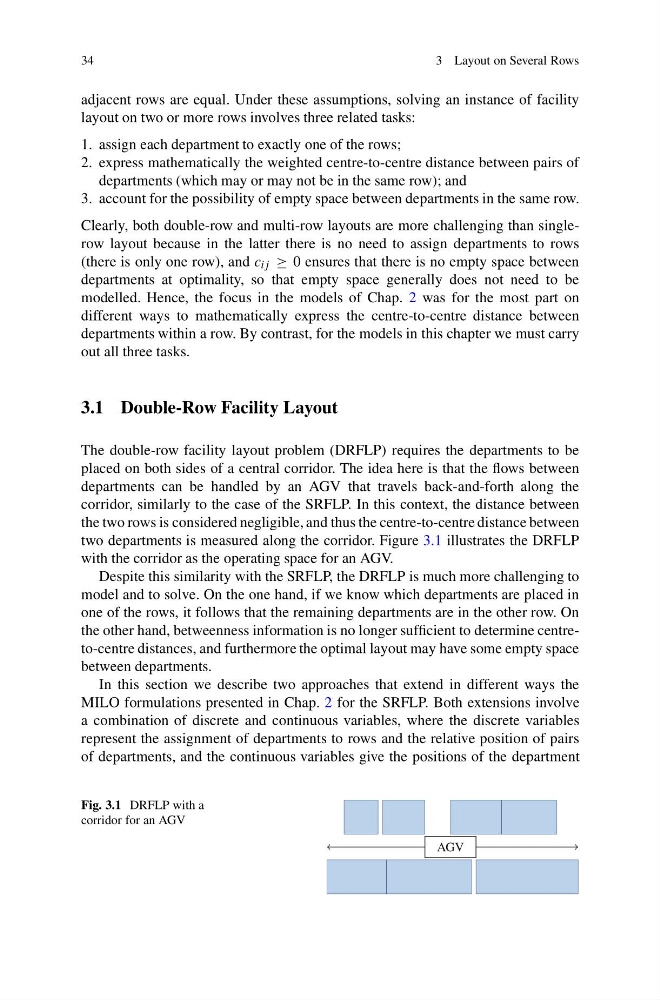
The double-row facility layout problem (DRFLP) requires the departments to be
placed on both sides of a central corridor. The idea here is that the flows between
departments can be handled by an AGV that travels back-and-forth along the
corridor, similarly to the case of the SRFLP. In this context, the distance between
the two rows is considered negligible, and thus the centre-to-centre distance between
two departments is measured along the corridor. Figure 3.1 illustrates the DRFLP
with the corridor as the operating space for an AGV.
Despite this similarity with the SRFLP, the DRFLP is much more challenging to
model and to solve. On the one hand, if we know which departments are placed in
one of the rows, it follows that the remaining departments are in the other row. On
the other hand, betweenness information is no longer sufficient to determine centreto-centre distances, and furthermore the optimal layout may have some empty space
between departments.
In this section we describe two approaches that extend in different ways the
MILO formulations presented in Chap. 2 for the SRFLP. Both extensions involve
a combination of discrete and continuous variables, where the discrete variables
represent the assignment of departments to rows and the relative position of pairs
of departments, and the continuous variables give the positions of the department
Fig. 3.1 DRFLP with a
corridor for an AGV
AGV
3 Layout on Several Rows
adjacent rows are equal. Under these assumptions, solving an instance of facility
layout on two or more rows involves three related tasks:
1. assign each department to exactly one of the rows;
2. express mathematically the weighted centre-to-centre distance between pairs of
departments (which may or may not be in the same row); and
3. account for the possibility of empty space between departments in the same row.
Clearly, both double-row and multi-row layouts are more challenging than singlerow layout because in the latter there is no need to assign departments to rows
(there is only one row), and c ij ≥ 0 ensures that there is no empty space between
departments at optimality, so that empty space generally does not need to be
modelled. Hence, the focus in the models of Chap. 2 was for the most part on
different ways to mathematically express the centre-to-centre distance between
departments within a row. By contrast, for the models in this chapter we must carry
out all three tasks.
3.1 Double-Row Facility Layout
The double-row facility layout problem (DRFLP) requires the departments to be
placed on both sides of a central corridor. The idea here is that the flows between
departments can be handled by an AGV that travels back-and-forth along the
corridor, similarly to the case of the SRFLP. In this context, the distance between
the two rows is considered negligible, and thus the centre-to-centre distance between
two departments is measured along the corridor. Figure 3.1 illustrates the DRFLP
with the corridor as the operating space for an AGV.
Despite this similarity with the SRFLP, the DRFLP is much more challenging to
model and to solve. On the one hand, if we know which departments are placed in
one of the rows, it follows that the remaining departments are in the other row. On
the other hand, betweenness information is no longer sufficient to determine centreto-centre distances, and furthermore the optimal layout may have some empty space
between departments.
In this section we describe two approaches that extend in different ways the
MILO formulations presented in Chap. 2 for the SRFLP. Both extensions involve
a combination of discrete and continuous variables, where the discrete variables
represent the assignment of departments to rows and the relative position of pairs
of departments, and the continuous variables give the positions of the department
Fig. 3.1 DRFLP with a
corridor for an AGV
AGV