

2.3 Realistic Models for Scattering Systems
63
state case). In fact, for r ≤ d the wave function has to be set equal to zero while
r > d the wave function coincides with that of a free particle (see Eq. 2.65)
R L (r) = α l j l (kr) + β l η l (kr).
(2.88)
Having the two solutions coincide at r = d to cancel each other out at this point
(2.88) and, using the Eq. (2.67), we obtain for the phase shift
j l (kd)
η l (kd)
= −
β l
α l
= tan δ l
(2.89)
In the low-energy limit (kd << 1), it is possible to approximate
23 the previous expression as:
tan δ l
kd<<1
∼
(kd)
2l+1
(2l + 1)!!(2l − 1)!!
=
(kd)
2l+1
(2l + 1)(1 · 3 · · · (2l − 1)) 2 .
(2.90)
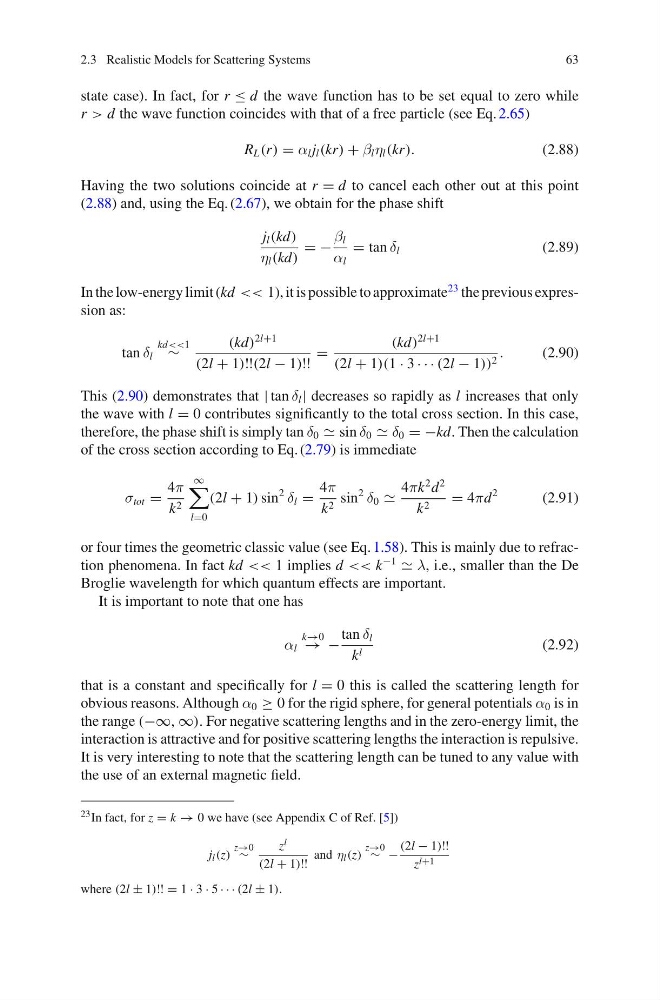
This (2.90) demonstrates that | tan δ l | decreases so rapidly as l increases that only
the wave with l = 0 contributes significantly to the total cross section. In this case,
therefore, the phase shift is simply tan δ 0 sin δ 0 δ 0 = −kd. Then the calculation
of the cross section according to Eq. (2.79) is immediate
σ tot =
4π
k 2
∞
l=0
(2l + 1) sin
2
δ l =
4π
k 2 sin
2
δ 0
4πk
2 d
2
k 2 = 4πd
2
(2.91)
or four times the geometric classic value (see Eq. 1.58). This is mainly due to refraction phenomena. In fact kd << 1 implies d << k
−1
λ, i.e., smaller than the De
Broglie wavelength for which quantum effects are important.
It is important to note that one has
α l
k→0
→ −
tan δ l
k l
(2.92)
that is a constant and specifically for l = 0 this is called the scattering length for
obvious reasons. Although α 0 ≥ 0 for the rigid sphere, for general potentials α 0 is in
the range (−∞, ∞). For negative scattering lengths and in the zero-energy limit, the
interaction is attractive and for positive scattering lengths the interaction is repulsive.
It is very interesting to note that the scattering length can be tuned to any value with
the use of an external magnetic field.
23 In fact, for z = k → 0 we have (see Appendix C of Ref. [5])
j l (z)
z→0
∼
z l
(2l + 1)!!
and η l (z)
z→0
∼ −
(2l − 1)!!
z l+1
where (2l ± 1)!! = 1 · 3 · 5 · · · (2l ± 1).
63
state case). In fact, for r ≤ d the wave function has to be set equal to zero while
r > d the wave function coincides with that of a free particle (see Eq. 2.65)
R L (r) = α l j l (kr) + β l η l (kr).
(2.88)
Having the two solutions coincide at r = d to cancel each other out at this point
(2.88) and, using the Eq. (2.67), we obtain for the phase shift
j l (kd)
η l (kd)
= −
β l
α l
= tan δ l
(2.89)
In the low-energy limit (kd << 1), it is possible to approximate
23 the previous expression as:
tan δ l
kd<<1
∼
(kd)
2l+1
(2l + 1)!!(2l − 1)!!
=
(kd)
2l+1
(2l + 1)(1 · 3 · · · (2l − 1)) 2 .
(2.90)
This (2.90) demonstrates that | tan δ l | decreases so rapidly as l increases that only
the wave with l = 0 contributes significantly to the total cross section. In this case,
therefore, the phase shift is simply tan δ 0 sin δ 0 δ 0 = −kd. Then the calculation
of the cross section according to Eq. (2.79) is immediate
σ tot =
4π
k 2
∞
l=0
(2l + 1) sin
2
δ l =
4π
k 2 sin
2
δ 0
4πk
2 d
2
k 2 = 4πd
2
(2.91)
or four times the geometric classic value (see Eq. 1.58). This is mainly due to refraction phenomena. In fact kd << 1 implies d << k
−1
λ, i.e., smaller than the De
Broglie wavelength for which quantum effects are important.
It is important to note that one has
α l
k→0
→ −
tan δ l
k l
(2.92)
that is a constant and specifically for l = 0 this is called the scattering length for
obvious reasons. Although α 0 ≥ 0 for the rigid sphere, for general potentials α 0 is in
the range (−∞, ∞). For negative scattering lengths and in the zero-energy limit, the
interaction is attractive and for positive scattering lengths the interaction is repulsive.
It is very interesting to note that the scattering length can be tuned to any value with
the use of an external magnetic field.
23 In fact, for z = k → 0 we have (see Appendix C of Ref. [5])
j l (z)
z→0
∼
z l
(2l + 1)!!
and η l (z)
z→0
∼ −
(2l − 1)!!
z l+1
where (2l ± 1)!! = 1 · 3 · 5 · · · (2l ± 1).