

40
2 The Quantum Approach to the Two-Body Problem
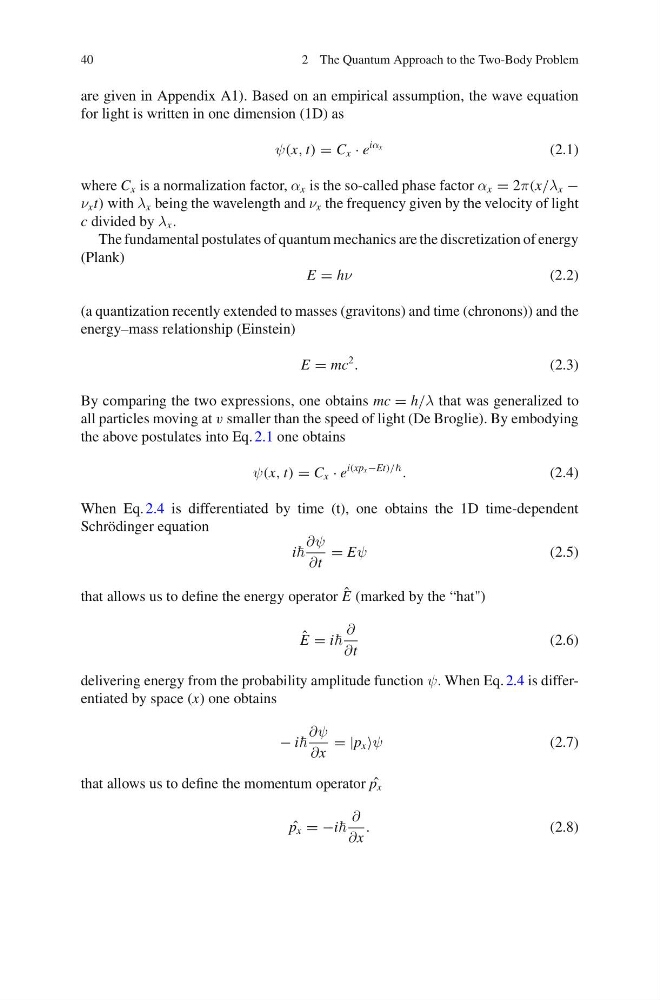
are given in Appendix A1). Based on an empirical assumption, the wave equation
for light is written in one dimension (1D) as
ψ(x, t) = C x · e
iα x
(2.1)
where C x is a normalization factor, α x is the so-called phase factor α x = 2π(x/λ x −
ν x t) with λ x being the wavelength and ν x the frequency given by the velocity of light
c divided by λ x .
The fundamental postulates of quantum mechanics are the discretization of energy
(Plank)
E = hν
(2.2)
(a quantization recently extended to masses (gravitons) and time (chronons)) and the
energy–mass relationship (Einstein)
E = mc
2
.
(2.3)
By comparing the two expressions, one obtains mc = h/λ that was generalized to
all particles moving at v smaller than the speed of light (De Broglie). By embodying
the above postulates into Eq. 2.1 one obtains
ψ(x, t) = C x · e
i(xp x −Et)/
.
(2.4)
When Eq. 2.4 is differentiated by time (t), one obtains the 1D time-dependent
Schrödinger equation
i
∂ψ
∂t
= Eψ
(2.5)
that allows us to define the energy operator ˆ
E (marked by the “hat")
ˆ
E = i
∂
∂t
(2.6)
delivering energy from the probability amplitude function ψ. When Eq. 2.4 is differentiated by space (x) one obtains
− i
∂ψ
∂x
= |p x ψ
(2.7)
that allows us to define the momentum operator ˆ
p x
ˆ
p x = −i
∂
∂x
.
(2.8)
2 The Quantum Approach to the Two-Body Problem
are given in Appendix A1). Based on an empirical assumption, the wave equation
for light is written in one dimension (1D) as
ψ(x, t) = C x · e
iα x
(2.1)
where C x is a normalization factor, α x is the so-called phase factor α x = 2π(x/λ x −
ν x t) with λ x being the wavelength and ν x the frequency given by the velocity of light
c divided by λ x .
The fundamental postulates of quantum mechanics are the discretization of energy
(Plank)
E = hν
(2.2)
(a quantization recently extended to masses (gravitons) and time (chronons)) and the
energy–mass relationship (Einstein)
E = mc
2
.
(2.3)
By comparing the two expressions, one obtains mc = h/λ that was generalized to
all particles moving at v smaller than the speed of light (De Broglie). By embodying
the above postulates into Eq. 2.1 one obtains
ψ(x, t) = C x · e
i(xp x −Et)/
.
(2.4)
When Eq. 2.4 is differentiated by time (t), one obtains the 1D time-dependent
Schrödinger equation
i
∂ψ
∂t
= Eψ
(2.5)
that allows us to define the energy operator ˆ
E (marked by the “hat")
ˆ
E = i
∂
∂t
(2.6)
delivering energy from the probability amplitude function ψ. When Eq. 2.4 is differentiated by space (x) one obtains
− i
∂ψ
∂x
= |p x ψ
(2.7)
that allows us to define the momentum operator ˆ
p x
ˆ
p x = −i
∂
∂x
.
(2.8)