

1.2 Classical Mechanics of Two-Particle Collisions
13
The repulsive interaction (like the one between two charges of the same sign) is
completely intuitive. The repulsion is very large at small distance (at the distance
where the particles nearly coalesce) and, as the two bodies move away from one
another, the interaction monotonically decreases. Similarly, the second type of force
attraction (such as that between two charges of opposite sign) is also negligible
at large distances. The attractive force tends to bring the two bodies together and
the magnitude of the interaction monotonically increases as they approach each
other. The same reasoning applies to the multipoles with different orientations. The
interaction is repulsive if the polarities are facing mainly of the same sign, and attract
each other if the polarities are facing mainly of different signs.
Yet, the most important role in chemistry is played by the third type of interaction
that can change from attractive to repulsive at different internuclear separations. It is
less intuitive but even more general and realistic. This type of interaction tends to be
more attractive at large distances and then becomes more repulsive at smaller internuclear distances. Thus, this system has an equilibrium distance where the interaction
is most attractive.
1.2.2 The Equations of Motion
As we have just seen, a complete description of the system of two particles A and B,
with masses m A and m B , must be based not only on the position vectors r A and r B
but also on their variation over time. For this reason, it is necessary to determine the
(linear) momenta p A and p B of the two particles as well. The space defined by the
set of pairs of conjugated variables (position r i and momentum p i for all particles
of the system under consideration is called “phase space”). Different points of the
phase space are characterized by different states of a classical system (the position
vectors r A and r B and their respective momenta p r A and p r B ). In Newton’s second
law, the motion of each particle is described by coupled 6N (where N is the number of
particles of the system) mathematical equations F i = dp i /dt and p i =m i v i = m i dr i /dt
in the coordinates of the chosen frame. The Hamiltonian of the two-body system is
given by
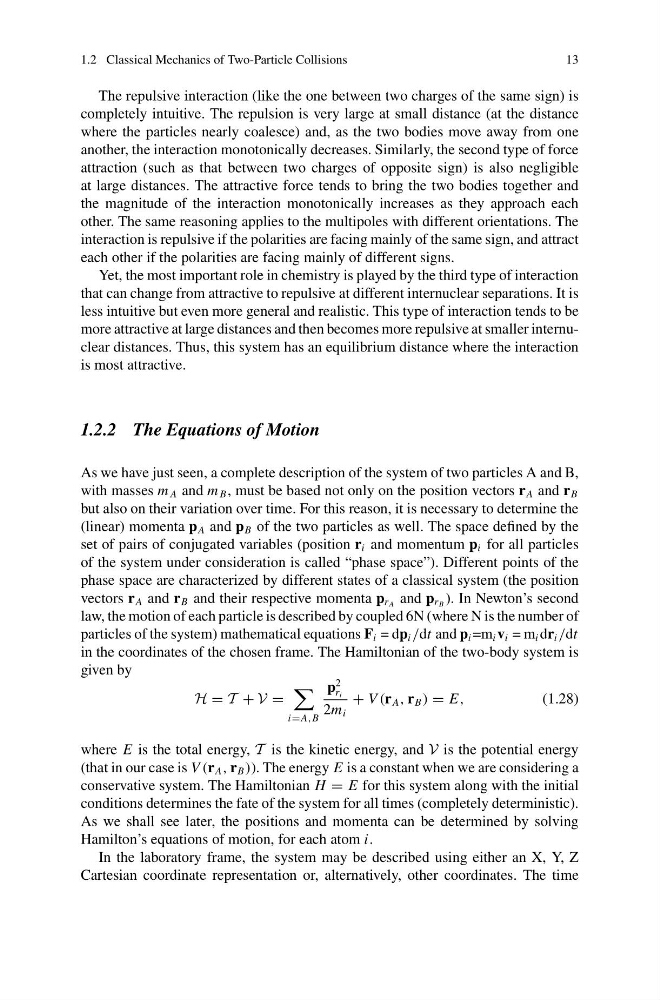
H = T + V =
i=A,B
p
2
r i
2m i
+ V (r A , r B ) = E,
(1.28)
where E is the total energy, T is the kinetic energy, and V is the potential energy
(that in our case is V (r A , r B )). The energy E is a constant when we are considering a
conservative system. The Hamiltonian H = E for this system along with the initial
conditions determines the fate of the system for all times (completely deterministic).
As we shall see later, the positions and momenta can be determined by solving
Hamilton’s equations of motion, for each atom i.
In the laboratory frame, the system may be described using either an X, Y, Z
Cartesian coordinate representation or, alternatively, other coordinates. The time
13
The repulsive interaction (like the one between two charges of the same sign) is
completely intuitive. The repulsion is very large at small distance (at the distance
where the particles nearly coalesce) and, as the two bodies move away from one
another, the interaction monotonically decreases. Similarly, the second type of force
attraction (such as that between two charges of opposite sign) is also negligible
at large distances. The attractive force tends to bring the two bodies together and
the magnitude of the interaction monotonically increases as they approach each
other. The same reasoning applies to the multipoles with different orientations. The
interaction is repulsive if the polarities are facing mainly of the same sign, and attract
each other if the polarities are facing mainly of different signs.
Yet, the most important role in chemistry is played by the third type of interaction
that can change from attractive to repulsive at different internuclear separations. It is
less intuitive but even more general and realistic. This type of interaction tends to be
more attractive at large distances and then becomes more repulsive at smaller internuclear distances. Thus, this system has an equilibrium distance where the interaction
is most attractive.
1.2.2 The Equations of Motion
As we have just seen, a complete description of the system of two particles A and B,
with masses m A and m B , must be based not only on the position vectors r A and r B
but also on their variation over time. For this reason, it is necessary to determine the
(linear) momenta p A and p B of the two particles as well. The space defined by the
set of pairs of conjugated variables (position r i and momentum p i for all particles
of the system under consideration is called “phase space”). Different points of the
phase space are characterized by different states of a classical system (the position
vectors r A and r B and their respective momenta p r A and p r B ). In Newton’s second
law, the motion of each particle is described by coupled 6N (where N is the number of
particles of the system) mathematical equations F i = dp i /dt and p i =m i v i = m i dr i /dt
in the coordinates of the chosen frame. The Hamiltonian of the two-body system is
given by
H = T + V =
i=A,B
p
2
r i
2m i
+ V (r A , r B ) = E,
(1.28)
where E is the total energy, T is the kinetic energy, and V is the potential energy
(that in our case is V (r A , r B )). The energy E is a constant when we are considering a
conservative system. The Hamiltonian H = E for this system along with the initial
conditions determines the fate of the system for all times (completely deterministic).
As we shall see later, the positions and momenta can be determined by solving
Hamilton’s equations of motion, for each atom i.
In the laboratory frame, the system may be described using either an X, Y, Z
Cartesian coordinate representation or, alternatively, other coordinates. The time