

1.2 Classical Mechanics of Two-Particle Collisions
11
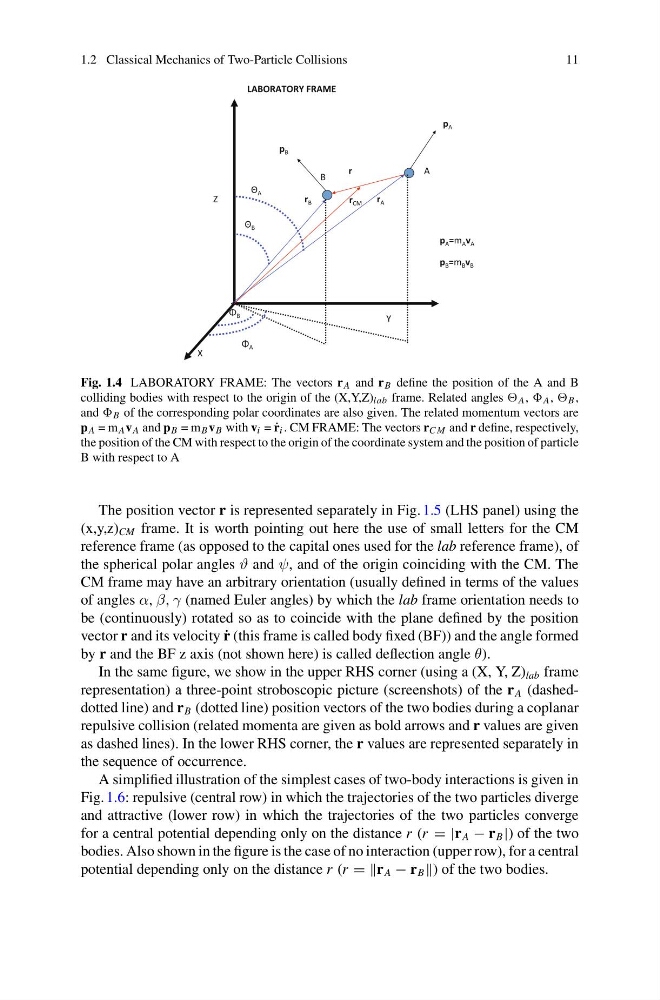
Fig. 1.4 LABORATORY FRAME: The vectors r A and r B define the position of the A and B
colliding bodies with respect to the origin of the (X,Y,Z) lab frame. Related angles A , A , B ,
and B of the corresponding polar coordinates are also given. The related momentum vectors are
p A = m A v A and p B = m B v B with v i = ˙
r i . CM FRAME: The vectors r C M and r define, respectively,
the position of the CM with respect to the origin of the coordinate system and the position of particle
B with respect to A
The position vector r is represented separately in Fig. 1.5 (LHS panel) using the
(x,y,z) CM frame. It is worth pointing out here the use of small letters for the CM
reference frame (as opposed to the capital ones used for the lab reference frame), of
the spherical polar angles ϑ and ψ, and of the origin coinciding with the CM. The
CM frame may have an arbitrary orientation (usually defined in terms of the values
of angles α, β, γ (named Euler angles) by which the lab frame orientation needs to
be (continuously) rotated so as to coincide with the plane defined by the position
vector r and its velocity ˙
r (this frame is called body fixed (BF)) and the angle formed
by r and the BF z axis (not shown here) is called deflection angle θ).
In the same figure, we show in the upper RHS corner (using a (X, Y, Z) lab frame
representation) a three-point stroboscopic picture (screenshots) of the r A (dasheddotted line) and r B (dotted line) position vectors of the two bodies during a coplanar
repulsive collision (related momenta are given as bold arrows and r values are given
as dashed lines). In the lower RHS corner, the r values are represented separately in
the sequence of occurrence.
A simplified illustration of the simplest cases of two-body interactions is given in
Fig. 1.6: repulsive (central row) in which the trajectories of the two particles diverge
and attractive (lower row) in which the trajectories of the two particles converge
for a central potential depending only on the distance r (r = |r A − r B |) of the two
bodies. Also shown in the figure is the case of no interaction (upper row), for a central
potential depending only on the distance r (r = =r A − r B ) of the two bodies.
11
Fig. 1.4 LABORATORY FRAME: The vectors r A and r B define the position of the A and B
colliding bodies with respect to the origin of the (X,Y,Z) lab frame. Related angles A , A , B ,
and B of the corresponding polar coordinates are also given. The related momentum vectors are
p A = m A v A and p B = m B v B with v i = ˙
r i . CM FRAME: The vectors r C M and r define, respectively,
the position of the CM with respect to the origin of the coordinate system and the position of particle
B with respect to A
The position vector r is represented separately in Fig. 1.5 (LHS panel) using the
(x,y,z) CM frame. It is worth pointing out here the use of small letters for the CM
reference frame (as opposed to the capital ones used for the lab reference frame), of
the spherical polar angles ϑ and ψ, and of the origin coinciding with the CM. The
CM frame may have an arbitrary orientation (usually defined in terms of the values
of angles α, β, γ (named Euler angles) by which the lab frame orientation needs to
be (continuously) rotated so as to coincide with the plane defined by the position
vector r and its velocity ˙
r (this frame is called body fixed (BF)) and the angle formed
by r and the BF z axis (not shown here) is called deflection angle θ).
In the same figure, we show in the upper RHS corner (using a (X, Y, Z) lab frame
representation) a three-point stroboscopic picture (screenshots) of the r A (dasheddotted line) and r B (dotted line) position vectors of the two bodies during a coplanar
repulsive collision (related momenta are given as bold arrows and r values are given
as dashed lines). In the lower RHS corner, the r values are represented separately in
the sequence of occurrence.
A simplified illustration of the simplest cases of two-body interactions is given in
Fig. 1.6: repulsive (central row) in which the trajectories of the two particles diverge
and attractive (lower row) in which the trajectories of the two particles converge
for a central potential depending only on the distance r (r = |r A − r B |) of the two
bodies. Also shown in the figure is the case of no interaction (upper row), for a central
potential depending only on the distance r (r = =r A − r B ) of the two bodies.