

196
5 Complex Reactive Applications: A Forward Look to Open Science
a rigid rotor. The orbital angular momentum quantum number should vary from
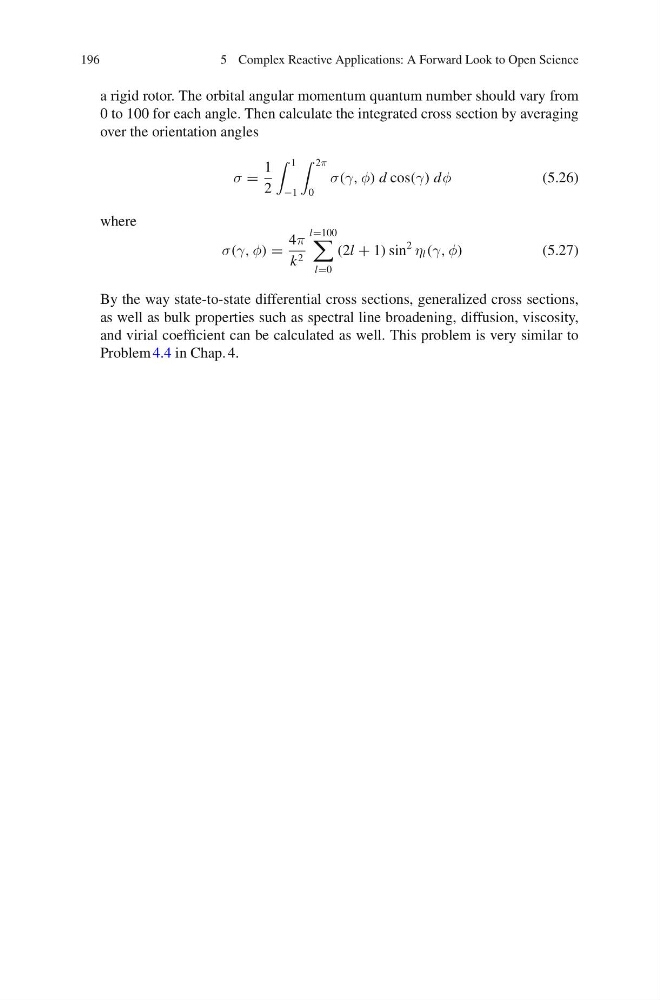
0 to 100 for each angle. Then calculate the integrated cross section by averaging
over the orientation angles
σ =
1
2
1
−1
2π
0
σ(γ, φ) d cos(γ) dφ
(5.26)
where
σ(γ, φ) =
4π
k 2
l=100
l=0
(2l + 1) sin
2
η l (γ, φ)
(5.27)
By the way state-to-state differential cross sections, generalized cross sections,
as well as bulk properties such as spectral line broadening, diffusion, viscosity,
and virial coefficient can be calculated as well. This problem is very similar to
Problem 4.4 in Chap. 4.
5 Complex Reactive Applications: A Forward Look to Open Science
a rigid rotor. The orbital angular momentum quantum number should vary from
0 to 100 for each angle. Then calculate the integrated cross section by averaging
over the orientation angles
σ =
1
2
1
−1
2π
0
σ(γ, φ) d cos(γ) dφ
(5.26)
where
σ(γ, φ) =
4π
k 2
l=100
l=0
(2l + 1) sin
2
η l (γ, φ)
(5.27)
By the way state-to-state differential cross sections, generalized cross sections,
as well as bulk properties such as spectral line broadening, diffusion, viscosity,
and virial coefficient can be calculated as well. This problem is very similar to
Problem 4.4 in Chap. 4.