

174
5 Complex Reactive Applications: A Forward Look to Open Science
cedures pushing computer architectures into the era of present supercomputers. In
molecular sciences this has meant in particular the enhancement of the performances
of electronic structure calculations based on matrix manipulations and linear algebra
operations despite their mixed heterogenous nature born out of subsequent stratifications of different software components. After all, as already pointed out, this has
happened during times in which scientific interests (including those in molecular
science) were the driving force for advancing the design of computer architectures.
The decisive leap forward, however, in molecular science computing has leveraged
on the introduction of multicore and multi-CPU machines prompted by more marketoriented consumer electronics.
Important steps of this process were the assemblage of single instruction stream
multiple data stream (SIMD) platforms (array processors, vector computers, etc.)
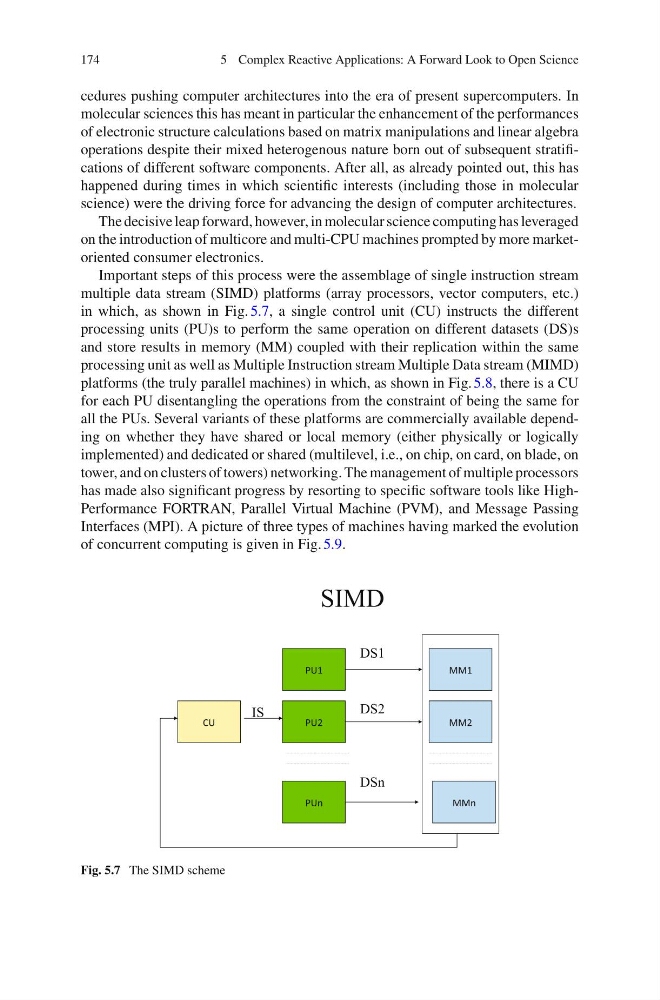
in which, as shown in Fig. 5.7, a single control unit (CU) instructs the different
processing units (PU)s to perform the same operation on different datasets (DS)s
and store results in memory (MM) coupled with their replication within the same
processing unit as well as Multiple Instruction stream Multiple Data stream (MIMD)
platforms (the truly parallel machines) in which, as shown in Fig. 5.8, there is a CU
for each PU disentangling the operations from the constraint of being the same for
all the PUs. Several variants of these platforms are commercially available depending on whether they have shared or local memory (either physically or logically
implemented) and dedicated or shared (multilevel, i.e., on chip, on card, on blade, on
tower, and on clusters of towers) networking. The management of multiple processors
has made also significant progress by resorting to specific software tools like HighPerformance FORTRAN, Parallel Virtual Machine (PVM), and Message Passing
Interfaces (MPI). A picture of three types of machines having marked the evolution
of concurrent computing is given in Fig. 5.9.
Fig. 5.7 The SIMD scheme
5 Complex Reactive Applications: A Forward Look to Open Science
cedures pushing computer architectures into the era of present supercomputers. In
molecular sciences this has meant in particular the enhancement of the performances
of electronic structure calculations based on matrix manipulations and linear algebra
operations despite their mixed heterogenous nature born out of subsequent stratifications of different software components. After all, as already pointed out, this has
happened during times in which scientific interests (including those in molecular
science) were the driving force for advancing the design of computer architectures.
The decisive leap forward, however, in molecular science computing has leveraged
on the introduction of multicore and multi-CPU machines prompted by more marketoriented consumer electronics.
Important steps of this process were the assemblage of single instruction stream
multiple data stream (SIMD) platforms (array processors, vector computers, etc.)
in which, as shown in Fig. 5.7, a single control unit (CU) instructs the different
processing units (PU)s to perform the same operation on different datasets (DS)s
and store results in memory (MM) coupled with their replication within the same
processing unit as well as Multiple Instruction stream Multiple Data stream (MIMD)
platforms (the truly parallel machines) in which, as shown in Fig. 5.8, there is a CU
for each PU disentangling the operations from the constraint of being the same for
all the PUs. Several variants of these platforms are commercially available depending on whether they have shared or local memory (either physically or logically
implemented) and dedicated or shared (multilevel, i.e., on chip, on card, on blade, on
tower, and on clusters of towers) networking. The management of multiple processors
has made also significant progress by resorting to specific software tools like HighPerformance FORTRAN, Parallel Virtual Machine (PVM), and Message Passing
Interfaces (MPI). A picture of three types of machines having marked the evolution
of concurrent computing is given in Fig. 5.9.
Fig. 5.7 The SIMD scheme