

5.1 Toward More Complex Systems
165
• OBSERVABLES, for model and statistical treatments necessary to cover the last
mile to measurable properties when the physical parameters of the experimental
apparatus are available to allow the evaluation of the experimental signal (like
when performing the conversion from CM quantities to the lab ones).
The GEMS scheme can be iteratively performed until theoretical outcomes agree
with experimental data better than the error of the numerical approximations and/or
the experimental uncertainties.
5.2 Large Systems Studies Using Classical Dynamics
5.2.1 Trajectory Studies for Many-Body Systems
The massive exploitation of the advanced features of parallel machines has impacted
significantly on the performance of molecular science calculations especially for
codes based on highly decoupled tasks. For these codes, in fact, data transfer is minimal and computations run as independent events resulting in a significant increase of
the performances (especially if the memory used is small and the number crunching
section of the procedure is large). This is the case, in fact, of many atoms trajectory (classical mechanics) codes. Trajectories, in fact, can be followed by integrating
numerically the corresponding set of first-order ordinary differential Hamilton equations (see Eq. 1.29) or equivalent ones like the Newton’s second law for which each
particle has
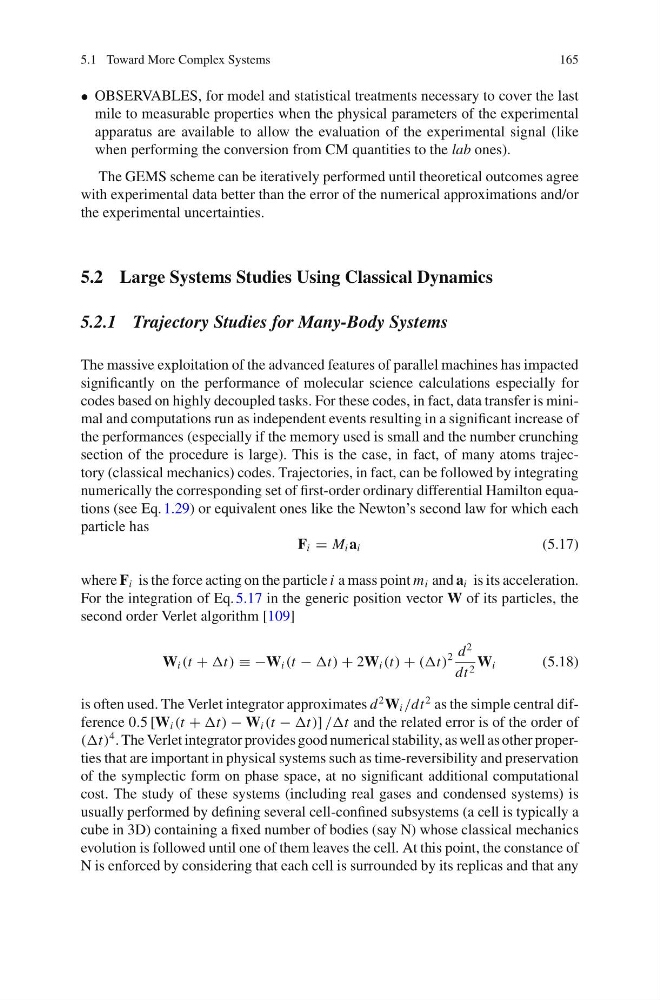
F i = M i a i
(5.17)
where F i is the force acting on the particle i a mass point m i and a i is its acceleration.
For the integration of Eq. 5.17 in the generic position vector W of its particles, the
second order Verlet algorithm [109]
W i (t + t) ≡ −W i (t − t) + 2W i (t) + ((t)
2 d
2
dt 2 W i
(5.18)
is often used. The Verlet integrator approximates d
2 W i /dt
2 as the simple central difference 0.5 [W i (t + t) − W i (t − t)] //t and the related error is of the order of
((t)
4 . The Verlet integrator provides good numerical stability, as well as other properties that are important in physical systems such as time-reversibility and preservation
of the symplectic form on phase space, at no significant additional computational
cost. The study of these systems (including real gases and condensed systems) is
usually performed by defining several cell-confined subsystems (a cell is typically a
cube in 3D) containing a fixed number of bodies (say N) whose classical mechanics
evolution is followed until one of them leaves the cell. At this point, the constance of
N is enforced by considering that each cell is surrounded by its replicas and that any
165
• OBSERVABLES, for model and statistical treatments necessary to cover the last
mile to measurable properties when the physical parameters of the experimental
apparatus are available to allow the evaluation of the experimental signal (like
when performing the conversion from CM quantities to the lab ones).
The GEMS scheme can be iteratively performed until theoretical outcomes agree
with experimental data better than the error of the numerical approximations and/or
the experimental uncertainties.
5.2 Large Systems Studies Using Classical Dynamics
5.2.1 Trajectory Studies for Many-Body Systems
The massive exploitation of the advanced features of parallel machines has impacted
significantly on the performance of molecular science calculations especially for
codes based on highly decoupled tasks. For these codes, in fact, data transfer is minimal and computations run as independent events resulting in a significant increase of
the performances (especially if the memory used is small and the number crunching
section of the procedure is large). This is the case, in fact, of many atoms trajectory (classical mechanics) codes. Trajectories, in fact, can be followed by integrating
numerically the corresponding set of first-order ordinary differential Hamilton equations (see Eq. 1.29) or equivalent ones like the Newton’s second law for which each
particle has
F i = M i a i
(5.17)
where F i is the force acting on the particle i a mass point m i and a i is its acceleration.
For the integration of Eq. 5.17 in the generic position vector W of its particles, the
second order Verlet algorithm [109]
W i (t + t) ≡ −W i (t − t) + 2W i (t) + ((t)
2 d
2
dt 2 W i
(5.18)
is often used. The Verlet integrator approximates d
2 W i /dt
2 as the simple central difference 0.5 [W i (t + t) − W i (t − t)] //t and the related error is of the order of
((t)
4 . The Verlet integrator provides good numerical stability, as well as other properties that are important in physical systems such as time-reversibility and preservation
of the symplectic form on phase space, at no significant additional computational
cost. The study of these systems (including real gases and condensed systems) is
usually performed by defining several cell-confined subsystems (a cell is typically a
cube in 3D) containing a fixed number of bodies (say N) whose classical mechanics
evolution is followed until one of them leaves the cell. At this point, the constance of
N is enforced by considering that each cell is surrounded by its replicas and that any