

5.1 Toward More Complex Systems
155
x
y
z
B
D
W CM
4 ATOMS JACOBI
COORDINATES
x CM
y CM
z CM
r 2
1 =m A m B /(m A +m B )
C
R
= µ 1 µ 2 /(µ 1 +µ 2 )= µ 1 µ 2 /M
A
r 1
2
1
2 =m C m D /(m C +m D )
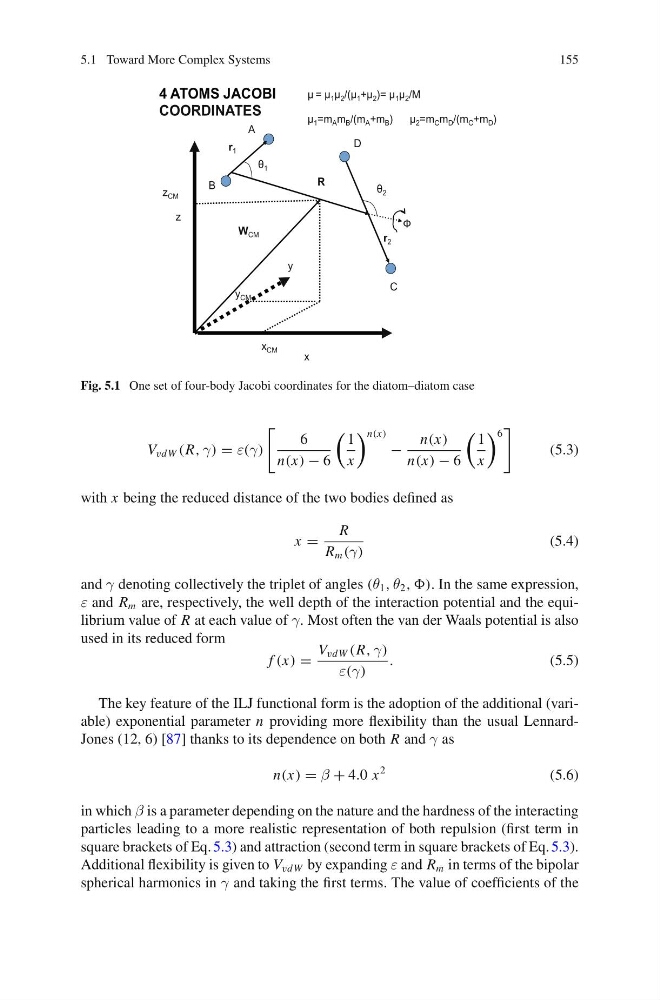
Fig. 5.1 One set of four-body Jacobi coordinates for the diatom–diatom case
V vdW (R, γ) = ε(γ)
6
n(x) − 6
1
x
n(x)
−
n(x)
n(x) − 6
1
x
6
(5.3)
with x being the reduced distance of the two bodies defined as
x =
R
R m (γ)
(5.4)
and γ denoting collectively the triplet of angles (θ 1 , θ 2 , ,). In the same expression,
ε and R m are, respectively, the well depth of the interaction potential and the equilibrium value of R at each value of γ. Most often the van der Waals potential is also
used in its reduced form
f (x) =
V vdW (R, γ)
ε(γ)
.
(5.5)
The key feature of the ILJ functional form is the adoption of the additional (variable) exponential parameter n providing more flexibility than the usual LennardJones (12, 6) [87] thanks to its dependence on both R and γ as
n(x) = β + 4.0 x
2
(5.6)
in which β is a parameter depending on the nature and the hardness of the interacting
particles leading to a more realistic representation of both repulsion (first term in
square brackets of Eq. 5.3) and attraction (second term in square brackets of Eq. 5.3).
Additional flexibility is given to V vdW by expanding ε and R m in terms of the bipolar
spherical harmonics in γ and taking the first terms. The value of coefficients of the
155
x
y
z
B
D
W CM
4 ATOMS JACOBI
COORDINATES
x CM
y CM
z CM
r 2
1 =m A m B /(m A +m B )
C
R
= µ 1 µ 2 /(µ 1 +µ 2 )= µ 1 µ 2 /M
A
r 1
2
1
2 =m C m D /(m C +m D )
Fig. 5.1 One set of four-body Jacobi coordinates for the diatom–diatom case
V vdW (R, γ) = ε(γ)
6
n(x) − 6
1
x
n(x)
−
n(x)
n(x) − 6
1
x
6
(5.3)
with x being the reduced distance of the two bodies defined as
x =
R
R m (γ)
(5.4)
and γ denoting collectively the triplet of angles (θ 1 , θ 2 , ,). In the same expression,
ε and R m are, respectively, the well depth of the interaction potential and the equilibrium value of R at each value of γ. Most often the van der Waals potential is also
used in its reduced form
f (x) =
V vdW (R, γ)
ε(γ)
.
(5.5)
The key feature of the ILJ functional form is the adoption of the additional (variable) exponential parameter n providing more flexibility than the usual LennardJones (12, 6) [87] thanks to its dependence on both R and γ as
n(x) = β + 4.0 x
2
(5.6)
in which β is a parameter depending on the nature and the hardness of the interacting
particles leading to a more realistic representation of both repulsion (first term in
square brackets of Eq. 5.3) and attraction (second term in square brackets of Eq. 5.3).
Additional flexibility is given to V vdW by expanding ε and R m in terms of the bipolar
spherical harmonics in γ and taking the first terms. The value of coefficients of the