

142
4 The Treatment of Few-Body Reactions
0.25 0.30 0.35 0.40 0.45 0.50 0.55 0.60 0.65 0.70 0.75
0.00
0.05
0.10
0.15
0.20
0.25
H+LiF(v'=0,j'=0)
H+LiF(v'=0,j'=1)
H+LiF(v'=0,j'=2)
H+LiF(v'=0,j'=3)
H+LiF(v'=0,j'=4)
H+LiF(v'=0,j'=5)
H+LiF(v'=0,j'=6)
H+LiF(v'=0,j'=7)
H+LiF(v'=0,j'=8)
H+LiF(v'=0,j'=9)
H+LiF(Total)
Probability from Li+FH(v=0, j=0) to H+LiF(v'=0,j')
Energy/eV
Li+HF
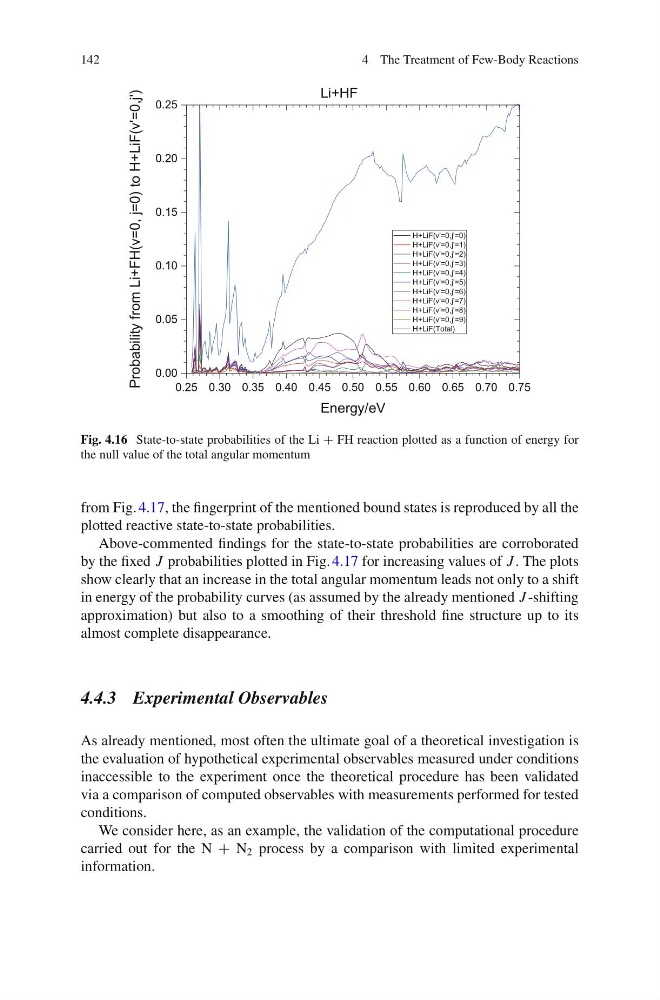
Fig. 4.16 State-to-state probabilities of the Li + FH reaction plotted as a function of energy for
the null value of the total angular momentum
from Fig. 4.17, the fingerprint of the mentioned bound states is reproduced by all the
plotted reactive state-to-state probabilities.
Above-commented findings for the state-to-state probabilities are corroborated
by the fixed J probabilities plotted in Fig. 4.17 for increasing values of J . The plots
show clearly that an increase in the total angular momentum leads not only to a shift
in energy of the probability curves (as assumed by the already mentioned J -shifting
approximation) but also to a smoothing of their threshold fine structure up to its
almost complete disappearance.
4.4.3 Experimental Observables
As already mentioned, most often the ultimate goal of a theoretical investigation is
the evaluation of hypothetical experimental observables measured under conditions
inaccessible to the experiment once the theoretical procedure has been validated
via a comparison of computed observables with measurements performed for tested
conditions.
We consider here, as an example, the validation of the computational procedure
carried out for the N + N 2 process by a comparison with limited experimental
information.
4 The Treatment of Few-Body Reactions
0.25 0.30 0.35 0.40 0.45 0.50 0.55 0.60 0.65 0.70 0.75
0.00
0.05
0.10
0.15
0.20
0.25
H+LiF(v'=0,j'=0)
H+LiF(v'=0,j'=1)
H+LiF(v'=0,j'=2)
H+LiF(v'=0,j'=3)
H+LiF(v'=0,j'=4)
H+LiF(v'=0,j'=5)
H+LiF(v'=0,j'=6)
H+LiF(v'=0,j'=7)
H+LiF(v'=0,j'=8)
H+LiF(v'=0,j'=9)
H+LiF(Total)
Probability from Li+FH(v=0, j=0) to H+LiF(v'=0,j')
Energy/eV
Li+HF
Fig. 4.16 State-to-state probabilities of the Li + FH reaction plotted as a function of energy for
the null value of the total angular momentum
from Fig. 4.17, the fingerprint of the mentioned bound states is reproduced by all the
plotted reactive state-to-state probabilities.
Above-commented findings for the state-to-state probabilities are corroborated
by the fixed J probabilities plotted in Fig. 4.17 for increasing values of J . The plots
show clearly that an increase in the total angular momentum leads not only to a shift
in energy of the probability curves (as assumed by the already mentioned J -shifting
approximation) but also to a smoothing of their threshold fine structure up to its
almost complete disappearance.
4.4.3 Experimental Observables
As already mentioned, most often the ultimate goal of a theoretical investigation is
the evaluation of hypothetical experimental observables measured under conditions
inaccessible to the experiment once the theoretical procedure has been validated
via a comparison of computed observables with measurements performed for tested
conditions.
We consider here, as an example, the validation of the computational procedure
carried out for the N + N 2 process by a comparison with limited experimental
information.