

140
4 The Treatment of Few-Body Reactions
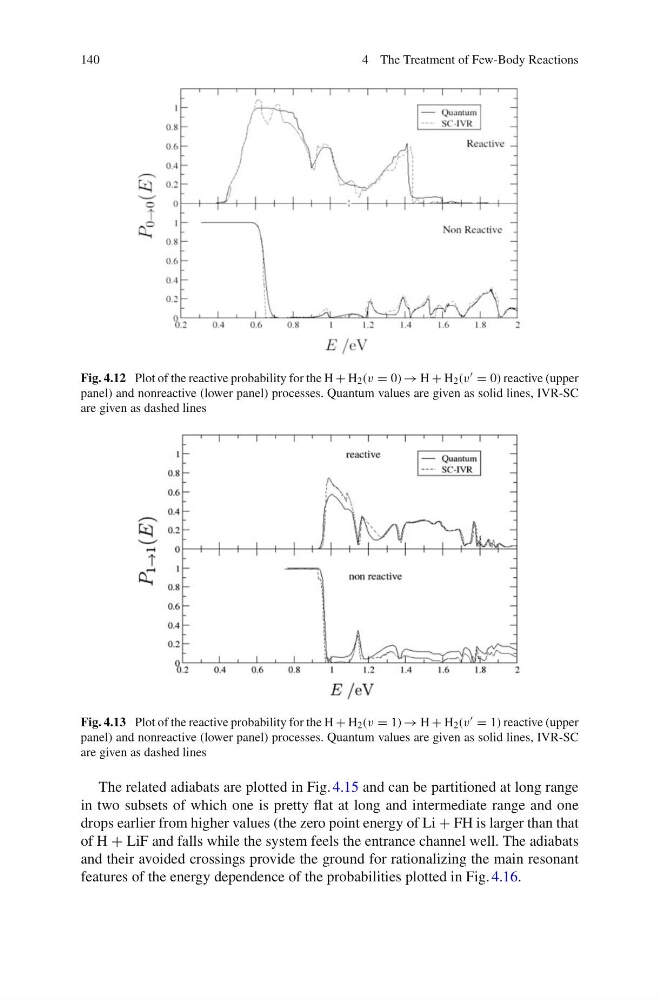
Fig. 4.12 Plot of the reactive probability for the H + H 2 (v = 0) → H + H 2 (v = 0) reactive (upper
panel) and nonreactive (lower panel) processes. Quantum values are given as solid lines, IVR-SC
are given as dashed lines
Fig. 4.13 Plot of the reactive probability for the H + H 2 (v = 1) → H + H 2 (v = 1) reactive (upper
panel) and nonreactive (lower panel) processes. Quantum values are given as solid lines, IVR-SC
are given as dashed lines
The related adiabats are plotted in Fig. 4.15 and can be partitioned at long range
in two subsets of which one is pretty flat at long and intermediate range and one
drops earlier from higher values (the zero point energy of Li + FH is larger than that
of H + LiF and falls while the system feels the entrance channel well. The adiabats
and their avoided crossings provide the ground for rationalizing the main resonant
features of the energy dependence of the probabilities plotted in Fig. 4.16.
4 The Treatment of Few-Body Reactions
Fig. 4.12 Plot of the reactive probability for the H + H 2 (v = 0) → H + H 2 (v = 0) reactive (upper
panel) and nonreactive (lower panel) processes. Quantum values are given as solid lines, IVR-SC
are given as dashed lines
Fig. 4.13 Plot of the reactive probability for the H + H 2 (v = 1) → H + H 2 (v = 1) reactive (upper
panel) and nonreactive (lower panel) processes. Quantum values are given as solid lines, IVR-SC
are given as dashed lines
The related adiabats are plotted in Fig. 4.15 and can be partitioned at long range
in two subsets of which one is pretty flat at long and intermediate range and one
drops earlier from higher values (the zero point energy of Li + FH is larger than that
of H + LiF and falls while the system feels the entrance channel well. The adiabats
and their avoided crossings provide the ground for rationalizing the main resonant
features of the energy dependence of the probabilities plotted in Fig. 4.16.