

4.4 Basic Features of Atom–Diatom Reactions
137
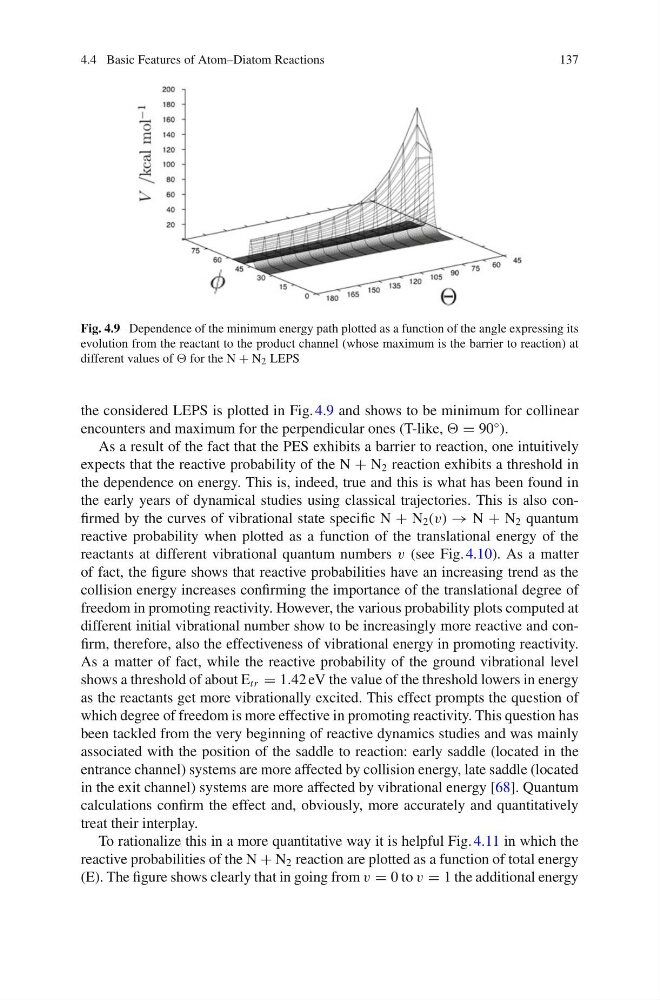
Fig. 4.9 Dependence of the minimum energy path plotted as a function of the angle expressing its
evolution from the reactant to the product channel (whose maximum is the barrier to reaction) at
different values of for the N + N 2 LEPS
the considered LEPS is plotted in Fig. 4.9 and shows to be minimum for collinear
encounters and maximum for the perpendicular ones (T-like, = 90
◦ ).
As a result of the fact that the PES exhibits a barrier to reaction, one intuitively
expects that the reactive probability of the N + N 2 reaction exhibits a threshold in
the dependence on energy. This is, indeed, true and this is what has been found in
the early years of dynamical studies using classical trajectories. This is also confirmed by the curves of vibrational state specific N + N 2 (v) → N + N 2 quantum
reactive probability when plotted as a function of the translational energy of the
reactants at different vibrational quantum numbers v (see Fig. 4.10). As a matter
of fact, the figure shows that reactive probabilities have an increasing trend as the
collision energy increases confirming the importance of the translational degree of
freedom in promoting reactivity. However, the various probability plots computed at
different initial vibrational number show to be increasingly more reactive and confirm, therefore, also the effectiveness of vibrational energy in promoting reactivity.
As a matter of fact, while the reactive probability of the ground vibrational level
shows a threshold of about E tr = 1.42 eV the value of the threshold lowers in energy
as the reactants get more vibrationally excited. This effect prompts the question of
which degree of freedom is more effective in promoting reactivity. This question has
been tackled from the very beginning of reactive dynamics studies and was mainly
associated with the position of the saddle to reaction: early saddle (located in the
entrance channel) systems are more affected by collision energy, late saddle (located
in the exit channel) systems are more affected by vibrational energy [68]. Quantum
calculations confirm the effect and, obviously, more accurately and quantitatively
treat their interplay.
To rationalize this in a more quantitative way it is helpful Fig. 4.11 in which the
reactive probabilities of the N + N 2 reaction are plotted as a function of total energy
(E). The figure shows clearly that in going from v = 0 to v = 1 the additional energy
137
Fig. 4.9 Dependence of the minimum energy path plotted as a function of the angle expressing its
evolution from the reactant to the product channel (whose maximum is the barrier to reaction) at
different values of for the N + N 2 LEPS
the considered LEPS is plotted in Fig. 4.9 and shows to be minimum for collinear
encounters and maximum for the perpendicular ones (T-like, = 90
◦ ).
As a result of the fact that the PES exhibits a barrier to reaction, one intuitively
expects that the reactive probability of the N + N 2 reaction exhibits a threshold in
the dependence on energy. This is, indeed, true and this is what has been found in
the early years of dynamical studies using classical trajectories. This is also confirmed by the curves of vibrational state specific N + N 2 (v) → N + N 2 quantum
reactive probability when plotted as a function of the translational energy of the
reactants at different vibrational quantum numbers v (see Fig. 4.10). As a matter
of fact, the figure shows that reactive probabilities have an increasing trend as the
collision energy increases confirming the importance of the translational degree of
freedom in promoting reactivity. However, the various probability plots computed at
different initial vibrational number show to be increasingly more reactive and confirm, therefore, also the effectiveness of vibrational energy in promoting reactivity.
As a matter of fact, while the reactive probability of the ground vibrational level
shows a threshold of about E tr = 1.42 eV the value of the threshold lowers in energy
as the reactants get more vibrationally excited. This effect prompts the question of
which degree of freedom is more effective in promoting reactivity. This question has
been tackled from the very beginning of reactive dynamics studies and was mainly
associated with the position of the saddle to reaction: early saddle (located in the
entrance channel) systems are more affected by collision energy, late saddle (located
in the exit channel) systems are more affected by vibrational energy [68]. Quantum
calculations confirm the effect and, obviously, more accurately and quantitatively
treat their interplay.
To rationalize this in a more quantitative way it is helpful Fig. 4.11 in which the
reactive probabilities of the N + N 2 reaction are plotted as a function of total energy
(E). The figure shows clearly that in going from v = 0 to v = 1 the additional energy