

4.3 Beyond Full Quantum Calculations
131
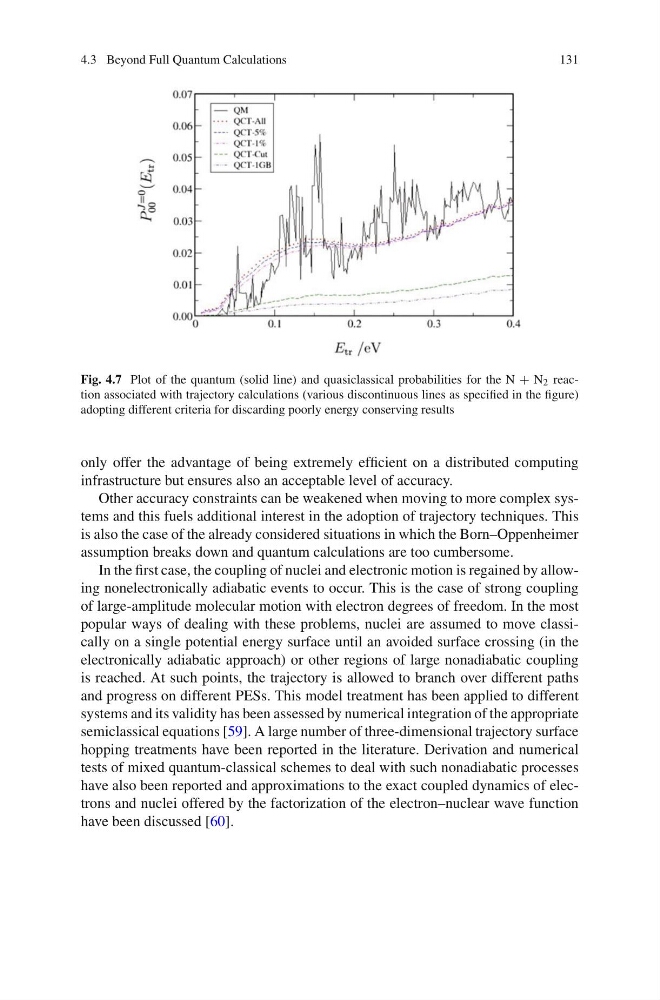
Fig. 4.7 Plot of the quantum (solid line) and quasiclassical probabilities for the N + N 2 reaction associated with trajectory calculations (various discontinuous lines as specified in the figure)
adopting different criteria for discarding poorly energy conserving results
only offer the advantage of being extremely efficient on a distributed computing
infrastructure but ensures also an acceptable level of accuracy.
Other accuracy constraints can be weakened when moving to more complex systems and this fuels additional interest in the adoption of trajectory techniques. This
is also the case of the already considered situations in which the Born–Oppenheimer
assumption breaks down and quantum calculations are too cumbersome.
In the first case, the coupling of nuclei and electronic motion is regained by allowing nonelectronically adiabatic events to occur. This is the case of strong coupling
of large-amplitude molecular motion with electron degrees of freedom. In the most
popular ways of dealing with these problems, nuclei are assumed to move classically on a single potential energy surface until an avoided surface crossing (in the
electronically adiabatic approach) or other regions of large nonadiabatic coupling
is reached. At such points, the trajectory is allowed to branch over different paths
and progress on different PESs. This model treatment has been applied to different
systems and its validity has been assessed by numerical integration of the appropriate
semiclassical equations [59]. A large number of three-dimensional trajectory surface
hopping treatments have been reported in the literature. Derivation and numerical
tests of mixed quantum-classical schemes to deal with such nonadiabatic processes
have also been reported and approximations to the exact coupled dynamics of electrons and nuclei offered by the factorization of the electron–nuclear wave function
have been discussed [60].
131
Fig. 4.7 Plot of the quantum (solid line) and quasiclassical probabilities for the N + N 2 reaction associated with trajectory calculations (various discontinuous lines as specified in the figure)
adopting different criteria for discarding poorly energy conserving results
only offer the advantage of being extremely efficient on a distributed computing
infrastructure but ensures also an acceptable level of accuracy.
Other accuracy constraints can be weakened when moving to more complex systems and this fuels additional interest in the adoption of trajectory techniques. This
is also the case of the already considered situations in which the Born–Oppenheimer
assumption breaks down and quantum calculations are too cumbersome.
In the first case, the coupling of nuclei and electronic motion is regained by allowing nonelectronically adiabatic events to occur. This is the case of strong coupling
of large-amplitude molecular motion with electron degrees of freedom. In the most
popular ways of dealing with these problems, nuclei are assumed to move classically on a single potential energy surface until an avoided surface crossing (in the
electronically adiabatic approach) or other regions of large nonadiabatic coupling
is reached. At such points, the trajectory is allowed to branch over different paths
and progress on different PESs. This model treatment has been applied to different
systems and its validity has been assessed by numerical integration of the appropriate
semiclassical equations [59]. A large number of three-dimensional trajectory surface
hopping treatments have been reported in the literature. Derivation and numerical
tests of mixed quantum-classical schemes to deal with such nonadiabatic processes
have also been reported and approximations to the exact coupled dynamics of electrons and nuclei offered by the factorization of the electron–nuclear wave function
have been discussed [60].