

4.2 Three-Atom Systems
117
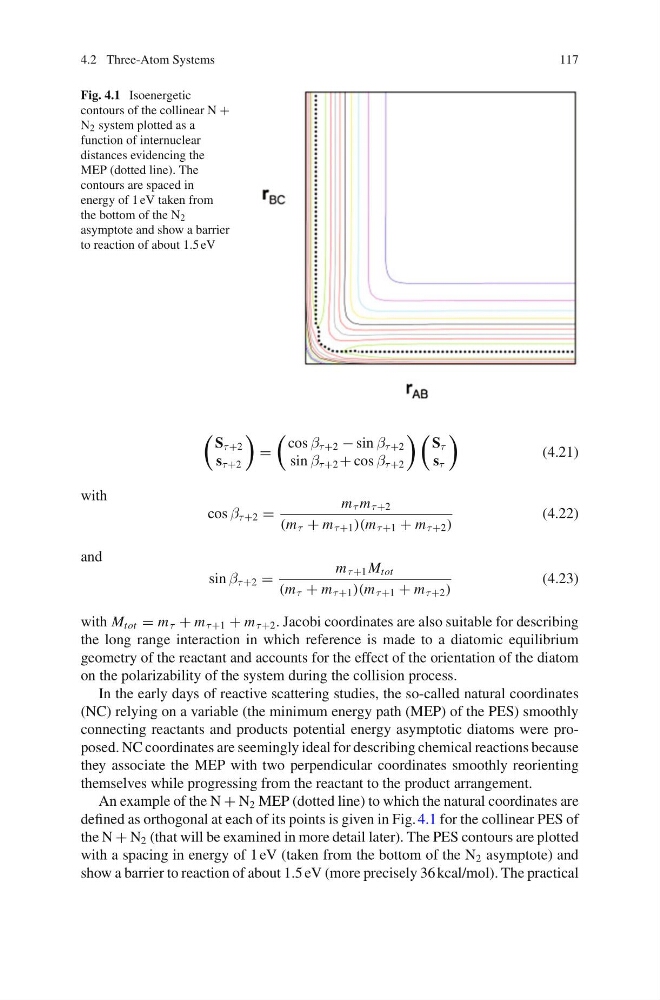
Fig. 4.1 Isoenergetic
contours of the collinear N +
N 2 system plotted as a
function of internuclear
distances evidencing the
MEP (dotted line). The
contours are spaced in
energy of 1 eV taken from
the bottom of the N 2
asymptote and show a barrier
to reaction of about 1.5 eV
S τ +2
s τ +2
=
cos β τ +2 − sin β τ +2
sin β τ +2 + cos β τ +2
S τ
s τ
(4.21)
with
cos β τ +2 =
m τ m τ +2
(m τ + m τ +1 )(m τ +1 + m τ +2 )
(4.22)
and
sin β τ +2 =
m τ +1 M tot
(m τ + m τ +1 )(m τ +1 + m τ +2 )
(4.23)
with M tot = m τ + m τ +1 + m τ +2 . Jacobi coordinates are also suitable for describing
the long range interaction in which reference is made to a diatomic equilibrium
geometry of the reactant and accounts for the effect of the orientation of the diatom
on the polarizability of the system during the collision process.
In the early days of reactive scattering studies, the so-called natural coordinates
(NC) relying on a variable (the minimum energy path (MEP) of the PES) smoothly
connecting reactants and products potential energy asymptotic diatoms were proposed. NC coordinates are seemingly ideal for describing chemical reactions because
they associate the MEP with two perpendicular coordinates smoothly reorienting
themselves while progressing from the reactant to the product arrangement.
An example of the N + N 2 MEP (dotted line) to which the natural coordinates are
defined as orthogonal at each of its points is given in Fig. 4.1 for the collinear PES of
the N + N 2 (that will be examined in more detail later). The PES contours are plotted
with a spacing in energy of 1 eV (taken from the bottom of the N 2 asymptote) and
show a barrier to reaction of about 1.5 eV (more precisely 36 kcal/mol). The practical
117
Fig. 4.1 Isoenergetic
contours of the collinear N +
N 2 system plotted as a
function of internuclear
distances evidencing the
MEP (dotted line). The
contours are spaced in
energy of 1 eV taken from
the bottom of the N 2
asymptote and show a barrier
to reaction of about 1.5 eV
S τ +2
s τ +2
=
cos β τ +2 − sin β τ +2
sin β τ +2 + cos β τ +2
S τ
s τ
(4.21)
with
cos β τ +2 =
m τ m τ +2
(m τ + m τ +1 )(m τ +1 + m τ +2 )
(4.22)
and
sin β τ +2 =
m τ +1 M tot
(m τ + m τ +1 )(m τ +1 + m τ +2 )
(4.23)
with M tot = m τ + m τ +1 + m τ +2 . Jacobi coordinates are also suitable for describing
the long range interaction in which reference is made to a diatomic equilibrium
geometry of the reactant and accounts for the effect of the orientation of the diatom
on the polarizability of the system during the collision process.
In the early days of reactive scattering studies, the so-called natural coordinates
(NC) relying on a variable (the minimum energy path (MEP) of the PES) smoothly
connecting reactants and products potential energy asymptotic diatoms were proposed. NC coordinates are seemingly ideal for describing chemical reactions because
they associate the MEP with two perpendicular coordinates smoothly reorienting
themselves while progressing from the reactant to the product arrangement.
An example of the N + N 2 MEP (dotted line) to which the natural coordinates are
defined as orthogonal at each of its points is given in Fig. 4.1 for the collinear PES of
the N + N 2 (that will be examined in more detail later). The PES contours are plotted
with a spacing in energy of 1 eV (taken from the bottom of the N 2 asymptote) and
show a barrier to reaction of about 1.5 eV (more precisely 36 kcal/mol). The practical